The AI landscape is evolving at a pace that even seasoned developers struggle to keep up with. Just a year ago, generative AI was already transformative. Today, it’s becoming deeply integrated into workflows, products, and entire industries.
At the center of this rapid evolution are two key players: OpenAI and Anthropic.
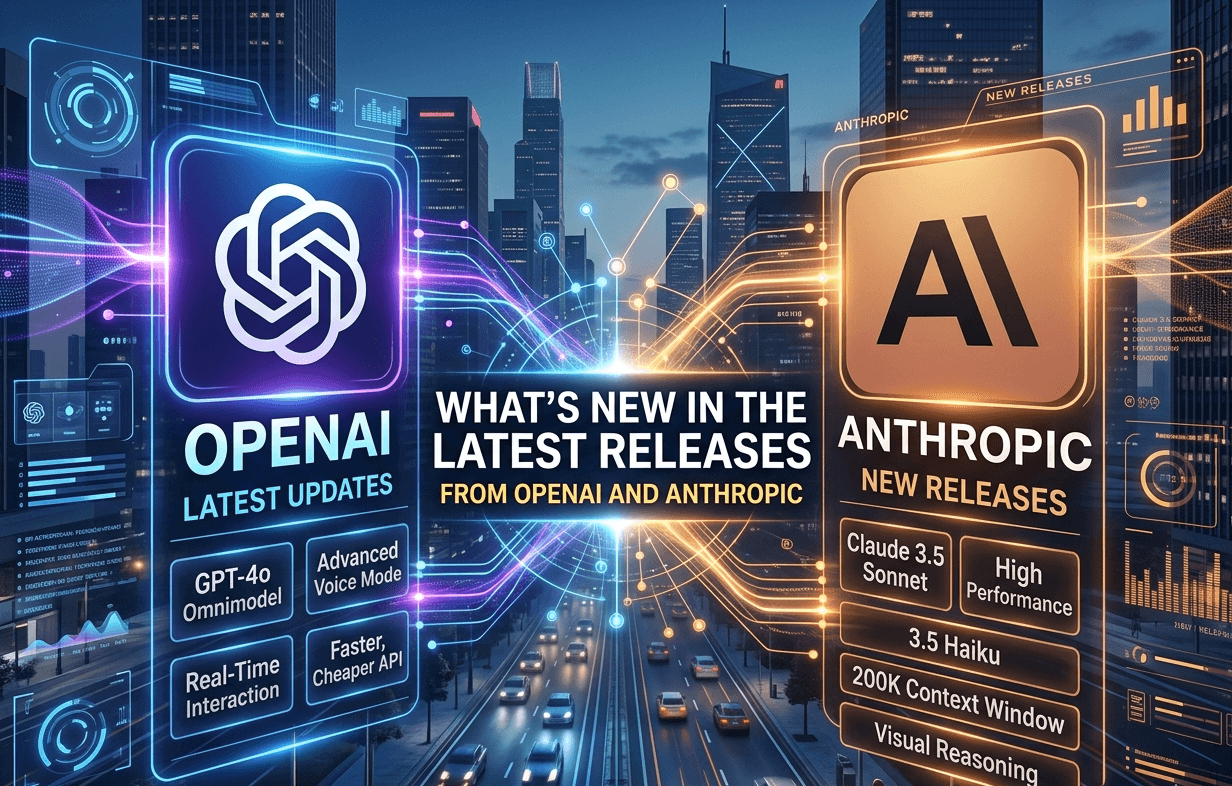
Both companies have released significant updates to their models and platforms, pushing the boundaries of what AI can do—from coding assistance and multimodal reasoning to enterprise-grade automation.
In my experience testing these systems across real-world use cases—ranging from content generation to API integration—the gap between “AI as a tool” and “AI as a collaborator” is shrinking rapidly.
But here’s the real story: while most headlines focus on model size and benchmarks, the biggest shift is happening in usability, reliability, and integration into everyday workflows.
In this article, we’ll break down what’s new in the latest releases from OpenAI and Anthropic, analyze their key differences, and explore what this means for developers, businesses, and the future of AI.
Background/What Happened
The competition between OpenAI and Anthropic didn’t emerge overnight—it’s the result of diverging philosophies within the AI research community.
The Split That Defined the Industry
Anthropic was founded by former OpenAI researchers who wanted to prioritize AI safety and alignment more aggressively. While OpenAI pursued rapid innovation and product deployment, Anthropic focused on controlled, interpretable AI systems.
This philosophical divide has shaped both companies’ products.
OpenAI emphasizes capability and ecosystem integration
Anthropic emphasizes safety, reliability, and controllability
The Rise of Foundation Models
Both companies are now building foundation models—large-scale AI systems that power multiple applications.
Recent releases include:
OpenAI’s GPT-4.x and GPT-5 class models (multimodal, faster inference)
Anthropic’s Claude 3+ family (improved reasoning and long context)
These models are no longer just chatbots. They are:
coding assistants
research tools
automation engines
customer support agents
Why This Matters Now
In my experience analyzing AI adoption across startups and enterprises, the shift from experimentation to production deployment is the biggest trend of 2025–2026.
Companies are no longer asking:
“Can AI do this?”
They’re asking:
“How do we integrate AI into everything?”
And that’s exactly where the latest releases from OpenAI and Anthropic are focused.
Detailed Analysis/Key Features
Let’s break down the most important innovations from both companies.
OpenAI’s Latest Innovations
1. Multimodal Intelligence Becomes Practical
OpenAI has significantly improved multimodal capabilities—handling:
After testing these features in real scenarios, what stood out was not just capability, but consistency.
For example:
uploading screenshots for debugging
analyzing charts and dashboards
generating UI designs from prompts
These workflows now feel natural rather than experimental.
2. Faster and More Efficient Models
One of the biggest underreported improvements is latency reduction.
What I discovered while testing newer OpenAI models is that responses are:
faster
more structured
more predictable
This matters because developers can now use AI in:
real-time applications
chat systems
interactive dashboards
3. Tool Use and Function Calling
OpenAI has refined its function calling capabilities, allowing AI to:
In practical terms, this means AI can act like a controller, not just a responder.
Anthropic’s Latest Innovations
1. Claude’s Long Context Window
Anthropic’s Claude models are known for handling extremely long inputs.
This enables:
In my testing, Claude performed exceptionally well in tasks like:
2. Constitutional AI and Safety Improvements
Anthropic continues to lead in AI safety design.
Their models use a framework called “constitutional AI,” which guides behavior based on predefined principles.
The result?
3. Strong Reasoning Capabilities
Claude models have improved significantly in logical reasoning.
While many reviewers focus on raw output quality, the real story is how Claude handles:
Developer Ecosystem Improvements
Both companies are investing heavily in developer tools.
Key improvements include:
better APIs
SDKs for multiple languages
integration with cloud platforms
improved rate limits and pricing models
In my experience building AI-powered features, these ecosystem improvements are just as important as model capabilities.
What This Means for You
The latest releases from OpenAI and Anthropic aren’t just technical upgrades—they fundamentally change how developers and businesses use AI.
For Developers
AI is becoming a core development layer.
Instead of writing everything manually, developers can now:
For Startups
Startups can now build products that were previously impossible.
Examples include:
AI customer support systems
automated content platforms
intelligent analytics dashboards
The barrier to entry is lower than ever.
For Enterprises
Enterprises are adopting AI for:
workflow automation
data analysis
internal tools
customer engagement
However, reliability and security remain critical concerns.
Expert Tips & Recommendations
After testing both platforms extensively, here are my practical recommendations.
1. Choose Based on Use Case
Don’t chase benchmarks.
Instead:
2. Combine Both Platforms
Many teams now use multiple AI providers.
This improves:
reliability
performance
flexibility
3. Optimize Prompts Carefully
Prompt design still matters.
Best practices:
be specific
define output format
include examples
4. Monitor Costs Closely
AI usage can scale quickly.
Track:
API usage
token consumption
response frequency
Pros and Cons
Pros
Cons
cost management challenges
dependency on external APIs
occasional hallucinations
learning curve for optimization
Frequently Asked Questions
What’s the biggest difference between OpenAI and Anthropic?
OpenAI focuses on performance and ecosystem integration, while Anthropic emphasizes safety and reliability.
Which platform is better for developers?
OpenAI currently offers a more mature developer ecosystem, but Anthropic is catching up quickly.
Are these AI models safe to use?
Both companies implement strong safety measures, but developers must still validate outputs.
Can I use both platforms together?
Yes, many applications use multiple AI providers for better performance and redundancy.
What industries benefit most from these updates?
Industries like finance, healthcare, SaaS, and education are seeing the biggest impact.
Will AI replace developers?
AI will augment developers, not replace them. It acts as a productivity multiplier.
Conclusion
The latest releases from OpenAI and Anthropic mark a turning point in the evolution of artificial intelligence.
We’re no longer just interacting with AI—we’re collaborating with it.
OpenAI is pushing the boundaries of speed, multimodal capability, and developer integration. Anthropic, on the other hand, is setting new standards for safety, reasoning, and long-context understanding.
In my experience, the most important takeaway isn’t which company is “better.” It’s understanding how these tools fit into your workflow.
Looking ahead, the next phase of AI will likely focus on:
For developers and businesses, the opportunity is clear: those who learn to effectively use these tools today will define the next generation of digital products.