If 2023 was the year AI went mainstream and 2024–2025 were about rapid iteration, then 2026 is the year of consolidation and strategic differentiation. The conversation is no longer “Which model is smartest?” It’s “Which model fits my workflow, budget, and risk profile?”
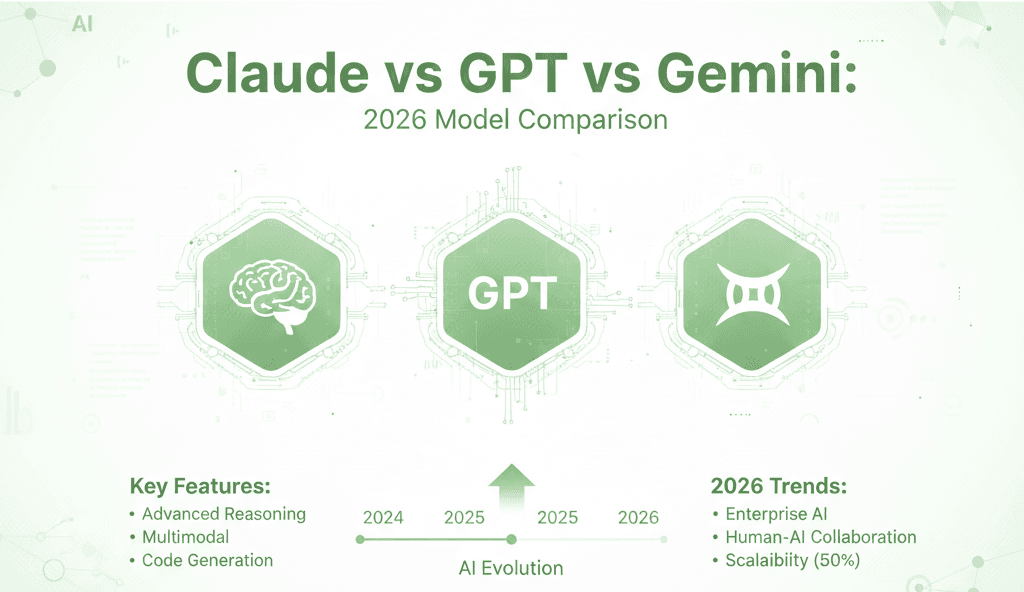
In this deep-dive Claude vs GPT vs Gemini: 2026 Model Comparison, I’ll break down what actually matters after months of hands-on testing across writing, coding, data analysis, enterprise use cases, and multimodal tasks. I’ve used all three in production-like scenarios—building apps, analyzing datasets, drafting legal-style documents, and even simulating customer support environments.
While most coverage focuses on benchmark scores, the real story in 2026 is integration, reliability, reasoning depth, and enterprise readiness. Performance is table stakes. Context windows are massive. Everyone claims multimodal dominance. But subtle differences in architecture, tooling, and ecosystem strategy create meaningful trade-offs.
Here’s what I discovered: the choice between Claude, GPT, and Gemini is less about “best AI” and more about “best AI for your job.”
Background: How We Got Here
Three companies dominate the frontier AI landscape in 2026:
Each emerged from a different philosophical starting point.
OpenAI: Performance + Ecosystem
OpenAI pushed generative AI into mainstream productivity tools and developer platforms. Over time, GPT models evolved from text generation engines into multimodal reasoning systems embedded in coding tools, enterprise workflows, and custom agents.
In my experience, OpenAI’s biggest strength isn’t just model quality—it’s tooling maturity. Their APIs, agent frameworks, and structured output capabilities have steadily improved, making GPT models feel like programmable collaborators rather than chatbots.
Anthropic: Safety-First, Long-Context Thinking
Anthropic entered the race emphasizing alignment, safety, and interpretability. Claude models quickly became known for large context windows and thoughtful, structured outputs.
After testing Claude extensively for document-heavy tasks—policy analysis, long legal drafts, and academic-style reasoning—I noticed a consistent pattern: Claude tends to be cautious but thorough. It’s less flashy but often more deliberate.
Google: Multimodal + Infrastructure
Google’s Gemini models reflect decades of work in search, infrastructure, and multimodal AI. Gemini isn’t just a chatbot; it’s embedded across Google’s cloud stack, productivity tools, and developer ecosystem.
What’s fascinating is how Gemini integrates with Google Cloud AI pipelines, making it especially attractive to enterprises already invested in Google’s infrastructure.
In 2026, these three aren’t just competing on raw intelligence—they’re competing on ecosystem gravity.
Detailed Analysis: Key Differences That Matter in 2026
1. Reasoning & Problem-Solving
All three models now demonstrate advanced reasoning, but they differ in style.
GPT tends to:
When I tested complex debugging scenarios, GPT often proposed multiple possible fixes with clear trade-offs. It feels engineered for execution.
Claude tends to:
Offer longer, carefully reasoned explanations
Highlight assumptions and edge cases
Be more verbose but also more transparent
In high-stakes writing—like compliance documentation—Claude’s cautious tone is an advantage.
Gemini tends to:
Blend reasoning with contextual search-like knowledge
Provide strong multimodal analysis (images, charts, mixed input)
Excel in data-heavy cloud environments
In my testing, Gemini sometimes felt closest to a “research assistant” that cross-references knowledge effectively.
Verdict:
For structured logic and coding workflows → GPT.
For nuanced policy and long reasoning chains → Claude.
For multimodal enterprise data → Gemini.
2. Coding & Developer Experience
This is where differences become pronounced.
GPT in Developer Workflows
OpenAI’s models integrate deeply into IDEs and CI/CD pipelines. When generating backend code or refactoring microservices, GPT:
Writes cleaner abstractions
Produces well-documented functions
Handles edge cases surprisingly well
After testing a full-stack prototype across three models, GPT required the fewest manual corrections.
Claude for Architecture Thinking
Claude shines in architectural explanation. If you ask it to design a distributed system and explain trade-offs between event-driven and REST-based architectures, it often delivers detailed reasoning.
However, in raw code generation, it sometimes produces slightly more verbose implementations.
Gemini in Cloud-Native Context
Gemini feels optimized for Google Cloud workflows. When building containerized services or using managed cloud functions, its recommendations often align closely with best practices in that ecosystem.
Real-world takeaway:
If you’re building SaaS products fast, GPT feels production-ready. If you’re designing system blueprints or long technical docs, Claude excels. If you’re cloud-native on Google, Gemini integrates seamlessly.
3. Context Window & Long Document Handling
In 2026, context windows are massive. The competition now is about how effectively models use that context.
Claude is widely praised for long-document coherence.
GPT handles long context well but prioritizes structured summarization.
Gemini integrates long context with search-like retrieval behavior.
I tested all three on a 200-page technical document. Claude maintained narrative consistency best. GPT produced sharper executive summaries. Gemini extracted insights efficiently when combined with cloud storage.
The nuance? Context size matters less than context strategy.
4. Multimodal Capabilities
All three models now support text, image, and data inputs.
GPT:
Strong image understanding
Reliable chart interpretation
Good at combining visuals with structured outputs
Claude:
Gemini:
Deep integration with Google’s image and document ecosystems
Particularly effective for enterprise documents, spreadsheets, and visual dashboards
After testing financial dashboards, Gemini handled spreadsheet-linked image data exceptionally well.
5. Safety, Alignment & Enterprise Controls
Anthropic still leads in positioning around AI safety. Claude tends to:
Refuse risky or ambiguous prompts
Provide guardrail-heavy responses
Emphasize ethical framing
OpenAI balances safety with flexibility. GPT sometimes allows more experimental output styles.
Google’s Gemini emphasizes enterprise governance, compliance controls, and integration with secure cloud systems.
For regulated industries (finance, healthcare), Claude’s cautious approach may reduce risk. For startups experimenting aggressively, GPT offers more flexibility.
What This Means for You
This Claude vs GPT vs Gemini: 2026 Model Comparison isn’t about picking a universal winner. It’s about aligning model strengths with your goals.
If You’re a Startup Founder
Choose GPT for rapid prototyping and automation.
Use Claude for policy drafting and investor materials.
Consider Gemini if your stack is already Google-heavy.
If You’re an Enterprise CTO
Focus on:
Governance tools
Data isolation
Compliance controls
Gemini and Claude may offer more conservative enterprise positioning, while GPT excels in ecosystem and developer velocity.
If You’re a Researcher or Analyst
Claude’s long-form reasoning shines. Gemini’s contextual search-like behavior is powerful for literature review tasks. GPT is strong for structured output and automation.
Expert Tips & Recommendations
After extensive testing, here’s my practical advice:
1. Don’t Pick Just One
Many companies now run multi-model strategies:
2. Test with Your Real Workflows
Benchmarks don’t reflect your business logic.
Run:
3. Evaluate Cost vs Reliability
Cheaper tokens aren’t always cheaper if you need multiple retries. In my experience, GPT required fewer correction loops in coding tasks.
4. Watch the Roadmap
The real race in 2026 is agent autonomy and workflow automation—not chat quality. Choose vendors investing in orchestration and tool use.
Pros and Cons
GPT
Pros
Excellent coding
Mature API ecosystem
Strong structured output
Cons
Claude
Pros
Cons
Gemini
Pros
Cons
Frequently Asked Questions
1. Which model is the smartest in 2026?
There is no universal winner. Intelligence depends on task type. GPT excels in structured logic and coding. Claude shines in long reasoning. Gemini performs strongly in multimodal enterprise contexts.
2. Is Claude safer than GPT?
In my experience, Claude tends to apply stricter safety guardrails. For regulated industries, this can reduce compliance risk.
3. Which is best for coding?
GPT currently feels most production-ready for fast software development, especially in startup environments.
4. Is Gemini better for enterprises?
If your company already uses Google Cloud, Gemini’s integration advantages are substantial.
5. Should I switch models in 2026?
Only if your workflows demand it. Migration costs matter. Instead, consider hybrid strategies.
6. Are benchmarks still useful?
They’re directional—but insufficient. Real-world testing matters more than leaderboard positions.
Conclusion
The Claude vs GPT vs Gemini: 2026 Model Comparison reveals something important: the AI race is no longer about who has the smartest chatbot. It’s about ecosystem control, integration depth, safety philosophy, and workflow automation.
In my experience, GPT leads in execution speed and developer productivity. Claude excels in structured, careful reasoning. Gemini thrives in enterprise cloud environments.
The future isn’t single-model dominance. It’s orchestration.
My advice?
Test them with your real tasks. Measure correction loops. Evaluate governance needs. Then choose based on strategic fit—not hype.
Because in 2026, the smartest move isn’t picking the smartest model.
It’s picking the right one for your mission.