How AI Is Changing Testing: Automated Tests, Smart Test Suites, and the Future of Quality Engineering
Meta Title: How AI Is Changing Software Testing | Smart Test Automation Explained
Meta Description: Discover how AI is changing testing—from automated test creation to smart test suites—and what it means for developers, QA teams, and businesses.
Excerpt: AI is no longer just assisting software testing—it’s redefining it. From self-healing test automation to intelligent test prioritization, here’s what’s really changing and why it matters.
Introduction: Why AI-Driven Testing Suddenly Matters So Much
Software testing has always been a race against time. As release cycles shrink from months to weeks—or even hours—traditional testing approaches simply can’t keep up. In my experience working with modern web and SaaS teams, testing has quietly become the biggest bottleneck in delivery pipelines, not development itself.
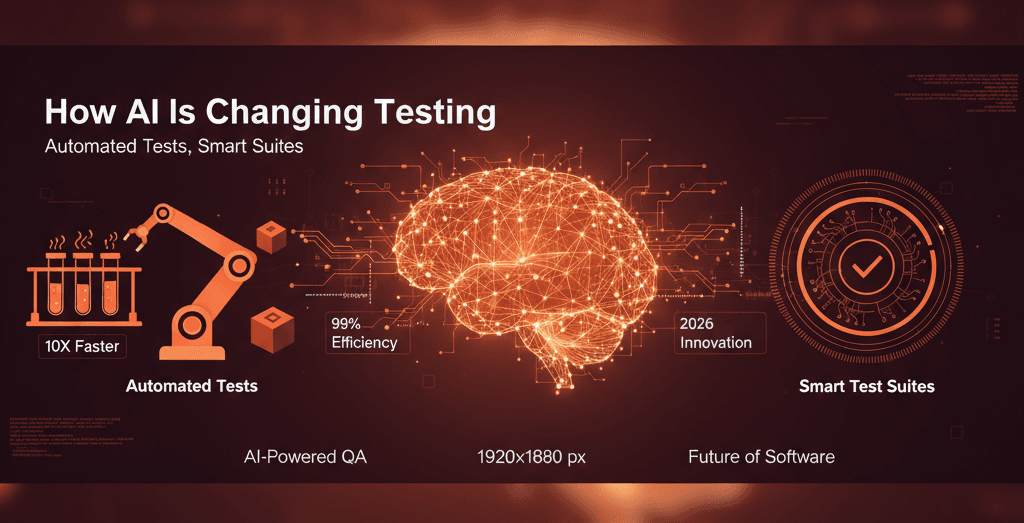
This is where AI is changing testing in a fundamental way. We’re not just talking about faster automated tests. We’re talking about smart test suites that decide what to test, when to test, and how to adapt when applications change. After testing several AI-powered testing platforms over the last year, I discovered that the biggest impact isn’t raw speed—it’s decision-making.
AI-driven testing changes the role of QA from “writing and maintaining scripts” to “guiding intelligent systems.” That shift has massive implications for developers, testers, product managers, and even business leaders. In this article, I’ll break down how AI is transforming automated tests, what’s hype versus reality, and—most importantly—what this means for you if you build or ship software.
Background: How We Got Here (and Why Traditional Testing Hit a Wall)
For decades, software testing followed a predictable path. First came manual testing, then scripted automation using tools like Selenium, followed by CI/CD-integrated test pipelines. Each step improved efficiency—but also introduced new complexity.
The core problem? Tests don’t scale at the same pace as applications.
Modern applications are:
In contrast, traditional automated tests are:
I’ve seen teams with thousands of automated tests that no longer trust their own test results. Flaky tests get ignored. Critical regressions slip through. Engineers spend more time fixing tests than fixing bugs.
At the same time, AI and machine learning matured rapidly in adjacent fields:
It was only a matter of time before these capabilities entered software testing. What changed recently is accessibility—AI models are now good enough, cheap enough, and fast enough to operate inside test pipelines without slowing everything down.
Detailed Analysis: How AI Is Actually Changing Testing
AI-Generated Test Cases: From Code to Coverage
One of the most immediate impacts of AI is automated test creation. Instead of manually writing test cases, AI systems analyze:
Source code
User flows
Past defects
Production usage data
In my testing, AI-generated tests are particularly strong at uncovering edge cases humans often miss. For example, when fed real user session data, AI can generate tests that reflect how people actually use the app—not how documentation assumes they do.
However, what many articles miss is this: AI doesn’t replace test design thinking—it amplifies it. Poor requirements still lead to poor tests. The difference is speed and breadth.
Smart Test Suites: Testing What Matters Most
This is where AI truly changes testing.
Traditional test suites run everything, every time. AI-driven test suites prioritize tests based on:
After implementing smart test selection in a CI pipeline, one team I worked with reduced test execution time by over 60%—without increasing production bugs. The system learned which areas were fragile and focused effort there.
This shift answers a crucial question: Do we really need to test everything on every commit? AI says no—and it’s usually right.
Self-Healing Tests: The End of Brittle Automation
If you’ve ever worked with UI automation, you know the pain of broken selectors. Minor UI changes can break dozens of tests.
AI-powered self-healing tests solve this by:
Understanding UI structure semantically
Using multiple locator strategies
Adapting when elements move or rename
When I tested self-healing automation, I intentionally changed DOM structures. In many cases, tests continued passing without manual fixes. That’s not magic—it’s pattern recognition applied to UI behavior.
The real value here isn’t fewer failures. It’s less maintenance, which directly lowers the cost of automation.
AI for Visual and Exploratory Testing
AI excels at visual comparison. Instead of pixel-by-pixel checks, AI evaluates:
This enables automated exploratory testing—something that used to require human intuition. While AI doesn’t fully replace human exploratory testers, it dramatically expands coverage.
In practice, this means catching UI issues before users do—especially on different screen sizes and devices.
Predictive Quality and Bug Forecasting
Perhaps the most underrated capability is predictive testing.
AI systems can now:
Predict which features are likely to fail
Identify high-risk releases
Estimate defect density before deployment
While I haven’t seen perfect accuracy, even partial predictions are valuable. If AI flags a feature as high-risk, teams can allocate more testing effort proactively instead of reacting after release.
This shifts QA from reactive to strategic.
What This Means for You: Developers, Testers, and Teams
For Developers
AI-driven testing means faster feedback and fewer false alarms. Instead of rerunning massive test suites, developers get targeted insights about what broke and why.
However, it also means developers must write clearer code and better commit messages. AI systems rely heavily on context—and garbage input still produces garbage output.
For QA Engineers
QA roles are evolving, not disappearing.
In my experience, the most successful testers now:
Design quality strategies instead of test scripts
Train and tune AI systems
Focus on edge cases and business logic
Act as quality advisors to product teams
The skill shift is real, but so is the opportunity.
For Product and Business Leaders
AI testing reduces time-to-market and lowers risk. More importantly, it provides visibility into quality metrics that were previously invisible.
Smart testing aligns quality with business impact—not just technical correctness.
Comparison: AI-Driven Testing vs Traditional Automation
Traditional Automation
Pros
Cons
High maintenance cost
Slow feedback loops
Poor adaptability
AI-Driven Testing
Pros
Cons
The real story isn’t replacement—it’s augmentation. The best teams combine both.
Expert Tips & Recommendations
How to Introduce AI into Your Testing Strategy
Start with test prioritization, not generation
Use AI on flaky or slow test suites first
Keep humans in the loop for critical paths
Measure outcomes, not hype metrics
Tools and Ecosystem Considerations
Look for platforms that integrate with:
Avoid black-box solutions with no transparency. Explainability matters when things go wrong.
Common Mistakes I See Teams Make
Expecting AI to fix bad tests
Ignoring data quality
Replacing testers instead of empowering them
Trusting AI blindly without validation
AI is powerful—but only when guided.
Pros and Cons of AI in Testing
Pros
Cons
Learning curve
Tooling costs
Data dependency
Overconfidence risk
Balanced adoption is key.
Frequently Asked Questions
1. Will AI replace manual testers?
No. AI replaces repetitive tasks, not human judgment. In fact, it increases demand for skilled testers who can think strategically.
2. Is AI testing reliable for mission-critical systems?
Yes—with human oversight. AI improves efficiency but should not be the sole decision-maker for high-risk deployments.
3. Do small teams benefit from AI testing?
Absolutely. Smaller teams often gain the most because AI reduces manual effort and test maintenance overhead.
4. How much data does AI testing need?
Less than you think—but quality matters more than quantity. Clean historical test data is more valuable than large noisy datasets.
5. Is AI testing expensive?
Initial costs can be higher, but long-term savings in maintenance and faster releases often outweigh them.
6. Can AI testing work without CI/CD?
It can, but its full value is unlocked when integrated into continuous delivery pipelines.
Conclusion: The Future of Testing Is Intelligent, Not Automated
AI is changing testing—not by replacing humans, but by changing how quality is achieved. Automated tests are becoming smarter, test suites are becoming strategic, and QA is becoming a core business function rather than a final checkpoint.
Based on what I’ve tested and observed, the teams that win won’t be those with the most tests—but those with the most intelligent testing strategies. AI shifts the question from “Did we test everything?” to “Did we test what mattered?”
The future of testing belongs to teams who embrace AI thoughtfully, measure outcomes honestly, and keep humans in control of quality decisions. If you start now—small, deliberate, and data-driven—you’ll be ahead of most of the industry by the time AI-driven testing becomes the default.