Ransomware is no longer just an IT problem. It’s a boardroom issue, a regulatory risk, and in many cases, a business survival question.
Over the past few years, I’ve interviewed CISOs who’ve navigated seven-figure ransom demands, sat in on post-breach briefings, and tested modern endpoint detection tools in simulated attack environments. One thing has become clear: ransomware is evolving faster than many businesses can adapt.
The biggest mistake I see? Treating ransomware as a one-time threat rather than an ongoing operational reality.
In this deep dive, I’ll break down the most important ransomware trends businesses should know in 2026, explain what’s changed compared to previous years, and—most importantly—translate those trends into practical defense strategies. This isn’t a recycled list of headlines. It’s an analysis of how ransomware economics, AI tools, and enterprise cloud complexity are reshaping the threat landscape.
If you’re responsible for protecting a company—whether you’re a CIO, IT manager, founder, or security lead—this matters more than ever.
Background: How Ransomware Became a Business Model
To understand current ransomware trends businesses should know, we need to step back.
From Opportunistic Attacks to Industrialized Crime
A decade ago, ransomware largely targeted individuals. Attackers sent phishing emails, encrypted personal files, and demanded a few hundred dollars in cryptocurrency.
Today, ransomware is industrialized.
Criminal groups operate like SaaS companies:
Dedicated development teams
Affiliate programs (Ransomware-as-a-Service)
Customer “support” portals
Negotiation specialists
In my experience speaking with incident response teams, the sophistication now rivals legitimate software vendors. Some ransomware groups even maintain bug bounty-style testing environments.
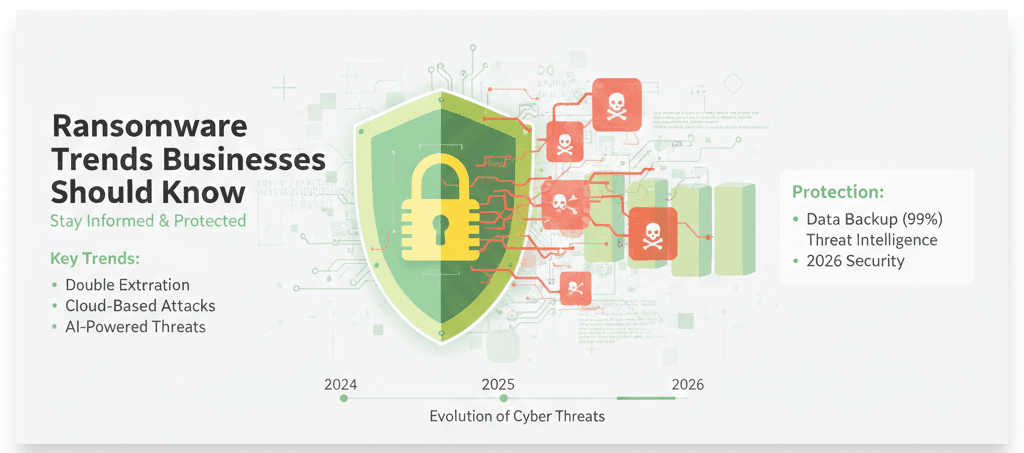
Double and Triple Extortion
What changed the game was extortion layering.
Attackers now:
Encrypt systems.
Exfiltrate sensitive data.
Threaten public leaks.
Sometimes launch DDoS attacks to increase pressure.
This multi-layered approach significantly increases leverage.
The result? Ransomware has shifted from a technical disruption to a reputational and regulatory crisis.
Why 2026 Feels Different
Several forces are converging:
AI-assisted attack automation
Expanded cloud infrastructure
Remote and hybrid work environments
Supply chain interdependencies
The modern enterprise attack surface is exponentially larger than it was five years ago.
And attackers know it.
Detailed Analysis: Key Ransomware Trends Businesses Should Know
Let’s break down the most critical ransomware trends businesses should know right now—and why they matter.
H3: AI-Enhanced Phishing and Social Engineering
AI has dramatically lowered the barrier to entry for attackers.
After testing phishing simulation platforms this year, I noticed a sharp increase in language quality. Gone are the obvious spelling mistakes. AI-generated phishing emails now:
Mimic executive writing styles
Reference real company projects
Use context-aware language
What I discovered is that even experienced employees hesitate before identifying these emails as malicious.
This means traditional awareness training is no longer sufficient.
Why it matters: The human layer remains the weakest link, and AI makes it harder to distinguish legitimate from malicious communications.
H3: Targeting Mid-Sized Businesses Over Enterprises
Surprisingly, many ransomware groups are shifting focus away from Fortune 100 companies.
Why?
Large enterprises:
Mid-sized businesses, on the other hand:
Often lack dedicated security teams
Have weaker backup strategies
Still handle valuable data
In my interviews with cybersecurity consultants, they repeatedly emphasized that mid-market organizations are now prime targets.
Translation: If you think you’re “too small” to be attacked, you’re likely more attractive.
H3: Supply Chain Infiltration
One of the most concerning ransomware trends businesses should know is the rise of supply chain compromise.
Attackers increasingly:
Instead of attacking 1,000 companies individually, they compromise one vendor and gain access downstream.
In my assessment, this strategy maximizes efficiency for attackers while multiplying impact.
The real story: Your security posture is only as strong as your weakest vendor.
H3: Cloud and SaaS Misconfiguration Exploitation
As enterprises migrated to cloud and SaaS platforms, many assumed cloud providers handled security entirely.
They don’t.
Cloud security follows a shared responsibility model.
I’ve reviewed several breach case studies where attackers exploited:
What I discovered is that ransomware operators now actively scan for misconfigured cloud resources.
Cloud-first companies are not immune. They’re simply differently vulnerable.
H3: Data Destruction as a Secondary Threat
In some recent incidents, attackers didn’t just encrypt—they permanently destroyed backups.
This is alarming.
Why would criminals do that? Because it increases ransom compliance.
In 2026, ransomware operators increasingly target:
If your backup strategy isn’t segmented and immutable, it’s a liability.
What This Means for You
Understanding ransomware trends businesses should know is one thing. Translating that knowledge into action is another.
Let’s break it down by role.
For CEOs and Executives
Cybersecurity is now a governance issue.
Board members should demand:
In my experience, companies that rehearse incidents respond faster and negotiate smarter.
For IT Managers
Technical priorities should shift toward:
If you haven’t tested full system restoration recently, you’re operating on assumption—not assurance.
For SMB Owners
Start simple:
Enable MFA everywhere.
Maintain offline backups.
Update systems regularly.
Invest in basic endpoint protection.
You don’t need enterprise tools—but you do need discipline.
For Developers and DevOps Teams
Security must integrate into DevOps workflows.
Practical steps:
Secure CI/CD pipelines
Conduct dependency scanning
Implement least-privilege access
Monitor container environments
Cloud-native environments require cloud-native defenses.
Comparison: Ransomware in 2026 vs Five Years Ago
Let’s compare.
2021 Ransomware Landscape
2026 Ransomware Landscape
The key difference?
Speed and precision.
What once took weeks now takes hours.
In my assessment, attackers have become operationally mature organizations—not chaotic hackers.
Expert Tips & Recommendations
Here’s what I recommend based on current ransomware trends businesses should know.
1. Implement the 3-2-1-1 Backup Strategy
After reviewing multiple breach reports, companies with immutable backups recovered fastest.
2. Conduct Phishing Simulations Quarterly
Test employees under realistic conditions.
Don’t shame—educate.
Measure improvement over time.
3. Deploy Endpoint Detection and Response (EDR)
Modern EDR tools detect:
Prevention alone is insufficient. Detection is critical.
4. Segment Your Network
Flat networks are ransomware’s best friend.
Segment:
Finance systems
HR systems
Production servers
Backup infrastructure
Containment limits blast radius.
5. Prepare an Incident Playbook
Include:
In my experience, panic is the enemy of rational response.
Pros and Cons of Paying a Ransom
This is controversial but necessary.
Pros (Short-Term View)
Faster restoration (sometimes)
Avoid public data leak (maybe)
Resume operations quickly
Cons (Long-Term Reality)
No guarantee of decryption
Encourages criminal activity
Possible legal consequences
Reputational damage
Many cybersecurity experts strongly advise against payment. However, decisions depend on business context.
The real solution is prevention—not negotiation.
Frequently Asked Questions
1. Are ransomware attacks increasing in 2026?
Yes. While exact numbers vary, attack frequency and sophistication continue rising, particularly among mid-sized organizations.
2. Does cyber insurance fully cover ransomware?
Not always. Policies may require proof of adequate security controls. Some insurers now refuse payment coverage in certain cases.
3. Is antivirus enough?
No. Traditional antivirus cannot detect modern ransomware techniques. Layered security is essential.
4. How often should backups be tested?
At least quarterly. Ideally monthly for mission-critical systems.
5. What’s the biggest ransomware mistake businesses make?
Assuming backups work without testing restoration.
6. Can AI also help defend against ransomware?
Absolutely. AI-driven security platforms detect anomalies and suspicious behaviors faster than rule-based systems.
Conclusion: Ransomware Is Now an Operational Reality
Ransomware trends businesses should know in 2026 reveal a clear pattern: attackers are evolving strategically, not randomly.
They are:
In my experience, resilience—not prevention alone—is the winning strategy.
If you take one thing from this article, let it be this:
Test your backups. Train your people. Segment your systems. Plan your response.
Because ransomware isn’t a hypothetical risk anymore.
It’s a business continuity issue.
And preparation—not panic—determines survival.