GitHub has become more than a code hosting service — it’s now the pulse of global software innovation. With over 150 million developers and hundreds of millions of repositories, the platform serves as both a barometer and driver of what developers care about most. Understanding most popular libraries & frameworks on GitHub in 2026 isn’t just trivia; it’s intel on where industry attention, talent, and momentum are coalescing.
In my experience covering developer ecosystems, the projects that attract millions of stars — and active contributor bases — often presage shifts in industry tooling and practices. After reviewing the latest rankings and community discourse, what’s become clear is that the top GitHub repositories span education, productivity, AI development, and cross‑platform tools. This article breaks down what’s trending, why these tools resonate, and how you can leverage them in your own workflows — from beginner learning paths to enterprise‑scale application development.
🔍 Background: How Popularity on GitHub is Measured
Before we dive into the specifics, it’s important to explain what “popular” means on GitHub. GitHub project influence is often measured by:
Stars: A proxy for community interest and endorsement.
Forks: Indicators of how often developers build off a repository.
Active commits and contribution traffic: Suggest ongoing maintenance and relevance.
Trend velocity: How quickly a project gains attention over short periods.
Many of the highest‑starred repositories aren’t directly libraries or frameworks in the traditional sense — they’re educational resources, curated lists of tools, and developer utilities that have grown into cornerstone projects. For example, freeCodeCamp and free‑programming‑books consistently rank among the top repositories by stars, reflecting their importance as community knowledge hubs.
Unlike typical comeback narratives focusing solely on narrowly defined technical stacks, GitHub’s popularity measures often blur the line between learning infrastructure and application‑level frameworks. This blended reality tells us something deeper: developers today aren’t just building software — they’re building knowledge, ecosystems, and communities.
⚙️ Detailed Analysis: Top Libraries & Frameworks Shaping 2026
In this section, we’ll unpack the most influential repositories — including libraries, frameworks, and essential projects — that have defined developer interest on GitHub going into 2026.
📚 Foundational Developer Learning Resources
While technically not code libraries in the traditional sense, these repositories top GitHub in stars and influence — with real development implications:
1. freeCodeCamp/freeCodeCamp
freeCodeCamp provides a full curriculum to learn web technologies and beyond through hands‑on tasks, projects, and certifications. It consistently ranks at the top of GitHub stars, with hundreds of thousands of developers using it to build skills and contribute back.
Serves both beginners and intermediates with structured lessons.
Acts as a community hub where learners transition into open‑source contributors.
Integrates real project workflows — a key reason it’s more than just a learning repo.
2. EbookFoundation/free‑programming‑books
This massive curated list of free programming books across dozens of languages and platforms remains one of the most starred repositories globally. It’s a go‑to resource for developers regardless of skill level.
Its popularity tells us something important: developers still value knowledge aggregation as a primary asset in open‑source ecosystems.
3. developer‑roadmap
Providing visual guides to becoming developers in various domains (frontend, backend, DevOps), developer‑roadmap bridges the gap between abstract skills and concrete project stacks.
🧰 Libraries & Toolkits Used Daily in Projects
Beyond educational or meta projects, there are repositories performing actual work in applications — from UI frameworks to AI libraries:
4. transformers (Hugging Face)
Though not as starred as the biggest resources above, transformers is a cornerstone of modern AI/ML workflows. It provides implementations of state‑of‑the‑art NLP and multimodal models, making it indispensable for LLM projects, research, and deployment tooling.
This library exemplifies how advanced machine learning capability is being democratized through open source.
5. system‑design‑primer
Another “resource” repository that blends learning with real coding patterns, system‑design‑primer helps developers think in terms of scalable architecture — essential for modern enterprise development and technical interviews alike.
6. public‑apis
While less about framework code, this curated list of free public APIs has become a developer staple for prototyping, learning, and experimentation.
🧩 Emerging Popular Technical Domains
Looking at trending topics in specific languages or ecosystem projects is also revealing. For example:
7. Rust & Go ecosystem projects
Rust projects like the Rust language repo itself, Deno, and Tauri are among top‑starred in their language categories on GitHub. This shows continued interest in performant, safe systems programming.
Similarly, Go projects such as Memos or Ollama reflect trending areas like developer tooling and AI support infrastructure.
📌 What This Means for You
Understanding most popular GitHub libraries & frameworks in 2026 isn’t about chasing stars — it’s about spotting where active developer interest intersects real utility.
🌱 For Beginners
💻 For Practitioners
🚀 For Enterprise Engineers
🔄 Comparison: How These Trends Stack Against Alternatives
When comparing popular GitHub repositories to traditional language or ecosystem rankings:
⭐ Stars vs. Active Usage
Stars: Reflect popularity and interest, often driven by breadth of use cases and virality.
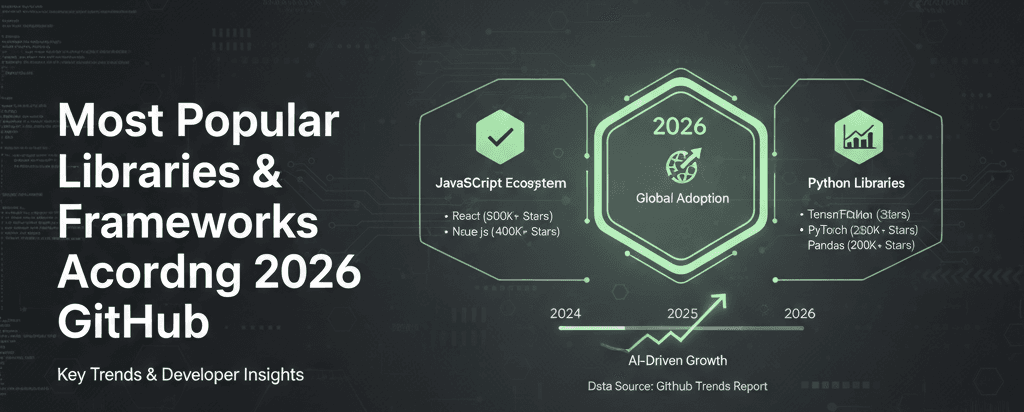
Active usage: Tools like React (for web development) or TensorFlow (for machine learning) may still dominate in production deployments, even if they don’t top star rankings. Their communities and industry adoption might not always match star counts yet reflect deeper, ongoing usage.
Stars and forks capture community attention, while usage in production signals long‑term sustainability and impact.
💡 Expert Tips & Recommendations
Here’s how to effectively engage with these popular libraries & frameworks:
🧠 Learn Strategically
Build with learning repos: Use freeCodeCamp or developer‑roadmap as structured resources when starting.
Match tools to projects: Use transformers when working with NLP or AI, but choose lightweight helpers for smaller tasks.
🧑💻 Stay Updated
Follow GitHub trending daily to spot emerging tools.
Watch contributions and commit velocity — a repo might be popular, but if maintenance declines, be cautious.
🧪 Hands‑On Experimentation
⚖️ Pros & Cons of Relying on GitHub Popularity
Pros:
Quick insight into community interest.
Often reveals rising stars before mainstream adoption.
Encourages learning broader ecosystems.
Cons:
Popularity doesn’t always equate to production readiness.
Star counts can be skewed by trends or beginner curiosity.
Some essential tools may be underrated.
❓ Frequently Asked Questions
1. Does star count equal quality?
No — stars indicate interest, not necessarily code quality or long‑term stability. Investigate issues and maintenance history before heavy adoption.
2. Why are learning repositories so popular?
They serve broad audiences — beginners and professionals alike — and often address skills gaps developers encounter.
3. Are frameworks like React still relevant despite lower ranking here?
Yes — GitHub stars don’t always reflect enterprise usage or ecosystem maturity.
4. Should I base project choices solely on these rankings?
No — use rankings as one signal among many, including community health and fit for your use case.
5. How often does popularity change?
Rapidly. Trending tools like AI infrastructure projects can surge within months on GitHub.
6. How can I discover emerging libraries?
Follow GitHub’s trending page and curated lists for up‑to‑date discovery.
🧠 Conclusion
In 2026, most popular libraries & frameworks on GitHub tell a nuanced story about what developers value most: education, accessible tooling, collaborative ecosystems, and powerful new capabilities like AI integration. This isn’t just about star counts — it’s about community engagement, innovation velocity, and practical utility. Whether you’re a novice seeking the best entry points or a seasoned engineer assessing where to invest your time, these trending open‑source projects provide both inspiration and leverage.
As we move forward, I predict GitHub’s landscape will continue blending learning resources with high‑impact frameworks. Staying curious and keeping a finger on these trends will give you an edge — not just in choosing tools, but in contributing back to the shared ecosystem that powers modern software development.