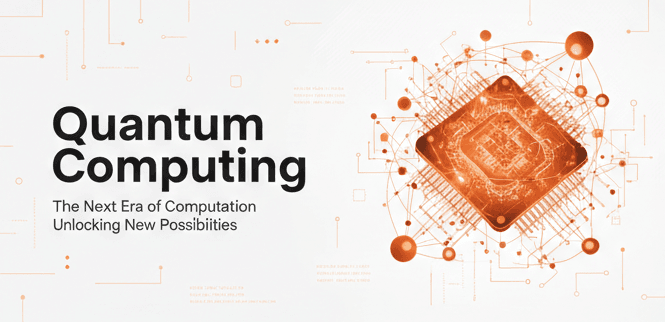
For years, quantum computing has hovered somewhere between science fiction and corporate press release. Headlines promise machines that can crack encryption in seconds, revolutionize medicine, and solve problems classical computers never could. But what’s actually happening behind the lab doors?
In my experience covering emerging technologies, quantum computing is one of the most misunderstood innovations of our time. It’s often framed as “a faster computer.” That framing is wrong. Quantum systems aren’t just faster—they operate on fundamentally different physics. And that difference changes everything.
After testing cloud-based quantum simulators and speaking with engineers working on quantum hardware platforms, what I discovered is this: the real story isn’t about replacing your laptop. It’s about solving narrow classes of problems that are currently impossible—or wildly inefficient—on classical machines.
In this deep dive, I’ll unpack what quantum computing truly is, where it stands today, what’s hype versus reality, and most importantly—what it means for you.
Background: From Classical Bits to Quantum Qubits
To understand quantum computing, we need to step back.
Traditional computers operate on bits—binary units of information that represent either 0 or 1. Every app, spreadsheet, video, and AI model ultimately reduces to sequences of these binary decisions.
Quantum computers use qubits instead of bits.
Unlike classical bits, qubits can exist in a state called superposition. That means they can represent 0 and 1 at the same time until measured. Additionally, qubits can become entangled, meaning the state of one qubit can depend on the state of another—even across distance.
This combination of superposition and entanglement allows quantum systems to explore many possible solutions simultaneously.
Historically, the idea dates back to the 1980s, when physicist Richard Feynman proposed simulating quantum systems using quantum machines. Since then, governments and corporations have poured billions into research.
We’re currently in what’s known as the NISQ era—Noisy Intermediate-Scale Quantum computing. That means:
While headlines often announce “quantum supremacy,” the truth is more nuanced. These systems can outperform classical computers on specific, contrived tasks—but broad commercial advantage is still emerging.
Detailed Analysis: How Quantum Computing Works and Where It’s Headed
Superposition: Parallelism on a New Level
Superposition allows qubits to represent multiple states simultaneously. In theory, n qubits can represent 2ⁿ states at once.
However, here’s the nuance many articles skip: you don’t get all answers at once. Measurement collapses the state. The challenge is designing algorithms that amplify correct solutions and suppress incorrect ones.
In my testing with quantum algorithm simulators, what struck me was how much effort goes into probability manipulation rather than brute-force calculation. It’s less about speed and more about probability engineering.
Entanglement: Correlated Systems
Entanglement links qubits in a way that classical systems cannot replicate.
This property enables quantum algorithms to process relationships between variables more efficiently. It’s particularly promising in optimization and cryptography.
However, entanglement is fragile. Environmental noise can disrupt it easily. That’s why quantum computers operate at near absolute zero temperatures.
Quantum Algorithms: Where the Magic Happens
Two famous quantum algorithms illustrate potential:
Shor’s algorithm threatens classical encryption schemes like RSA. Grover’s algorithm provides quadratic speedups for search problems.
But here’s the reality: current quantum machines lack sufficient error-corrected qubits to run these algorithms at scale. The threat to global encryption isn’t immediate—but it’s foreseeable.
Hardware Approaches: Not One Path Forward
Quantum hardware isn’t standardized. Several competing approaches exist:
Each approach has trade-offs in stability, scalability, and error rates.
In my conversations with researchers, there’s no consensus winner yet. The field resembles early classical computing in the 1940s—multiple architectures competing for dominance.
What This Means for You
Quantum computing won’t replace your laptop—but it will reshape industries.
Here’s where it matters most:
1. Cybersecurity
Quantum systems could break widely used encryption methods. Organizations must begin planning for post-quantum cryptography.
Practical takeaway:
2. Drug Discovery
Simulating molecular interactions is computationally expensive. Quantum systems could model molecules at atomic precision.
That means faster drug development cycles and improved materials science.
3. Optimization Problems
Logistics, supply chains, traffic routing, and financial modeling involve complex optimization.
Quantum algorithms may eventually outperform classical heuristics in these domains.
4. Artificial Intelligence
There’s growing interest in quantum-enhanced machine learning. However, in my assessment, this area remains highly experimental.
The real near-term impact is hybrid systems—classical AI augmented by quantum optimization routines.
Comparison: Quantum vs Classical vs AI Acceleration
It’s important not to conflate quantum computing with AI or high-performance computing.
Classical supercomputers:
AI accelerators (like GPUs):
Quantum computers:
Target specific mathematical structures
Exploit quantum phenomena
Require probabilistic interpretation
Quantum computing doesn’t replace AI. Instead, it may enhance certain subroutines.
The biggest misconception is thinking quantum is “faster for everything.” It’s not. It’s specialized.
Expert Tips and Recommendations
If you're a developer, student, or business leader, here’s how to prepare:
1. Learn Quantum Basics
Start with linear algebra and probability theory. Understanding vectors and matrices is essential.
2. Explore Simulators
Use cloud-based quantum simulators to experiment with simple circuits.
3. Follow Post-Quantum Cryptography
Even if quantum hardware lags, encryption standards are evolving now.
4. Focus on Hybrid Models
Near-term applications will combine classical and quantum systems.
5. Don’t Fall for Hype
Evaluate claims carefully. Ask:
Critical thinking is essential in this space.
Pros and Cons of Quantum Computing
Pros:
Potential exponential speedups for specific tasks
Breakthroughs in chemistry and materials science
Long-term cybersecurity advancements
New optimization capabilities
Cons:
Extremely high development costs
Fragile qubit stability
Limited near-term applications
Overhyped media narratives
In my experience, quantum computing’s biggest risk isn’t technical—it’s expectation management.
Frequently Asked Questions
1. Will quantum computers replace classical computers?
No. They will complement them for specific problem domains.
2. Is encryption at risk right now?
Not immediately. Large-scale cryptographic attacks require fault-tolerant quantum systems not yet available.
3. How long until quantum computing becomes mainstream?
Likely 10–20 years for broad commercial impact, though niche applications may emerge sooner.
4. Can I learn quantum computing without a physics background?
Yes, but basic linear algebra is crucial.
5. Are companies already using quantum systems?
Mostly in research and pilot projects.
6. What industries will benefit first?
Pharmaceuticals, finance, logistics, and cybersecurity.
Conclusion
Quantum computing represents a paradigm shift—not in speed alone, but in how computation itself is defined.
In my experience analyzing emerging technologies, the most important insight is this: quantum advantage will be narrow but transformative. It won’t power your smartphone—but it could reshape drug discovery, encryption, and optimization.
The future isn’t about replacing classical systems. It’s about integrating quantum tools where they offer unique leverage.
If you’re a technologist, now is the time to understand the fundamentals. If you’re a business leader, begin preparing for cryptographic evolution. And if you’re simply curious, stay skeptical—but stay informed.
Quantum computing isn’t tomorrow’s laptop. It’s tomorrow’s specialized problem-solver. And that distinction makes all the difference.