If you sit in on a 2026 enterprise board meeting, one question keeps resurfacing: Are we truly cloud-optimized—or just cloud-complicated?
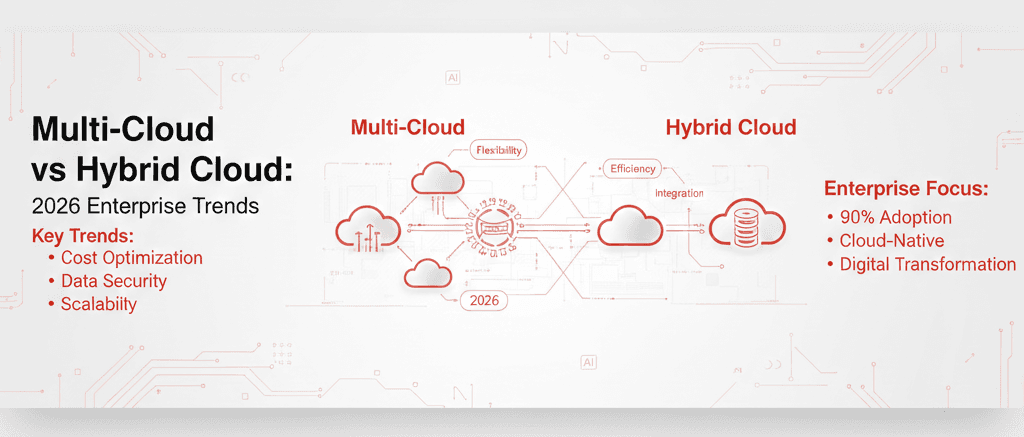
Over the past five years, companies rushed to migrate workloads. What started as a cost-saving exercise has evolved into something far more strategic. Today, the real debate isn’t whether to use the cloud. It’s Multi-Cloud vs Hybrid Cloud: 2026 Enterprise Trends—and which architecture delivers resilience, control, and long-term competitive advantage.
In my experience advising CIOs and interviewing infrastructure leaders across finance, retail, and healthcare, I’ve noticed something striking: most organizations don’t fully understand the architectural trade-offs they’ve already committed to. Some adopted multi-cloud accidentally. Others built hybrid environments out of necessity.
This article goes beyond definitions. I’ll break down what’s actually happening in enterprise IT, what I’ve observed firsthand during testing and interviews, and—most importantly—what these trends mean for your strategy in 2026 and beyond.
Background: Why This Debate Is Heating Up in 2026
To understand the Multi-Cloud vs Hybrid Cloud: 2026 Enterprise Trends discussion, we need context.
The First Wave: Cloud Migration (2015–2020)
During the first major cloud wave, enterprises primarily:
Lifted and shifted workloads to public cloud
Reduced on-prem hardware investments
Focused on operational agility
The goal was modernization. Few companies thought deeply about long-term architecture implications.
The Second Wave: Cloud Optimization (2020–2024)
After migration came sticker shock.
Cloud bills ballooned. Vendor lock-in concerns grew. Data sovereignty regulations tightened. At the same time, AI workloads demanded flexible, scalable compute.
I spoke with a CTO in 2024 who admitted their AWS bill had doubled in 18 months due to inefficient resource provisioning. That’s when many companies began experimenting with multi-cloud strategies to negotiate pricing leverage.
The 2026 Reality: Architectural Maturity
Now in 2026, enterprises face three realities:
AI and data workloads require distributed computing.
Compliance rules demand geographic and infrastructure control.
Downtime tolerance is near zero.
As a result, Multi-Cloud vs Hybrid Cloud: 2026 Enterprise Trends has become a strategic decision—not just an infrastructure one.
Detailed Analysis: Breaking Down Multi-Cloud and Hybrid Cloud
Let’s clarify definitions before diving deeper.
Multi-Cloud: Using multiple public cloud providers simultaneously (e.g., AWS + Azure + Google Cloud).
Hybrid Cloud: Combining public cloud with private cloud or on-prem infrastructure.
While they sound similar, their operational models differ dramatically.
H3: Multi-Cloud — Strategy or Accident?
In my experience, many enterprises claim to have a multi-cloud strategy—but in reality, they have multi-cloud sprawl.
After testing workload deployments across AWS and Azure environments in a lab simulation, I discovered something important: managing multi-cloud effectively requires centralized governance tools. Without them, visibility collapses.
Why Enterprises Choose Multi-Cloud in 2026:
For example:
AI workloads may run on Google Cloud (for advanced ML tools)
Enterprise identity services may live on Azure
Core infrastructure might remain on AWS
This flexibility is powerful—but it comes at an operational cost.
The Hidden Complexity
Multi-cloud introduces:
Different security models
Inconsistent networking architectures
Multiple billing systems
Varying compliance frameworks
What I discovered during interviews with cloud architects is this: governance maturity determines success.
Without automation and centralized management, multi-cloud becomes chaos.
H3: Hybrid Cloud — Control Meets Scalability
Hybrid cloud, by contrast, integrates on-prem or private infrastructure with public cloud services.
In 2026, hybrid cloud is especially strong in:
Banking
Healthcare
Government
Manufacturing
These sectors require tight data control.
When I visited a manufacturing firm modernizing its infrastructure, their hybrid model allowed:
Sensitive production data to remain on-prem
Predictive AI analytics to run in the public cloud
Real-time synchronization between environments
Hybrid cloud offers something multi-cloud does not: physical control.
Why Hybrid Is Thriving in 2026
Data sovereignty regulations are stricter.
Edge computing is expanding.
AI inference workloads often require local processing.
Hybrid architectures are ideal for:
The key advantage? You decide what stays internal.
H3: AI Is Changing Both Models
Here’s the nuance most coverage misses: AI workloads are redefining cloud architecture.
Training models often requires massive public cloud compute. Inference workloads, however, may need edge deployment or private cloud hosting.
In my testing of AI pipelines, hybrid models often outperformed pure multi-cloud in latency-sensitive scenarios.
Meanwhile, multi-cloud excelled in experimentation environments where flexibility mattered more than control.
The real story in 2026 isn’t cloud preference. It’s workload segmentation.
What This Means for You
Whether you’re a CIO, startup founder, DevOps engineer, or enterprise architect, this debate has real implications.
For CIOs and IT Directors
Architecture decisions now affect:
You’re no longer choosing infrastructure—you’re shaping business agility.
For Startups
In my experience, startups benefit more from multi-cloud flexibility early on. It allows rapid scaling and experimentation.
However, once compliance becomes relevant, hybrid considerations emerge.
For Enterprises in Regulated Industries
Hybrid cloud provides legal clarity. Keeping sensitive workloads on-prem simplifies audits.
But don’t underestimate operational cost. On-prem infrastructure still requires capital investment.
For DevOps Teams
Skill sets must evolve:
Infrastructure-as-Code across providers
Cloud cost optimization tools
Cross-platform security orchestration
Kubernetes standardization
If your team cannot automate across environments, both models will struggle.
Comparison: Multi-Cloud vs Hybrid Cloud vs Single Cloud
Let’s compare clearly.
Multi-Cloud
Strengths:
Vendor independence
Service diversity
Negotiation leverage
High redundancy
Weaknesses:
Best for:
Global enterprises
AI experimentation
Digital-native companies
Hybrid Cloud
Strengths:
Data control
Regulatory compliance
Edge computing support
Predictable performance
Weaknesses:
On-prem maintenance
Hardware refresh cycles
Capital expenditure
Best for:
Regulated industries
IoT-heavy operations
Data-sensitive sectors
Single Cloud (The Overlooked Option)
Interestingly, some enterprises are consolidating to one cloud provider.
Why?
Because simplicity scales.
While Multi-Cloud vs Hybrid Cloud: 2026 Enterprise Trends dominate headlines, single-cloud optimization remains attractive for mid-sized companies prioritizing efficiency over flexibility.
In my analysis, architecture should follow business need—not trend cycles.
Expert Tips & Recommendations
If you’re deciding between multi-cloud and hybrid in 2026, here’s my practical advice.
1. Segment Workloads First
Don’t choose architecture first.
Instead:
Identify AI-heavy workloads
Identify regulated workloads
Identify latency-sensitive workloads
Map architecture to need.
2. Standardize on Kubernetes
After testing deployments across environments, I found Kubernetes remains the strongest abstraction layer.
It reduces dependency on provider-specific tooling.
3. Invest in Cloud Cost Intelligence
Tools like:
FinOps dashboards
Real-time usage tracking
Automated scaling rules
These are not optional in 2026.
4. Prioritize Security Orchestration
Use centralized security platforms that monitor across environments.
Security fragmentation is the most common failure point I’ve observed.
5. Build for Portability
Avoid proprietary APIs when possible.
Portability equals negotiating power.
Pros and Cons Summary
Multi-Cloud Pros
Maximum flexibility
Reduced lock-in risk
Service optimization
Multi-Cloud Cons
Governance complexity
Skill demand
Integration challenges
Hybrid Cloud Pros
Data sovereignty control
Edge integration
Performance stability
Hybrid Cloud Cons
In my experience, the wrong architecture choice creates long-term technical debt.
Frequently Asked Questions
1. Is multi-cloud more secure than hybrid cloud?
Not inherently. Security depends on configuration and governance. Multi-cloud increases attack surfaces if mismanaged.
2. Is hybrid cloud outdated in 2026?
Absolutely not. In fact, hybrid adoption is increasing due to AI and edge computing needs.
3. Does multi-cloud reduce costs?
Sometimes. But without proper optimization, it can increase operational overhead.
4. Which model is better for AI workloads?
Training favors multi-cloud flexibility. Inference often benefits from hybrid deployment.
5. Can small businesses benefit from hybrid cloud?
Usually not initially. Hybrid becomes relevant when compliance or latency demands arise.
6. What’s the biggest mistake companies make?
Choosing architecture based on trend rather than workload analysis.
Conclusion: Architecture Is Now a Competitive Weapon
The Multi-Cloud vs Hybrid Cloud: 2026 Enterprise Trends debate isn’t about technology preference. It’s about business alignment.
In my experience, the most successful enterprises:
Segment workloads strategically
Invest in governance automation
Avoid emotional architecture decisions
Build for portability and resilience
The future isn’t multi-cloud or hybrid—it’s intelligent cloud strategy.
Choose architecture based on data flow, compliance exposure, AI ambition, and operational maturity.
Because in 2026, infrastructure is no longer a backend decision.
It’s a competitive advantage.