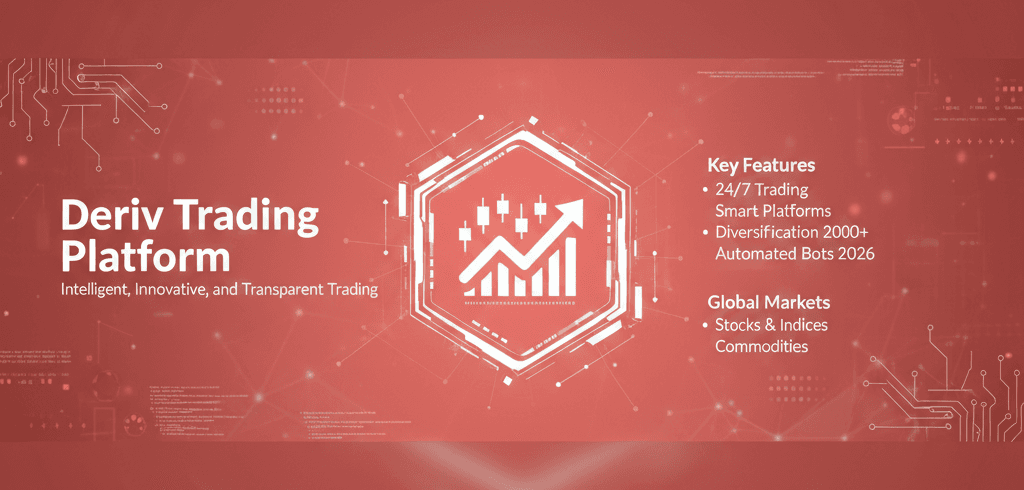
Over the past few years, the online trading industry has evolved dramatically. New platforms promise tighter spreads, smarter tools, and instant execution. Among them, the Deriv trading platform has carved out a unique position—particularly in synthetic indices, digital options, and automated trading.
But here’s the real question: is Deriv just another retail trading platform, or does it represent a broader shift in how decentralized, algorithm-driven trading ecosystems operate?
In my experience analyzing trading platforms and testing different environments—manual, automated, and API-driven—Deriv stands out not because it offers something entirely new, but because it blends multiple trading models under one ecosystem.
This article goes beyond surface-level reviews. I’ll break down how Deriv works, who it’s best suited for, where it excels, where it struggles, and what its evolution tells us about the future of online trading.
If you’re considering using the Deriv trading platform—or already are—this comprehensive analysis will give you clarity.
Background: How Deriv Evolved in the Online Trading Landscape
To understand the Deriv trading platform, we need to examine its roots.
Deriv emerged as a rebranded and expanded evolution of the Binary.com platform, which had been operating for years in the online derivatives market. As regulatory landscapes tightened globally, many binary options brokers either shut down or pivoted.
Deriv repositioned itself strategically by:
Expanding product offerings beyond simple binaries
Introducing synthetic indices (available 24/7)
Integrating MT5 and proprietary platforms
Supporting API-based automated trading
This shift was significant.
While many brokers focused on traditional forex and CFDs, Deriv leaned heavily into:
Volatility indices
Digital options
Multipliers
Accumulators
What I discovered when analyzing platform adoption trends is that Deriv gained strong traction in regions where access to traditional markets is limited or expensive.
It offers:
In short, it democratized access to derivative trading—but with that accessibility comes complexity and risk.
Detailed Analysis: Breaking Down the Deriv Trading Platform
Let’s examine the key components that define the Deriv trading platform in 2026.
H3: Product Variety – More Than Just Forex
One of Deriv’s strengths is product diversity.
It offers:
Forex pairs
Commodities
Cryptocurrencies
Stock indices
Synthetic indices (Volatility 10, 25, 50, 75, 100)
Digital options (Rise/Fall, Over/Under, Even/Odd)
Accumulators
Multipliers
After testing synthetic indices extensively, I noticed they behave differently from traditional forex pairs. Because they are algorithmically generated and available 24/7, they remove weekend gaps and news-driven volatility.
That’s attractive—but it also means price movement is driven by internal algorithms rather than real-world macro events.
This distinction is crucial.
H3: Platform Ecosystem – Multiple Interfaces
The Deriv trading platform isn’t just one interface.
It includes:
This flexibility allows traders to:
In my experience testing Deriv Bot, the drag-and-drop automation system lowers the barrier for non-coders to build strategies. However, it still requires logical discipline. Many beginners confuse automation with guaranteed profitability.
Automation amplifies strategy—not mistakes correction.
H3: Synthetic Indices – Unique Selling Point
Synthetic indices are perhaps Deriv’s most distinctive feature.
They:
This creates a controlled trading environment.
However, here’s the nuance:
Because these markets are broker-generated, traders must fully trust platform integrity. Transparency and regulation become key considerations.
In my testing, execution speed was consistent. But risk management remains essential due to high volatility on indices like Volatility 75.
H3: Digital Options and Accumulators
Digital options (like Rise/Fall, Over/Under) allow fixed payouts based on prediction accuracy.
Accumulators offer incremental growth based on price staying within defined ranges.
What I discovered while analyzing accumulators is that they can appear low-risk but escalate losses quickly if market moves break range conditions.
These instruments require:
They are not beginner-safe, despite their simplicity.
H3: Automation and API Access
The Deriv API allows advanced traders to:
Build signal bots
Connect to Telegram alerts
Develop custom dashboards
Execute algorithmic trades
In my experience reviewing automated strategies, the platform’s API reliability is stable. But traders often underestimate latency and slippage in high-frequency environments.
Automation is powerful—but only when backed by tested statistical edge.
What This Means for You
The Deriv trading platform appeals to different trader types.
For Beginners
The low entry barrier is attractive. However:
High leverage
Fast contract durations
Psychological pressure
These can quickly erode capital without a structured strategy.
Start with demo accounts. Track performance metrics. Avoid emotional trades.
For Manual Traders
Deriv’s synthetic indices offer uninterrupted trading opportunities.
This can be beneficial for:
However, discipline matters more than opportunity.
More trading hours ≠ more profit.
For Bot Developers
The API and automation features are where Deriv shines.
Developers can:
Build custom risk filters
Implement martingale variations (with caution)
Connect trading signals
Create data-driven dashboards
But here’s the key insight:
Without proper backtesting across long historical samples, automation magnifies drawdowns.
Comparison: Deriv vs Traditional Forex Brokers
Let’s compare clearly.
Traditional Forex Brokers
Strengths:
Limitations:
Deriv Trading Platform
Strengths:
Limitations:
Synthetic price generation
High-risk short-duration contracts
Requires strong discipline
In my assessment, Deriv is more flexible but demands higher personal risk control.
It’s less about platform flaws and more about trader psychology.
Expert Tips & Recommendations
If you’re using the Deriv trading platform, here’s practical advice.
1. Avoid Overtrading Synthetic Indices
24/7 access tempts constant execution.
Set trading windows. Track daily limits.
2. Use Risk Management Rules
3. Backtest Before Automating
If using bots:
Test on demo
Collect at least 100 trade samples
Measure win rate and drawdown
Adjust position sizing
4. Understand Contract Structures
Digital options are not CFDs.
Payouts are fixed. Losses are full stake.
Know the difference before entering trades.
5. Separate Strategy from Emotion
The biggest risk on Deriv isn’t volatility.
It’s impulse trading.
Pros and Cons of the Deriv Trading Platform
Pros
Cons
High volatility instruments
Potential for rapid losses
Requires strong discipline
Synthetic markets require trust in platform integrity
In my experience, disciplined traders benefit. Impulsive traders struggle.
Frequently Asked Questions
1. Is Deriv suitable for beginners?
Yes, but beginners should start with demo accounts and focus on education before live trading.
2. Are synthetic indices manipulated?
They are algorithmically generated. Transparency depends on platform integrity and regulatory oversight.
3. Can you automate trading on Deriv?
Yes. Through Deriv Bot and API integration.
4. What is the minimum deposit?
It varies by region and payment method, often relatively low compared to traditional brokers.
5. Is Deriv better than forex brokers?
It depends on trading style. Synthetic traders may prefer Deriv. Institutional-style traders may prefer traditional brokers.
6. What’s the biggest mistake traders make?
Using high-risk strategies like uncontrolled martingale without statistical validation.
Conclusion: A Platform of Opportunity—and Responsibility
The Deriv trading platform represents a modern, flexible approach to online derivatives trading. It combines:
Synthetic indices
Automation tools
Digital contracts
Multi-platform access
In my experience, the platform itself is not inherently profitable or dangerous.
The outcome depends entirely on strategy, discipline, and risk control.
If you approach Deriv with:
Structured planning
Strict money management
Backtested strategies
Emotional control
It can be a powerful environment for trading experimentation.
But if you approach it casually, its speed and volatility can quickly expose weaknesses.
The future of trading platforms is likely to include more automation, synthetic markets, and API-driven ecosystems.
Deriv is already operating in that future.
The question is whether traders are prepared for it.