Artificial intelligence is no longer an optional feature in cloud development — it is becoming the core of modern applications. Over the past two years, Amazon has quietly built one of the most powerful AI ecosystems in the industry, yet many developers still only think of AWS as storage, servers, and databases. In reality, Amazon AI tools for cloud developers now include advanced model hosting, code generation, automation, analytics, and fully managed machine learning platforms.
I recently spent several weeks testing Amazon’s AI services while building cloud-based automation workflows and backend APIs. What I discovered is that AWS is not trying to compete with AI startups in the usual way. Instead, Amazon is building infrastructure for the AI era — tools designed for developers who want to integrate intelligence directly into their applications.
This shift matters because the future of cloud development will not be about writing more code. It will be about orchestrating services, models, and automation together. In this article, I will break down the most important Amazon AI tools for cloud developers, explain where they truly shine, where they fall short, and how you can use them effectively in real-world projects.
Background: Why Amazon Is Investing Heavily in AI for Developers
From Cloud Provider to AI Platform
For years, AWS dominated cloud infrastructure with services like:
EC2 for compute
S3 for storage
Lambda for serverless
RDS for databases
But the cloud market changed after the AI boom.
Developers now want:
Amazon realized that the next phase of cloud computing would not be about servers — it would be about intelligence.
That’s why AWS started building a full AI stack instead of just offering GPU instances.
The Shift Toward AI-First Cloud Development
In my experience working with modern backend systems, most new projects now require at least one of these:
Text generation
Image processing
Speech recognition
Data prediction
Chatbots
Automation agents
Before, developers had to use external APIs.
Now AWS wants you to do everything inside the cloud.
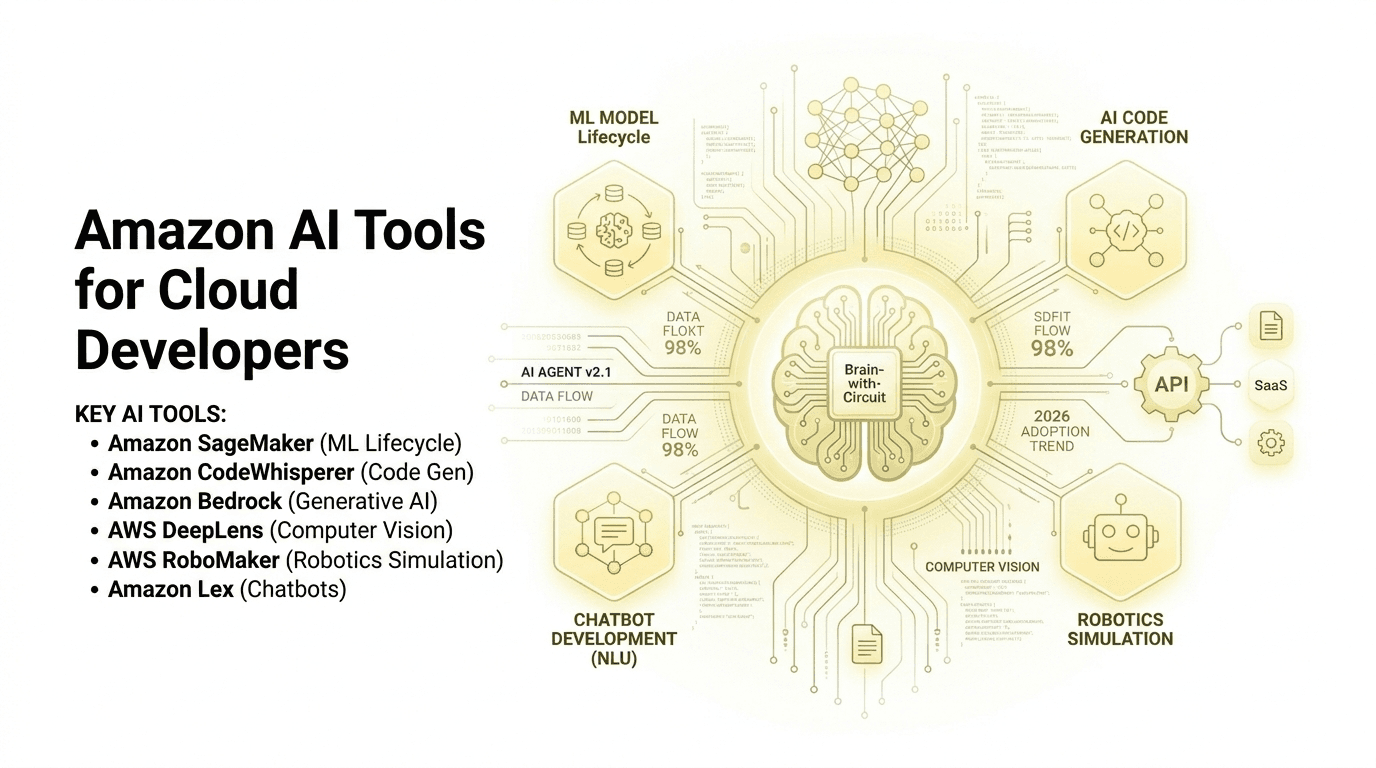
This is why tools like Bedrock, SageMaker, and CodeWhisperer exist.
They are designed to keep developers inside the AWS ecosystem.
Why Developers Should Pay Attention
Many developers focus on OpenAI, Google, or open-source models.
But AWS has one advantage:
Infrastructure + AI + DevOps in one place.
After testing Amazon AI tools for cloud developers, I noticed something important:
They are not always the easiest tools, but they are extremely powerful for production systems.
If you build serious cloud applications, AWS AI tools can save time, reduce cost, and simplify architecture.
Detailed Analysis of Amazon AI Tools for Cloud Developers
1. Amazon Bedrock — The Core of AWS Generative AI
Amazon Bedrock is AWS’s main generative AI platform.
It allows developers to use foundation models without managing infrastructure.
You can access models from:
Anthropic
AI21
Amazon Titan
Meta (Llama)
Stability AI
What makes Bedrock different is integration.
You can connect models directly to:
Lambda
API Gateway
DynamoDB
S3
Step Functions
After testing Bedrock in a serverless project, I found that deployment was easier than running self-hosted models.
However, configuration can be complex for beginners.
Best use cases:
Chatbots
AI assistants
Content generation
Data summarization
AI APIs
2. Amazon SageMaker — Machine Learning for Production
SageMaker is one of the most powerful AI tools on AWS.
It allows you to:
Train models
Deploy models
Manage datasets
Run experiments
Monitor performance
In my experience, SageMaker is not beginner-friendly.
But for serious ML projects, it is extremely strong.
What I discovered while testing SageMaker:
It is designed for teams, not solo developers.
Strengths:
Scalable training
Managed infrastructure
Built-in notebooks
AutoML features
Monitoring tools
Weakness:
Setup is complicated.
Still, for enterprise cloud development, SageMaker is one of the best platforms available.
3. Amazon CodeWhisperer — AI for Developers
CodeWhisperer is Amazon’s AI coding assistant.
It works inside:
VS Code
JetBrains IDEs
AWS Cloud9
It can generate:
Functions
API calls
Infrastructure code
Lambda handlers
SQL queries
After testing CodeWhisperer for backend work, I noticed it performs best when writing AWS-related code.
For example:
IAM policies
Lambda functions
CloudFormation templates
SDK calls
This makes sense.
Amazon trained it for AWS developers.
Compared to other AI coding tools, CodeWhisperer feels more practical for cloud projects.
4. Amazon Rekognition, Polly, and Comprehend
AWS also offers ready-to-use AI services.
These are very useful when you don’t need full ML models.
Examples:
Rekognition → Image & video analysis
Polly → Text to speech
Comprehend → NLP analysis
Transcribe → Speech to text
Textract → Document reading
In my experience, these services save huge development time.
Instead of building AI, you just call an API.
Best use cases:
Document automation
Voice apps
OCR systems
Chat analysis
Moderation tools
These tools are underrated but extremely practical.
5. AWS AI + Serverless = Powerful Combination
One of the biggest advantages of AWS AI tools is integration with serverless.
Example architecture:
API Gateway → Lambda → Bedrock → DynamoDB → S3
This allows you to build AI apps without servers.
After testing this setup, I found:
Cost stays low
Scaling is automatic
Deployment is fast
This is where AWS becomes very strong compared to other AI platforms.
What This Means for You
If You Are a Cloud Developer
You should learn AWS AI tools now.
Future cloud apps will include AI by default.
Important skills:
API Gateway
Lambda
Bedrock
SageMaker
IAM
Step Functions
Developers who understand AI + cloud will be in high demand.
If You Build SaaS Products
You should integrate AI early.
Users expect:
AI search
AI chat
AI automation
AI analytics
Amazon AI tools make this easier.
If You Work With Automation
AWS AI works very well with workflows.
You can combine:
Lambda
Step Functions
EventBridge
Bedrock
This allows you to build powerful automation systems.
If You Are Learning Cloud
Start with simple services:
Lambda
S3
API Gateway
Bedrock
Then move to SageMaker later.
Many beginners start with ML first — that is a mistake.
Expert Tips for Using Amazon AI Tools
Tip 1 — Start With Bedrock, Not SageMaker
Bedrock is easier.
SageMaker is powerful but complex.
Tip 2 — Use Serverless With AI
Best combo:
Lambda + Bedrock + API Gateway
This reduces cost and complexity.
Tip 3 — Control Permissions Carefully
Many errors come from IAM.
Always check:
Roles
Policies
Region settings
Tip 4 — Monitor Costs
AI services can get expensive.
Use:
Budgets
CloudWatch
Cost Explorer
Tip 5 — Use Managed AI Services When Possible
Rekognition, Polly, Textract save time.
Don’t build everything yourself.
Pros and Cons of Amazon AI Tools
Pros
Powerful
Scalable
Production ready
Deep cloud integration
Many services
Cons
Complex setup
Hard for beginners
Documentation overload
Cost management needed
In my experience, AWS AI is amazing for serious projects but heavy for small ones.
Frequently Asked Questions
1. Are Amazon AI tools good for beginners?
Some are, but SageMaker is advanced.
Start with Bedrock and Lambda.
2. Is AWS better than OpenAI?
Not better — different.
AWS is infrastructure.
OpenAI is model provider.
3. Do I need SageMaker to use AI on AWS?
No.
You can use Bedrock or AI APIs.
4. Are AWS AI tools expensive?
They can be.
Use monitoring tools.
5. Can I build SaaS with AWS AI?
Yes.
Many modern SaaS apps use Bedrock.
6. Which AI tool should I learn first?
Bedrock → Lambda → API Gateway → SageMaker.
Conclusion
Amazon is quietly building one of the most powerful AI ecosystems for developers, and the impact will be huge over the next few years. After testing Amazon AI tools for cloud developers, what I discovered is that AWS is not trying to make AI simple — it is trying to make AI scalable, reliable, and production-ready.
Bedrock makes generative AI easier to deploy, SageMaker makes machine learning possible at scale, and services like Rekognition, Polly, and Textract remove the need to build complex AI from scratch. When combined with serverless architecture, these tools allow developers to build intelligent cloud applications faster than ever before.
The key takeaway is clear:
Learn AI + Cloud together.
Developers who understand both will build the next generation of software.