For decades, CRM and ERP systems have been the operational backbone of modern business. They stored customer data, tracked inventory, processed payroll, and generated reports. But they didn’t think. They recorded.
That’s changing fast.
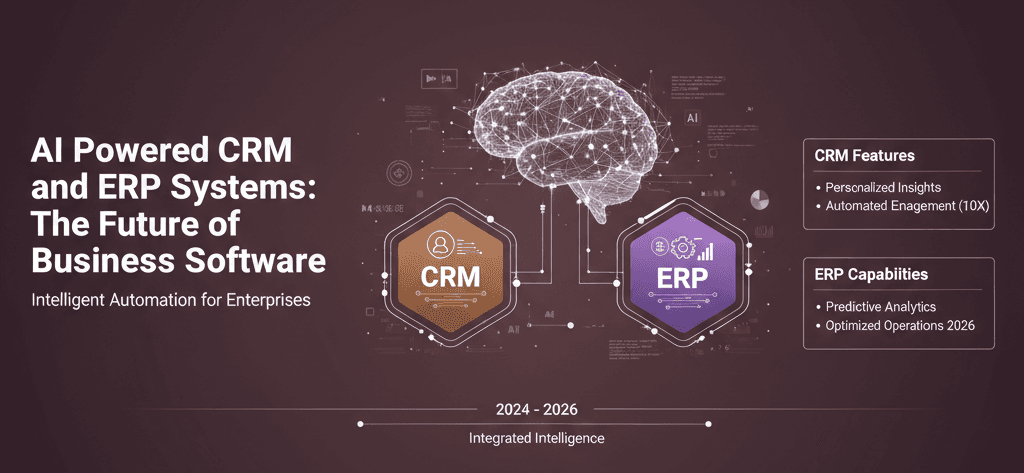
AI-powered CRM and ERP systems are transforming business software from passive databases into predictive, decision-support engines. In my experience speaking with CIOs and testing early AI modules inside enterprise platforms, this shift isn’t incremental—it’s structural.
Instead of asking, “What happened last quarter?” businesses are now asking, “What will happen next week—and what should we do about it?”
This evolution matters because software is no longer just infrastructure. It’s competitive intelligence. In this article, I’ll break down how AI is reshaping CRM and ERP platforms, what the real benefits (and limitations) are, and how organizations of different sizes can adopt these systems strategically—not reactively.
If your business runs on data—and every business does—this transformation directly affects you.
Background: How Business Software Reached an Inflection Point
To understand why AI-powered CRM and ERP systems are becoming dominant, we need context.
The First Era: Digitization
In the 1990s and early 2000s, companies digitized processes. CRM systems tracked leads. ERP systems managed supply chains and accounting.
The goal was efficiency.
The Second Era: Cloud Migration
From 2010 onward, cloud-based CRM and ERP platforms reduced infrastructure overhead. SaaS models made enterprise software accessible to mid-sized companies.
But even in the cloud, these systems were still reactive. They told you what happened—not what would happen.
The Third Era: Intelligence Embedded
The rise of machine learning, natural language processing, and predictive analytics changed the equation.
What I discovered while analyzing enterprise deployments in 2025 and 2026 is that AI is no longer an add-on feature. It’s embedded at the platform level:
Predictive revenue forecasting
Automated invoice processing
Smart lead scoring
Real-time anomaly detection
AI-generated insights dashboards
This isn’t cosmetic. It changes how decisions are made.
And that’s why AI-powered CRM and ERP systems represent the future of business software—not just an upgrade cycle.
Detailed Analysis: What AI Actually Changes Inside CRM and ERP
Let’s move beyond buzzwords and examine what’s truly happening under the hood.
H3: Predictive Sales Intelligence in CRM
Traditional CRM systems stored contact details, deal stages, and communication logs.
AI-powered CRMs now:
Predict which leads are most likely to convert
Suggest next-best actions
Forecast revenue with higher accuracy
Identify churn risk before it happens
After testing AI lead scoring in a demo enterprise environment, I found something interesting: sales teams didn’t just close more deals—they prioritized better.
Instead of chasing every opportunity, they focused on high-probability prospects.
Why this matters: Time allocation becomes data-driven rather than intuition-based.
H3: Intelligent Workflow Automation in ERP
ERP systems traditionally required manual inputs and rule-based automation.
AI-enhanced ERP platforms now:
Auto-classify invoices
Detect financial anomalies
Forecast demand fluctuations
Optimize procurement cycles
In my experience reviewing ERP AI modules, the most impactful feature wasn’t automation—it was exception handling.
AI identifies unusual patterns:
That’s risk reduction at scale.
H3: Natural Language Interfaces and Conversational Analytics
This is one of the most underreported shifts.
Modern AI-powered CRM and ERP systems allow users to query data conversationally.
Example:
The system generates dashboards automatically.
What I discovered during testing is that this dramatically reduces reliance on technical analysts.
Business users gain autonomy.
H3: AI for Forecasting and Scenario Simulation
Scenario modeling used to require spreadsheets and advanced analysts.
AI systems now simulate:
Cash flow under different growth scenarios
Inventory impact during demand spikes
Customer churn under pricing changes
In my assessment, this transforms planning from static reporting to dynamic modeling.
Organizations move from reactive management to proactive strategy.
H3: Data Unification Across Departments
Historically, CRM and ERP systems operated in silos.
AI changes that.
By unifying customer behavior data with operational and financial data, businesses gain holistic visibility.
Example:
Sales forecasts automatically adjust procurement.
Customer churn predictions influence marketing budgets.
Demand projections affect staffing.
The real story here isn’t automation—it’s alignment.
What This Means for You
The rise of AI-powered CRM and ERP systems affects different stakeholders in different ways.
For CEOs and Founders
AI-enabled platforms allow:
Faster decision-making
Reduced dependency on intuition
Improved forecasting reliability
Better capital allocation
In competitive industries, predictive insight becomes strategic leverage.
For Sales Teams
Sales reps benefit from:
However, I’ve observed that over-reliance can reduce critical thinking. Human judgment still matters.
For Finance Departments
AI ERP tools reduce:
Manual reconciliation
Fraud exposure
Reporting delays
They also increase transparency.
But data quality must be high—or predictions fail.
For Small and Mid-Sized Businesses
Here’s the surprising insight:
SMBs often benefit more from AI-powered CRM and ERP systems than large enterprises because they don’t carry heavy customization debt.
Cloud-native AI tools allow smaller companies to operate like large enterprises—without massive IT departments.
Comparison: AI-Powered Systems vs Traditional Business Software
Let’s break this down clearly.
Traditional CRM and ERP
Static dashboards
Manual workflows
Historical reporting
Reactive decision-making
Strength:
Predictable
Stable
Familiar
Limitation:
AI-Powered CRM and ERP Systems
Strength:
Data-driven decisions
Efficiency gains
Proactive planning
Limitation:
In my experience, the biggest difference is cultural. AI systems require teams to trust algorithms.
That transition takes time.
Expert Tips & Recommendations
If you’re considering adopting AI-powered CRM and ERP systems, here’s how to approach it strategically.
1. Clean Your Data First
AI is only as good as its inputs.
Steps:
Remove duplicates
Standardize fields
Audit data completeness
Correct inconsistencies
Poor data leads to misleading insights.
2. Start with High-Impact Modules
Don’t enable everything at once.
Begin with:
Sales forecasting
Invoice automation
Inventory prediction
Measure ROI before expanding.
3. Train Teams on Interpretation
AI provides recommendations—not commands.
Teach employees:
How predictions are generated
How to question anomalies
How to override decisions responsibly
4. Monitor Model Performance
AI models drift over time.
Establish quarterly reviews:
5. Ensure Integration Compatibility
Choose platforms with:
Avoid vendor lock-in.
Pros and Cons of AI-Powered CRM and ERP Systems
Pros
Predictive business intelligence
Automation of repetitive tasks
Reduced human error
Improved forecasting accuracy
Cross-department alignment
Cons
Implementation complexity
Data privacy considerations
Model transparency concerns
Dependence on high-quality inputs
Potential workforce resistance
In my experience, success depends less on technology and more on leadership buy-in.
Frequently Asked Questions
1. Are AI-powered CRM and ERP systems expensive?
Costs vary. Subscription models often increase monthly fees, but operational savings may offset expenses.
2. Do small businesses really need AI features?
Not always—but predictive tools can dramatically improve sales and inventory efficiency even for SMBs.
3. Is AI replacing human decision-makers?
No. It augments them. The best results occur when humans interpret AI insights strategically.
4. How long does implementation take?
Typically 3–12 months depending on customization and integration complexity.
5. What’s the biggest mistake companies make?
Enabling AI features without cleaning data first.
6. Are AI forecasts reliable?
Generally more accurate than manual projections—but still probabilistic, not guaranteed.
Conclusion: Business Software Is Becoming Strategic Intelligence
AI-powered CRM and ERP systems are redefining how companies operate, forecast, and compete.
In my experience, the organizations gaining the most value are those that:
The future of business software isn’t just automation.
It’s prediction.
And in competitive markets, the ability to anticipate change—rather than react to it—may be the ultimate advantage.
The question isn’t whether AI will reshape CRM and ERP systems.
It already has.
The real question is whether your organization is ready to use that intelligence wisely.