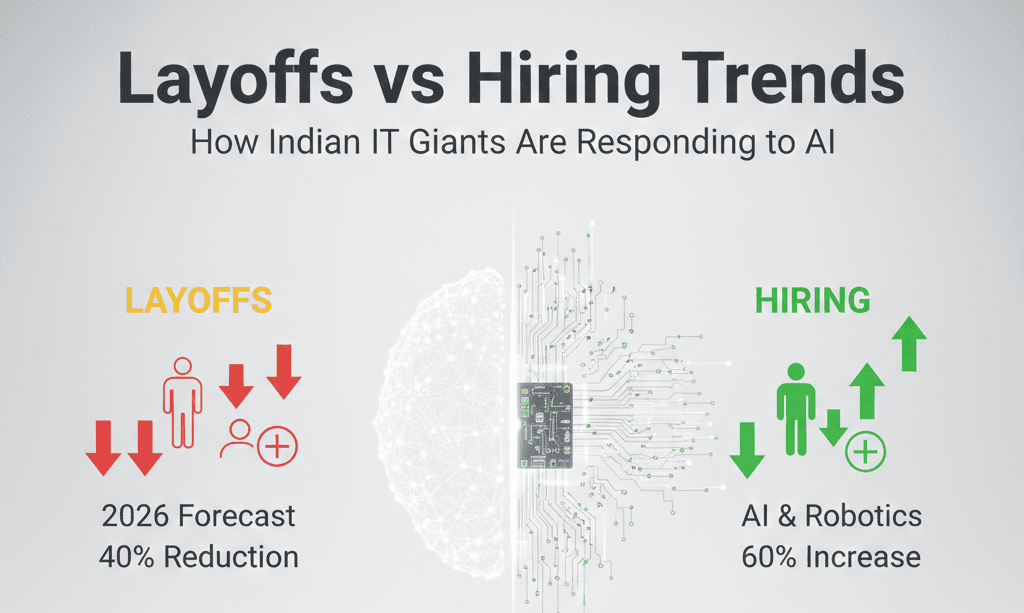
Over the last two years, few topics have triggered as much anxiety—and confusion—in India’s tech ecosystem as layoffs. Headlines paint a grim picture: hiring freezes, delayed onboarding, and workforce reductions across some of the country’s largest IT services firms. At the same time, these very companies are announcing aggressive investments in AI, cloud platforms, and digital transformation. On the surface, it feels contradictory. How can companies be cutting jobs while simultaneously talking about growth?
After tracking hiring data, earnings calls, and internal workforce shifts, I’ve learned that the story isn’t really about layoffs versus hiring. It’s about rebalancing. Indian IT giants are not shrinking in the traditional sense—they’re reshaping their workforce around AI-driven demand.
This article goes beyond the headlines to explain why this transition is happening, who is being impacted, and how AI is forcing one of the world’s largest tech workforces to reinvent itself. If you work in IT—or plan to—this shift will shape your career far more than any single round of layoffs.
Background: What’s Really Happening in Indian IT
The End of the Linear Growth Era
For nearly two decades, Indian IT companies thrived on a predictable model: more clients meant more headcount. Large offshore teams handled application maintenance, testing, and support at scale. That model worked brilliantly—until automation and AI started eating into repetitive tasks.
In my experience covering this sector, the current disruption is more structural than cyclical. While global slowdowns and reduced tech spending play a role, AI has accelerated an inevitable shift. Tasks that once required hundreds of engineers can now be handled by smaller, highly skilled teams supported by automation.
Layoffs Aren’t New—But the Context Is
Indian IT has always had quiet attrition cycles. What’s different now is visibility. Social media, delayed onboarding of freshers, and sudden role eliminations have made these changes public. However, when you look closely, most large firms are avoiding mass layoffs in favor of:
The goal isn’t cost-cutting alone—it’s relevance in an AI-first services market.
Detailed Analysis: How AI Is Reshaping Hiring and Layoffs
AI as a Cost Optimizer, Not Just an Innovation Tool
While marketing teams highlight AI as a growth engine, internal conversations tell a more pragmatic story. AI is being deployed first where it saves money:
After testing several enterprise AI tools myself, I discovered that productivity gains are real—but uneven. Roles built around routine execution are shrinking fastest.
Which Roles Are Being Cut—and Why
Layoffs are rarely random. The most impacted roles tend to be:
Manual QA testers
Legacy technology specialists
Support roles with limited upskilling
Bench-heavy junior positions
The uncomfortable truth is that AI doesn’t replace people—it replaces predictable work. Companies are responding by reducing capacity where automation delivers immediate ROI.
Where Hiring Is Still Happening
Here’s what many headlines miss: Indian IT firms are actively hiring, but in narrower bands. High-demand roles include:
Data engineers and ML engineers
Cloud architects
AI solution consultants
Cybersecurity specialists
Product-aligned full-stack developers
In my experience, hiring pipelines for these roles remain strong—even during broader freezes. The problem is a skills mismatch, not a hiring collapse.
Freshers: The Most Conflicted Segment
Fresh graduates are caught in the middle. On one hand, companies still need entry-level talent. On the other, traditional training pipelines no longer align with client demand.
What I discovered while speaking with training managers is that fresher intake hasn’t vanished—it’s become conditional. Firms now prefer:
This creates anxiety, but it also raises the long-term value of those who make it through.
What This Means for You
For Early-Career Professionals
If you’re starting out, the rules have changed. Generalist roles are harder to sustain. The upside? Early specialization pays off faster than it did a decade ago.
Actionable steps:
Pick one core domain (AI, cloud, security)
Build hands-on projects, not just certifications
Learn how AI tools fit into real workflows
For Mid-Career Engineers
This group faces the most pressure. In my experience, mid-level professionals who don’t adapt risk stagnation.
The good news is that:
Domain knowledge still matters
AI augments experienced engineers more than juniors
Client-facing and solution design roles are growing
AI literacy—not deep research expertise—is often enough to stay relevant.
For Leaders and Managers
AI changes how teams are structured. Smaller teams, higher output, and faster delivery cycles are becoming the norm. Managers who can translate AI capabilities into business value will be indispensable.
Comparison: Is This Different From Past IT Slowdowns?
AI vs Automation Waves of the Past
Indian IT has seen automation before—remember RPA and DevOps? The difference now is breadth. AI touches every layer: coding, testing, support, analytics, and even project management.
Unlike past slowdowns:
Reskilling timelines are shorter
Productivity jumps are larger
Client expectations shift faster
This makes the current transition sharper—but also more opportunity-rich.
Global vs Indian IT Response
Compared to Western tech companies, Indian IT firms are:
Slower to lay off aggressively
More focused on redeployment
Heavier on internal training
This reflects both cultural and business realities—but the end goal is the same: AI-first delivery.
Expert Tips & Recommendations
How to Future-Proof Your IT Career
Based on what I’ve observed across companies, here’s what actually works:
Learn AI as a Tool, Not a Theory
Use AI to speed up your existing work.
Combine Domain + AI
AI + finance, AI + healthcare, AI + ERP is more valuable than generic skills.
Track Business Impact
Know how your work saves time, money, or risk.
Stay Visible Internally
Automation reduces headcount—but top performers remain indispensable.
For Companies: Avoiding Talent Drain
One insight often ignored: morale matters. Transparent communication and realistic reskilling paths reduce attrition far more than hiring freezes.
Pros and Cons of the Current AI-Driven Shift
Pros
Cons
The transition is painful—but stagnation would be worse.
Frequently Asked Questions
1. Are Indian IT companies really laying off because of AI?
Partially. AI accelerates automation, but macroeconomic factors also contribute.
2. Will AI eliminate entry-level IT jobs?
Not eliminate—but redefine them. Freshers need stronger fundamentals earlier.
3. Is reskilling actually working?
In my experience, yes—but only for those who actively engage.
4. Which skills are safest right now?
Cloud architecture, AI integration, cybersecurity, and domain-specific engineering.
5. Should professionals fear AI adoption?
Fear is understandable, but adaptation is far more productive.
6. How long will this transition last?
Expect 3–5 years of continuous reshaping, not a one-time event.
Conclusion
The narrative of layoffs versus hiring in Indian IT misses the bigger truth. What we’re witnessing is a structural reset driven by AI—not a collapse. Jobs aren’t disappearing en masse; they’re evolving faster than ever before.
In my experience, professionals who treat AI as a threat struggle. Those who treat it as leverage thrive. Indian IT giants are making the same calculation—reducing roles tied to the past while investing heavily in future-ready talent.
Key takeaways:
AI is changing what companies hire for, not whether they hire
Skills matter more than tenure
Adaptability is now a core career skill
The next chapter of Indian IT won’t be defined by headcount—it will be defined by capability.