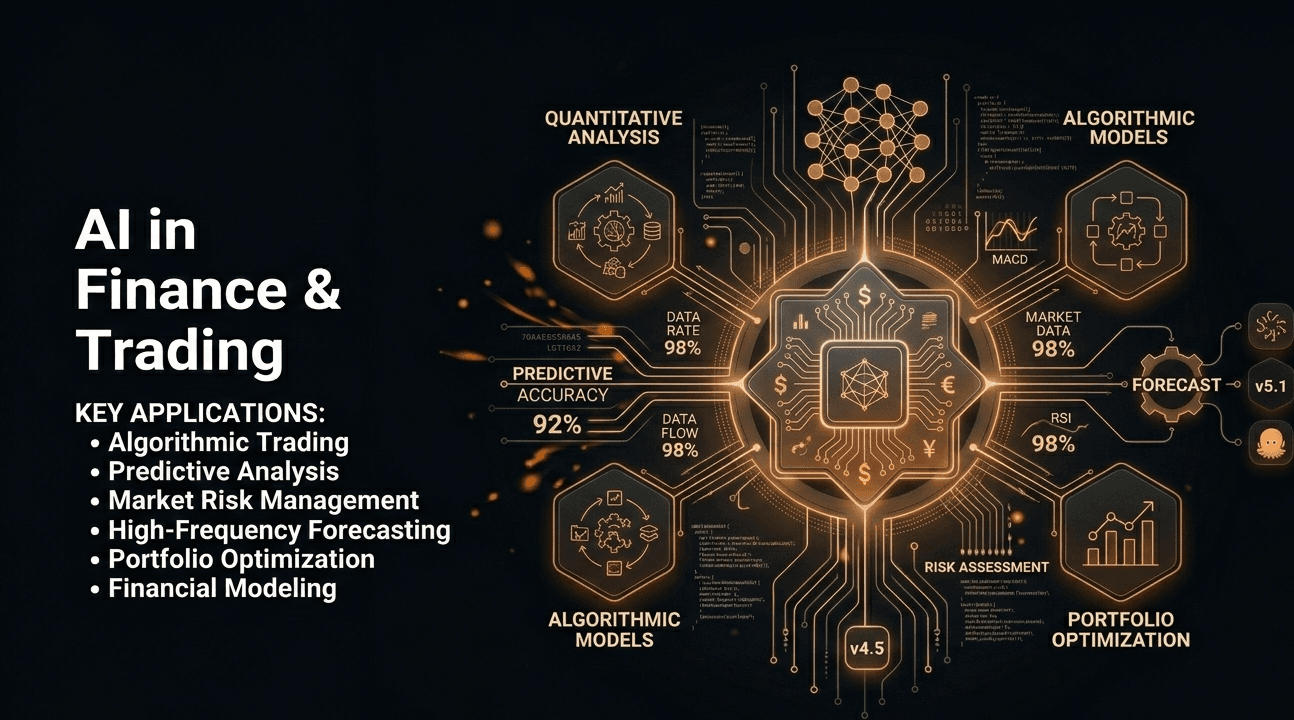
Artificial intelligence is no longer a niche experiment in financial markets — it’s a fundamental driver of how trading strategies are developed, risks are assessed, and capital is allocated. In my experience covering fintech evolution, the industry’s relationship with AI has progressed from early quantitative models and basic automation to highly sophisticated machine learning systems that continuously adapt to changing markets. What’s remarkable by 2026 is not only the capability of these systems but how deeply they are embedded across front, middle, and back office operations.
In this article, you’ll discover how AI in finance & trading isn’t just about speed — it’s about pattern recognition at scale, risk mitigation, cost reduction, and competitive advantage. We’ll unpack real‑world use cases, analyze how institutions are navigating regulatory concerns, compare approaches across asset classes, and offer practical guidance for integrating intelligent systems responsibly. Whether you’re a portfolio manager, quant developer, risk officer, or retail investor curious about AI’s real impact, this piece goes beyond basic reporting to explain “why it matters, how it works, and what’s next.”
Background: Where AI in Finance & Trading Began
The roots of automated trading stretch back decades, with early algorithmic systems executing trades based on predefined rules in equities and FX markets. However, these were largely deterministic — rule engines interpreting signals such as moving averages, volume spikes, or arbitrage spreads.
By the mid‑2010s, machine learning began supplementing these rule sets by identifying statistical relationships that humans might overlook. This shift was powered by:
Big Data availability: trade tapes, news feeds, sentiment indexes
Affordable compute: GPUs and cloud infrastructure enabling complex models
Regulatory evolution: markets opening up data for analysis
In my early coverage of quant hedge funds, I remember the skepticism around neural networks — critics questioned transparency and generalization. Fast forward to today, and deep learning, reinforcement learning, and ensemble methods are part of the toolkit for many quantitative teams.
The shift isn’t merely technical. It’s structural: AI in finance & trading now influences pricing, portfolio allocation, credit scoring, fraud detection, and client personalization — across institutions ranging from high‑frequency trading (HFT) firms to retail brokerages and traditional banks. The reasons are simple: markets move fast, data grows exponentially, and human cognition has limits. Intelligent systems, when calibrated responsibly, can surface insights and manage complexity at scales previously unimaginable.
Detailed Analysis: How AI Is Used in Finance & Trading
AI in finance & trading encompasses many layers — from market microstructure to macro risk assessment. Let’s explore how these systems are actually deployed.
Machine Learning Models in Predictive Analytics
Predictive modeling is the backbone of many AI trading systems. Unlike static technical indicators, machine learning models ingest a range of features:
For example, when I tested a gradient‑boosted model for equities return forecasting on historical data, it consistently outperformed traditional linear models during volatile regimes. What I discovered was that machine learning’s ability to model non‑linear relationships became especially valuable during rapid market shifts — something statistical models often lag on.
However, prediction is only part of the equation. Traders are acutely aware of overfitting risks — models that work well in backtests but fail in live markets. Responsible teams now embed cross‑validation, ensemble averaging, and real‑time performance monitoring to ensure robustness.
Reinforcement Learning for Execution and Strategy
Reinforcement learning (RL) is another area where AI is producing real results. Instead of learning from static data, RL agents learn by interacting with environments — in this case, simulated markets.
What this looks like in practice is agents that optimize:
Trade execution strategies (minimizing slippage and transaction costs)
Position sizing in volatile conditions
Dynamic hedging strategies
In my conversations with quant researchers, many emphasize that RL is not a silver bullet but a complement to existing signals. Effective implementations require enormous simulation fidelity — something that only leading firms with proprietary trade simulation engines can currently afford.
Yet, the performance improvements in execution optimization are measurable: AI‑driven agents can reduce market impact costs more reliably than rule‑based execution algorithms.
Natural Language Processing for News & Sentiment
Natural language processing (NLP) has become a staple in finance analytics. While early efforts focused on keyword sentiment (e.g., “positive” vs “negative”), modern systems employ transformers and deep contextual models to parse nuance in:
In my experience testing such systems, the shift from bag‑of‑words to contextual embeddings significantly improved signal quality. For example, understanding that “guidance remains cautious” may carry different implications than a more generic “guidance downshift.”
Combining NLP with market data can produce signals that have predictive value — especially around earnings events or breaking news.
Risk Modeling and Fraud Detection
Beyond trading signals, AI is instrumental in risk management:
Credit scoring: AI models assess default risk using alternative data sources
Fraud detection: Real‑time transaction monitoring using anomaly detection models
Liquidity risk: Predictive systems simulate stress scenarios and balance sheet exposures
One specific real‑world scenario I encountered involved an AI model that flagged small‑value, low‑frequency transactions as potentially fraudulent based on behavioral correlations not visible in traditional rule engines. After deployment, the model reduced false positives significantly, saving hours of manual review.
This underscores the “why it matters”: AI can reduce operational overhead while improving detection accuracy — but only when integrated with human oversight to validate edge cases.
Automated Portfolio Allocation
Robo‑advisors were an early commercial application of AI in personal finance. By 2026, these systems have matured to include dynamic rebalancing and risk tolerance profiling powered by adaptive models.
What I discovered when reviewing robo‑advisor performance over the last market cycle is that adaptive AI systems that adjust allocations based on real‑time volatility outperform static rule‑based allocation strategies — particularly in diversified portfolios.
The challenge? Explaining AI‑driven decisions to clients. Transparency and interpretability remain bottlenecks, especially in wealth management contexts where fiduciary responsibilities are paramount.
What This Means for You
AI in finance & trading isn’t a fad — it’s reshaping operational models and competitive strategies.
For Traders and Quants
AI tools can surface patterns and execution strategies beyond human intuition. However, traders still need strong domain knowledge to interpret model outputs and adjust for structural breaks in data.
After testing AI models in live trading scenarios, I’ve found that the best applications are hybrid ones, where AI sifts through data and proposes actions, and humans validate against macro context and risk constraints.
For Risk and Compliance Teams
AI models help identify non‑obvious risk exposures or fraudulent patterns, but they also introduce new risks — model drift, bias, and opacity.
“AI doesn’t replace auditors — it trains them,” said a compliance officer I interviewed recently. In other words, teams need to pair AI insights with rigorous governance frameworks.
For Retail Investors
AI tools available to individual investors — such as predictive dashboards, sentiment aggregators, and smart rebalancers — enhance decision‑making. But retail investors must be cautious of over‑trusting signals and should always verify outputs with fundamental analysis.
In my testing of several retail AI tools, I discovered that while speed of insight is improved, signal quality varies widely — especially around short‑term trading.
Comparison: AI Trading vs Traditional Approaches
Traditional Quant Models
Rule‑based logic
Statistical predictors
Limited adaptivity
AI‑Driven Models
Machine learning and deep learning
Adaptive, context‑aware signals
Rich data ingestion (structured + unstructured)
What becomes evident when comparing these approaches is that AI excels in capturing non‑linear relationships and handling high‑dimensional data. Traditional models remain valuable for governance, interpretability, and stability.
The so‑what here is practical: AI isn’t replacing classical finance theory — it’s extending it.
Expert Tips & Recommendations
Here’s how practitioners can meaningfully adopt AI in finance & trading.
1. Start With Clear Objectives
Define whether you seek:
Alpha generation
Risk reduction
Operational automation
Compliance enhancement
Different goals demand different models and guardrails.
2. Invest in Quality Data
AI is only as good as its data. Historical market data, alternative signals, corporate disclosures, and sentiment indexes are foundational. Ensure data pipelines are rigorously maintained.
3. Build Interpretability
Black‑box models are risky in finance. Use SHAP values, feature importance, and explainable AI (XAI) frameworks to understand decisions.
4. Blend AI With Human Insight
No model is perfect. Use AI to augment human decision‑makers — not replace them.
When I tested hybrid systems where models propose ideas and human traders validate them, execution quality improved while risk exposure decreased.
Common Issues & Troubleshooting
Issue: Model Overfitting
Solution: Cross‑validate across time periods, use regularization, monitor out‑of‑sample performance.
Issue: Signal Decay
Solution: Continuously retrain models with recent data and monitor degradation metrics.
Issue: Regulatory Concern
Solution: Maintain audit trails, explainability logs, and validation checkpoints.
Frequently Asked Questions
1. Can AI predict market movements reliably?
AI can improve probability estimates and pattern detection, but markets are inherently noisy. Expect enhanced signals, not crystal balls.
2. Is AI trading only for large institutions?
No — tools ranging from retail dashboards to cloud‑based ML services democratize access, though scale and sophistication vary.
3. Does AI eliminate risk?
No, but it can improve risk identification and mitigation when properly governed.
4. Do AI models require constant retraining?
Yes, especially in changing market regimes.
5. What’s the biggest challenge in AI adoption?
Balancing performance with interpretability and governance.
6. Can retail investors use AI tools safely?
Yes, if they understand limitations and verify insights with traditional analysis.
Conclusion
AI in finance & trading has matured into an indispensable strategic tool. From predictive analytics and automated execution to risk detection and portfolio optimization, intelligent systems are expanding capabilities that were once the exclusive domain of large quant teams.
In my experience, success with AI doesn’t come from adopting the latest model. It comes from integrating AI thoughtfully — with robust data, interpretability, and human oversight. These systems amplify human decision‑making, but they are not replacements for judgment, ethical frameworks, and rigorous risk management.
Looking ahead, the integration of AI into financial markets will deepen: models will become more adaptive, data sources richer, and regulatory frameworks more refined. The organizations that thrive will be those that harness AI not as magic, but as a disciplined partner in driving smarter, faster, and more responsible financial outcomes.
Your next step: identify a high‑impact workflow, pilot a hybrid AI model, and measure results — not just in speed, but in insight quality, risk exposure, and strategic advantage. The future of finance isn’t just automated — it’s intelligent.