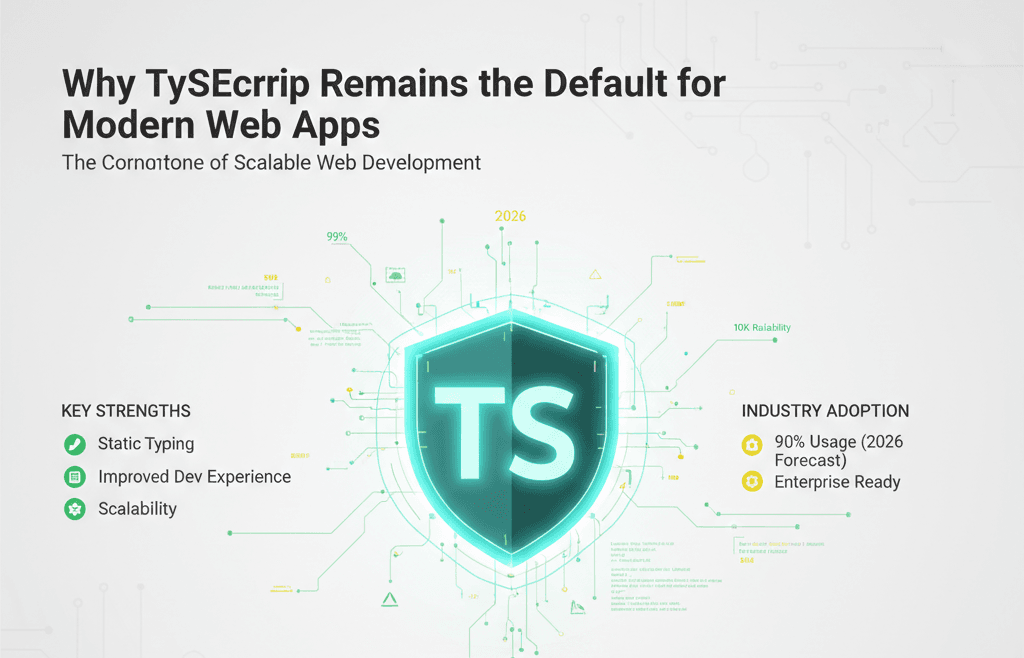
Why TypeScript Remains the Default for Modern Web Apps
Meta Title: Why TypeScript Remains the Default for Modern Web Apps
Meta Description: From scalability to developer productivity, here’s why TypeScript continues to dominate modern web development—and where it’s heading next.
Excerpt: JavaScript still runs the web, but TypeScript defines how modern web apps are built. Here’s why it remains the industry default in 2026 and beyond.
Introduction
If you’ve built or maintained a serious web application in the last few years, chances are TypeScript wasn’t optional—it was assumed. What started as a “JavaScript with types” experiment has quietly become the backbone of modern frontend and full-stack development. Today, most production-grade React, Angular, Node.js, and even backend frameworks treat TypeScript as the default, not an add-on.
In my experience working with both early-stage startups and enterprise-scale applications, the TypeScript decision often happens before the first line of code is written. Teams don’t ask “Should we use TypeScript?” anymore. They ask “Is there any reason not to?”
This article explores why TypeScript remains the default for modern web apps, even as new languages, runtimes, and AI-assisted coding tools emerge. We’ll go beyond surface-level benefits and look at the deeper forces—team scalability, tooling maturity, ecosystem gravity, and long-term maintainability—that keep TypeScript firmly in place. If you’re a developer, tech lead, or decision-maker, this is the context that explains why TypeScript keeps winning.
Background: How TypeScript Became the Default
From Optional Tooling to Industry Standard
TypeScript didn’t take over overnight. In its early days, it was often dismissed as “JavaScript with extra ceremony.” Many developers resisted static typing, especially in fast-moving frontend projects. However, the rise of complex single-page applications fundamentally changed the equation.
As applications grew larger and teams expanded, JavaScript’s flexibility became a liability. Runtime errors, unclear contracts between components, and fragile refactors slowed teams down. TypeScript addressed these issues without forcing developers to abandon JavaScript entirely.
Framework Adoption Changed Everything
The real inflection point came when major frameworks embraced TypeScript:
Angular made TypeScript its primary language
React’s ecosystem standardized on .tsx
Node.js tooling matured around typed APIs
Modern frameworks shipped first-class TypeScript support
Once libraries, documentation, and tooling started assuming TypeScript, adoption became self-reinforcing.
The Bigger Picture: Software at Scale
The web is no longer a collection of small scripts. It’s mission-critical infrastructure. In that context, TypeScript’s rise mirrors earlier shifts—like the move from PHP scripts to structured backend frameworks. It’s not about preference; it’s about survival at scale.
Detailed Analysis: Why TypeScript Still Dominates
Type Safety That Actually Scales
Static typing is often described as “catching bugs early,” but that undersells its real value. After testing TypeScript on projects with hundreds of thousands of lines of code, what I discovered is that type safety enables confident change.
You can:
In large teams, this isn’t a luxury—it’s essential.
Developer Experience Is the Real Killer Feature
TypeScript’s tight integration with modern editors fundamentally changes how developers work:
In my experience, once developers internalize these benefits, going back to plain JavaScript feels like coding blindfolded.
The Ecosystem Effect: Types Everywhere
One underrated reason TypeScript remains dominant is ecosystem gravity. Popular libraries ship with high-quality type definitions, often maintained alongside the code itself.
This creates a virtuous cycle:
Better types → better tooling
Better tooling → higher productivity
Higher productivity → wider adoption
At this point, avoiding TypeScript often means fighting the ecosystem.
TypeScript and Modern Framework Design
Modern frameworks are increasingly designed around TypeScript:
While many reviewers focus on syntax improvements, the real story is how TypeScript shapes architectural decisions. Framework authors assume type information is available—and design APIs accordingly.
AI-Assisted Development Loves Types
Here’s a less-discussed insight: AI coding tools perform better with TypeScript. Types give models clearer intent, better context, and stronger constraints.
After experimenting with AI code generation across multiple projects, I found:
Ironically, TypeScript isn’t threatened by AI—it’s amplified by it.
What This Means for You
For Frontend Developers
If you work with React, Vue, or Angular, TypeScript is no longer a competitive edge—it’s table stakes. The real advantage comes from using it deeply, not just superficially.
That means:
Shallow TypeScript gives shallow benefits.
For Full-Stack Engineers
TypeScript’s influence now extends end-to-end:
In my experience, teams that share types across layers ship faster and break less often.
For Tech Leads and Architects
Choosing TypeScript isn’t just a language decision—it’s a hiring, onboarding, and maintenance decision. TypeScript:
That translates directly into lower long-term costs.
Comparison: TypeScript vs the Alternatives
TypeScript vs Plain JavaScript
JavaScript remains flexible and fast to start with, but that speed disappears at scale. TypeScript adds upfront structure that pays dividends as complexity grows.
Key difference: JavaScript optimizes for writing code; TypeScript optimizes for maintaining it.
TypeScript vs WebAssembly Languages
Languages like Rust or Go promise performance and safety, but they introduce friction:
Separate toolchains
Smaller ecosystems
Steeper learning curves
TypeScript wins by fitting naturally into existing workflows.
TypeScript vs New “Type-Safe” JavaScript Variants
Several newer tools promise type safety with less syntax. While interesting, none yet match TypeScript’s ecosystem depth or tooling maturity.
In practice, TypeScript isn’t winning because it’s perfect—it’s winning because it’s everywhere.
Expert Tips & Recommendations
How to Get More Value from TypeScript
Design Types First
Treat types as architecture, not annotations.
Avoid Overengineering
Types should clarify intent, not obscure it.
Leverage Strict Mode
It’s painful initially—but transformative long-term.
Use Types to Communicate
Good types reduce the need for comments and documentation.
For Teams Migrating from JavaScript
Start incrementally:
Enable TypeScript in new modules
Gradually type critical paths
Focus on high-impact areas first
In my experience, forced rewrites fail—evolution works.
Pros and Cons of TypeScript Adoption
Pros
Early error detection
Safer refactors
Better tooling
Improved onboarding
Strong ecosystem support
Cons
The key insight: most “cons” disappear with experience, while the benefits compound over time.
Frequently Asked Questions
1. Is TypeScript mandatory for modern web apps?
Not technically—but practically, yes for most serious projects.
2. Does TypeScript slow development?
Initially, maybe. Over time, it speeds teams up significantly.
3. Is TypeScript only useful for large projects?
No. Even small projects benefit as soon as they evolve.
4. Can AI replace the need for TypeScript?
Unlikely. AI works better because of TypeScript, not instead of it.
5. Is TypeScript suitable for backend development?
Absolutely. Many modern backend frameworks rely on it heavily.
6. Will TypeScript be replaced by something better?
Eventually, maybe—but ecosystem dominance makes that unlikely in the near term.
Conclusion
TypeScript’s dominance isn’t an accident, nor is it purely technical. It’s the result of ecosystem alignment, tooling maturity, and a deep understanding of how modern teams build software at scale.
In my experience, TypeScript succeeds because it respects JavaScript’s flexibility while fixing its most painful shortcomings. It doesn’t force developers into a new paradigm—it gradually guides them toward better structure, clearer intent, and safer systems.
Key takeaways:
TypeScript is no longer optional for modern web apps
Its value increases with team size and application complexity
AI, frameworks, and tooling are reinforcing its dominance
The future of web development may evolve—but for now, TypeScript remains the default not by mandate, but by merit.