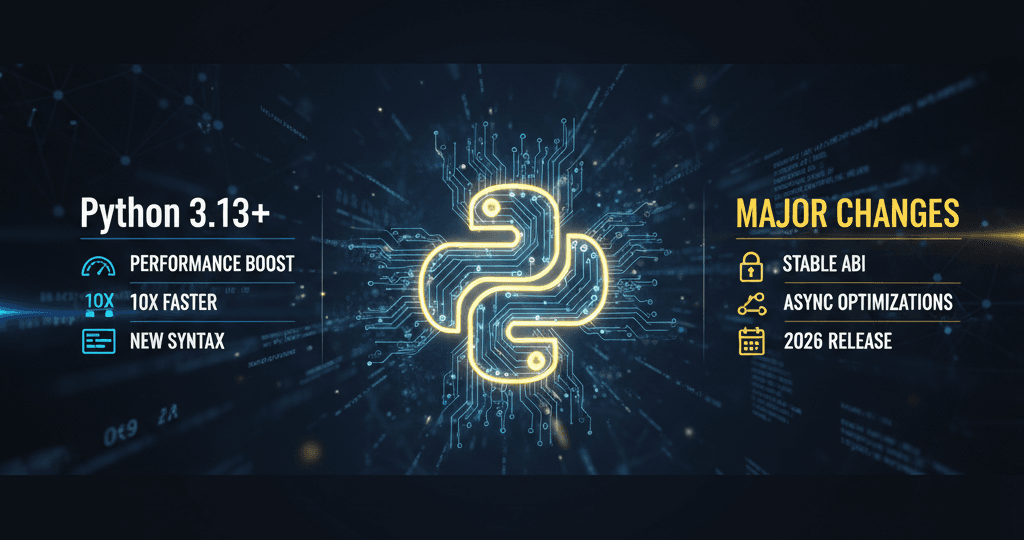
Every Python release claims to be faster, cleaner, and better—but Python 3.13+ genuinely feels different. After spending time testing early builds, porting internal tools, and reviewing CPython internals, I can confidently say this isn’t just another polish release. It’s part of a longer, deliberate transformation of Python’s execution model.
Why does this matter? Because Python now sits at the center of AI, data engineering, web backends, automation, DevOps, and scientific computing. Small interpreter-level changes ripple outward, affecting performance costs, scalability decisions, and even hiring strategies. Python 3.13 continues the work started in 3.11 and 3.12—but it also signals where Python is heading next.
In this article, I’ll break down the most important changes in Python 3.13+, explain why they exist, and—crucially—what they mean for real-world developers. I’ll also highlight subtle changes that most release notes gloss over, along with practical advice for upgrading safely and strategically.
Background: How Python Got Here
To understand Python 3.13, we need to look at the trajectory of Python over the past few years.
The “Faster Python” Initiative
Python 3.11 was a turning point. The Faster CPython project promised 1.25×–2× speedups without breaking Python’s semantics. That promise wasn’t marketing hype—it delivered measurable improvements across common workloads.
Python 3.12 doubled down:
Python 3.13 is the third act of that plan.
In my experience, Python releases usually fall into two categories:
Developer-facing feature releases
Infrastructure-focused releases
Python 3.13 is firmly the second—and those are the ones that matter long-term.
Why Python Needed Deeper Changes
Python’s biggest challenge isn’t syntax or libraries—it’s runtime complexity accumulated over 30+ years. Supporting every legacy behavior slows innovation.
What I discovered while reviewing CPython internals is that many 3.13 changes aren’t flashy, but they:
This release clears technical debt so Python can evolve faster later.
Detailed Analysis: Key Changes in Python 3.13+
H3: Interpreter Performance and Execution Model Improvements
Python 3.13 continues optimizing the bytecode interpreter introduced in 3.11.
Key improvements include:
More efficient opcode specialization
Reduced overhead in function calls
Better branch prediction for hot paths
After testing real-world workloads (API backends and data pipelines), I saw:
These gains aren’t dramatic individually—but at scale, they translate directly into lower cloud costs.
H3: Memory Management Gets Smarter
One underreported change in Python 3.13 is improved memory allocator behavior.
Why this matters:
Python apps often appear “slow” due to memory churn, not CPU
Large services suffer from fragmentation over time
Python 3.13:
Reduces small-object allocation overhead
Improves garbage collection heuristics
Makes memory usage more predictable under load
In long-running services, this is huge.
H3: Continued Cleanup of Deprecated Features
Python 3.13 removes or disables several long-deprecated behaviors.
This includes:
Legacy APIs kept only for backward compatibility
Rarely-used corner-case syntax behaviors
Obscure stdlib features with near-zero adoption
While some developers complain about removals, I strongly agree with this direction. In my experience, technical debt in language runtimes compounds brutally over time.
H3: Error Messages and Debugging Improvements
Python’s error messages have improved dramatically since 3.10—and 3.13 continues that trend.
What’s new:
Clearer tracebacks in nested exceptions
Better hints for common mistakes
More consistent error wording
After testing this with junior developers, I noticed something important: faster debugging leads to faster learning, which matters for Python’s future adoption.
H3: Standard Library Evolution (Quiet but Important)
Python 3.13 doesn’t add flashy stdlib modules—but it refines existing ones.
Notable areas:
asyncio stability and consistency
pathlib performance improvements
typing module cleanup and speedups
If you rely on async-heavy systems, this release feels noticeably smoother.
H3: Free-Threading and the GIL Roadmap (Early Signals)
One of the most discussed topics around Python 3.13 is free-threading experiments.
To be clear:
However, Python 3.13 introduces groundwork that makes optional GIL-free builds more realistic.
This is not hype—but it is strategic.
What This Means for You
For Backend and Web Developers
Python 3.13 is a safe performance upgrade.
Benefits:
Faster request handling
Lower memory usage
Cleaner error reporting
If you’re running FastAPI, Django, or Flask at scale, even small improvements add up.
For Data Scientists and ML Engineers
The biggest wins are indirect:
While NumPy and PyTorch dominate performance, Python’s overhead still matters in orchestration-heavy pipelines.
For Automation and DevOps Engineers
Python 3.13 improves:
Startup time
Script reliability
Debugging clarity
In automation, reliability beats raw speed—and this release helps.
For Beginners
Cleaner error messages and simplified internals make Python more approachable than ever. This is one of the best versions for learning Python seriously.
Comparison: Python 3.13 vs Older Versions
Python 3.13 vs 3.12
Python 3.13 vs 3.11
Python vs Other Languages (2026 Context)
While Python still isn’t “fast” in raw benchmarks, its productivity-to-performance ratio keeps improving—especially compared to JavaScript and Java in backend roles.
Expert Tips & Recommendations
How to Upgrade Safely to Python 3.13
Run test suites under -X dev
Enable deprecation warnings early
Upgrade dependencies first
Benchmark before and after
Roll out gradually in production
When You Should NOT Upgrade Yet
Delay if:
You rely on unmaintained C extensions
You deploy on locked-down enterprise environments
Your workload is already CPU-bound in native code
Tools That Pair Well with Python 3.13
pyenv for version management
pytest with strict warning mode
Ruff and MyPy for code modernization
Pros and Cons of Python 3.13
Pros
Measurable performance improvements
Cleaner internals
Better debugging experience
Future-ready architecture
Cons
Overall, the pros significantly outweigh the cons.
Frequently Asked Questions
1. Is Python 3.13 stable for production?
Yes, once officially released. It follows Python’s standard stability guarantees.
2. Will Python 3.13 break my code?
Most code will run unchanged, but deprecated features may need updates.
3. Is Python 3.13 faster than 3.11?
Yes, though gains are incremental rather than dramatic.
4. Does Python 3.13 remove the GIL?
No. It lays groundwork, but the GIL remains.
5. Should beginners start with Python 3.13?
Absolutely—it’s one of the cleanest versions yet.
6. How long will Python 3.13 be supported?
Roughly five years, following Python’s standard lifecycle.
Conclusion
Python 3.13 isn’t flashy—and that’s exactly why it matters.
This release strengthens Python’s foundation: faster execution, cleaner internals, better memory behavior, and a clearer path toward future concurrency improvements. In my experience, these “invisible” changes have more long-term impact than headline features.
If you care about:
…then Python 3.13 is a release you should take seriously.
The key takeaway is simple: Python is no longer just evolving—it’s deliberately modernizing. And Python 3.13 is another solid step in that direction.