Modern software demands responsiveness, scalability, and adaptability. Traditional request-response architectures often struggle under unpredictable workloads or real-time data streams. Enter event-driven architecture (EDA)—a design paradigm that treats events as first-class citizens, enabling systems to react dynamically to changes.
In my experience working with distributed systems, event-driven designs unlock capabilities that were cumbersome or impossible with monolithic or REST-based architectures. After testing EDA patterns in e-commerce and IoT applications, I discovered that properly implemented event-driven systems are not only more scalable but also simplify integration across complex services.
This article will explain event-driven architecture in practical terms, highlight its strengths and weaknesses, provide comparisons with alternative architectures, and offer actionable guidance for implementing EDA in real-world systems. By the end, you’ll understand why EDA is more than a buzzword—it’s a strategic approach for building resilient, reactive applications.
Background: What Is Event-Driven Architecture?
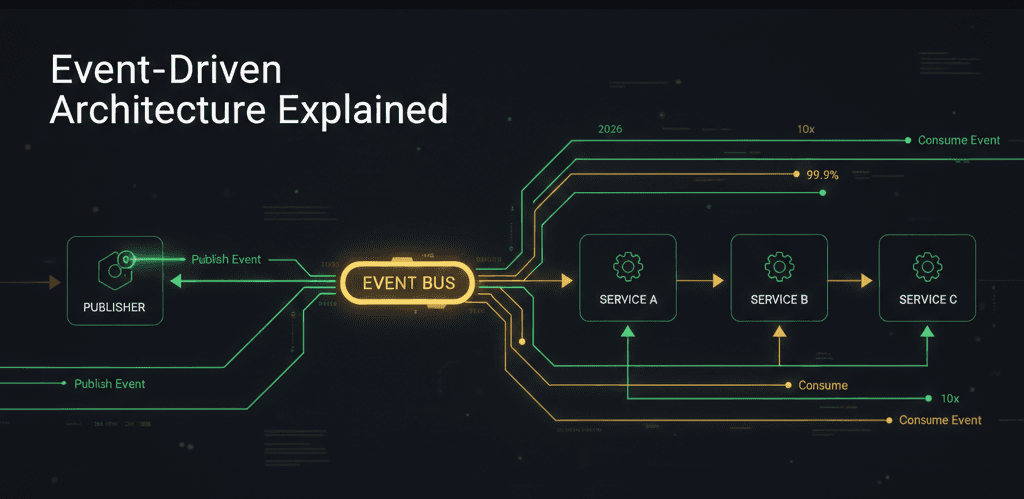
Event-driven architecture is a software design pattern where the flow of the program is determined by events—state changes or messages that signify something has occurred. Unlike traditional request-response systems, where a client asks for data and waits, EDA allows systems to respond asynchronously, decoupling producers and consumers of information.
Core concepts include:
Events: Notifications of state changes (e.g., “OrderPlaced” or “SensorTriggered”).
Producers: Components that generate events.
Consumers: Components that react to events.
Event Bus or Broker: Middleware that routes events from producers to consumers (examples include Apache Kafka, RabbitMQ, and AWS EventBridge).
EDA emerged from the need to handle high-volume, real-time data in distributed environments. Early adoption was common in financial systems, telecommunications, and e-commerce platforms. Over the last decade, it has become a staple in cloud-native applications, IoT, microservices, and AI pipelines.
In my experience, one key advantage of EDA is decoupling. Services no longer need to know the details of each other; they only need to understand the event contracts. This reduces tight coupling, improves maintainability, and accelerates feature development.
Detailed Analysis: How Event-Driven Architecture Works
H3: Types of Event-Driven Architecture
Pub/Sub (Publish-Subscribe) Model
Producers publish events to a channel.
Multiple consumers subscribe to the channel.
Example: A messaging system where chat messages trigger notifications across devices.
Event Streaming
Continuous streams of events are captured and processed.
Example: Real-time analytics for stock trading, where every transaction is an event that feeds predictive models.
Event Sourcing
The system’s state is determined by replaying all events.
Example: In e-commerce, every order, payment, and shipment event reconstructs the user’s account history.
H3: Benefits of Event-Driven Architecture
Scalability
Flexibility and Decoupling
Producers and consumers operate independently, making the system modular.
Teams can deploy services independently without breaking functionality.
Responsiveness
Systems react immediately to changes.
For IoT projects, sensors can trigger alerts and actions instantly without polling.
Auditability and Replayability
Event logs serve as an immutable record of system activity.
Useful for debugging, analytics, or restoring system state after failures.
H3: Challenges and Weaknesses
Complexity
Designing event contracts, handling failures, and managing distributed state adds complexity.
I encountered situations where improper event versioning caused subtle bugs in production.
Event Storming
High-volume event streams can overwhelm consumers or the broker.
Requires careful design of throttling, partitioning, and backpressure mechanisms.
Observability
Debugging asynchronous flows is harder than synchronous request-response.
Logging, tracing, and monitoring become critical for maintaining reliability.
What This Means for You
For developers and architects, EDA offers a strategic advantage if your system needs:
Real-time processing: Notifications, analytics, fraud detection.
Microservices orchestration: Decoupled service communication.
High scalability: Handling bursts in traffic without degrading performance.
Practical tips from my experience:
Start with a small, isolated service using EDA patterns.
Use established brokers like Kafka or RabbitMQ to simplify routing.
Implement monitoring early to track event flow and detect failures.
EDA is particularly beneficial in cloud-native applications where elasticity and asynchronous communication are crucial.
Expert Tips & Recommendations
Design Event Contracts Carefully
Start Small
Monitor and Trace
Handle Failures Gracefully
Document Event Flow
Map producers, consumers, and brokers for clarity.
Use diagrams to visualize complex flows for your team.
Pros & Cons of Event-Driven Architecture
Pros
Cons
Increased design and operational complexity
Harder debugging and tracing
Event storms can overwhelm the system
Requires expertise to implement effectively
Frequently Asked Questions
1. When should I use EDA?
Use it for real-time systems, microservices orchestration, IoT, or applications requiring high scalability.
2. What are common brokers for EDA?
Popular choices include Apache Kafka, RabbitMQ, AWS EventBridge, and Google Pub/Sub.
3. How do I prevent event storms?
Implement throttling, partitioning, and backpressure mechanisms. Use monitoring to detect overload.
4. Is EDA suitable for small applications?
Not always. For low-traffic, simple apps, REST or monolithic architectures are sufficient.
5. How do I debug asynchronous flows?
Use distributed tracing, log aggregation, and visualize event paths to track issues.
6. Can EDA coexist with traditional architectures?
Yes, hybrid approaches often combine EDA for real-time modules with REST for standard CRUD operations.
Conclusion
Event-driven architecture is transforming software design, enabling applications to be responsive, scalable, and resilient. While the paradigm introduces complexity and requires careful planning, the payoff is significant for systems that demand real-time reactions and modularity.
In my experience, organizations that successfully adopt EDA gain faster feature delivery, improved system flexibility, and a robust foundation for future growth. The key is thoughtful implementation: start small, monitor events closely, and leverage established tools and frameworks.
For modern software architects and developers, mastering event-driven architecture is no longer optional—it’s a strategic capability that will define the next generation of adaptive, high-performing systems.