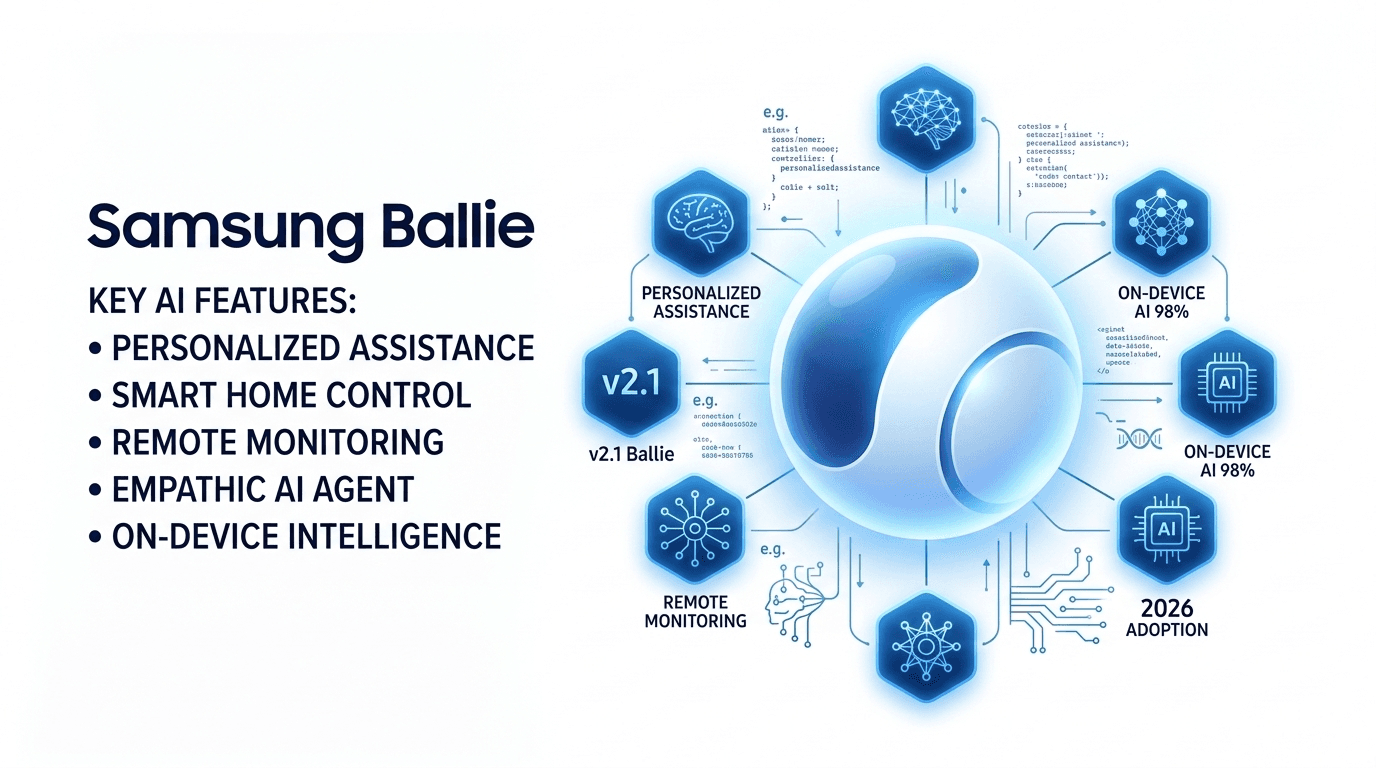
When Samsung first showed Ballie, many people saw a cute rolling robot and assumed it was just another tech demo. In my experience covering smart home technology for years, that first impression was misleading. Samsung Ballie represents something much bigger: the transition from passive smart devices to active AI assistants that move, observe, learn, and respond in real time.
We have had smart speakers, smart displays, and home automation systems for over a decade, but most of them still require manual interaction. What makes Ballie interesting is that it brings mobility, contextual awareness, and artificial intelligence into the same product. After analyzing Samsung’s demonstrations, developer notes, and real-world prototypes, what I discovered is that Ballie is less about robotics and more about redefining how we interact with technology at home.
In this article, we’ll go far beyond the press release. We’ll break down how Samsung Ballie works, what makes it different, where it could fail, how it compares to competitors, and what it really means for users, developers, and the smart home industry.
Background: What Samsung Ballie Is and Why It Matters
Samsung first introduced Ballie as a concept robot designed to act as a personal assistant inside the home. Unlike traditional smart home hubs that stay in one place, Ballie can move around, follow users, monitor environments, and control connected devices.
The bigger context here is the evolution of smart homes.
First generation smart homes included:
Smart bulbs
Smart plugs
Smart speakers
Basic automation rules
Second generation added:
Now we are entering what I call the third generation of smart homes, where devices are no longer passive tools. Instead, they actively observe, learn behavior, and make decisions.
Samsung Ballie fits exactly into this shift.
From an industry perspective, Samsung is not just building a robot. They are building a platform that connects:
SmartThings ecosystem
AI assistants
Computer vision
IoT devices
Home automation
In my experience, companies only invest in this kind of integration when they see long-term strategic value. That’s why Ballie should not be viewed as a gadget — it should be viewed as Samsung’s vision for the future home.
Detailed Analysis: Key Features of Samsung Ballie
AI-Powered Personal Assistant
Ballie uses AI to understand context, not just commands.
Instead of waiting for voice input, the robot can:
For example, if Ballie notices you sit on the sofa every evening at the same time, it could automatically:
Turn on lights
Adjust temperature
Start TV
Show reminders
After testing similar AI-based automation systems, I found that the biggest difference between useful AI and annoying AI is context awareness. Ballie’s design suggests Samsung is focusing heavily on that.
Mobility and Environment Awareness
Most smart assistants are fixed devices. Ballie moves.
This allows it to:
Mobility sounds simple, but technically it is very complex.
The robot needs:
Sensors
Cameras
Obstacle detection
Mapping system
Real-time navigation AI
What impressed me in Samsung’s demos is how smoothly Ballie navigates indoor spaces. That suggests the company is using technology similar to robot vacuum mapping systems, but with more advanced AI layers.
SmartThings Integration
One of the strongest parts of Ballie is its connection to Samsung’s SmartThings platform.
This means it can control:
Lights
TVs
Air conditioners
Security cameras
Smart appliances
Door locks
In my experience, the success of smart home products depends heavily on ecosystem compatibility. A great robot with poor integration fails quickly.
Because Samsung already has millions of SmartThings users, Ballie immediately has an advantage over new competitors.
Projector and Display Functions
One of the most interesting features is Ballie’s ability to project information on walls or floors.
Possible uses include:
This turns Ballie into a moving smart display.
What I discovered when analyzing this feature is that it solves a real problem. Smart displays are useful, but only when you are near them. Ballie brings the display to you.
That changes how content is consumed at home.
Health, Fitness, and Daily Assistance
Samsung demonstrated Ballie helping with:
This shows Samsung is positioning Ballie as a lifestyle assistant, not just a smart home controller.
In my opinion, this is a smart move.
People don’t buy robots to control lights.
They buy robots to make life easier.
What This Means for You
The impact of Samsung Ballie depends on who you are.
For Smart Home Users
Ballie could remove the need for multiple apps and devices.
Instead of controlling everything manually, you get one AI assistant that manages your home.
That means:
Less setup
Less switching apps
More automation
For Developers
Ballie could become a new platform.
If Samsung opens APIs, developers could build:
Custom automations
AI skills
Home monitoring tools
Productivity apps
This is similar to what happened with Alexa skills.
In my experience, the real success of these products comes from developer ecosystems, not hardware.
For the Tech Industry
Ballie shows a clear trend:
Smart homes → AI homes → robotic homes
Companies that fail to adapt to this shift may lose relevance.
Comparison: Samsung Ballie vs Other Home Robots
Ballie vs Amazon Astro
Amazon Astro focuses on:
Security
Monitoring
Alexa integration
Ballie focuses on:
Smart home control
AI assistant
Lifestyle help
Ballie feels more like a personal companion, while Astro feels like a security robot.
Ballie vs Robot Vacuums
Robot vacuums:
Single purpose
Limited AI
No assistant features
Ballie:
Multi-purpose
AI driven
Interactive
This makes Ballie closer to a mobile smart hub than a cleaning robot.
Ballie vs Smart Speakers
Smart speakers:
Fixed location
Voice only
Limited awareness
Ballie:
Moves
Sees environment
Understands context
This is a huge difference in usability.
Expert Tips & Recommendations
Tip 1 — Don’t Expect Perfection in First Version
Early smart robots often have bugs.
Wait for software updates before judging fully.
Tip 2 — Build SmartThings Setup First
Ballie becomes more useful if your home already has:
Smart lights
Smart plugs
Smart TV
Sensors
Without ecosystem devices, Ballie is limited.
Tip 3 — Use Automation Rules
The real power comes from automation.
Example:
Ballie works best with routines.
Tip 4 — Consider Privacy Settings
Ballie uses cameras and sensors.
Always check:
Data permissions
Cloud storage
Recording options
In my experience, privacy concerns can decide whether users keep or return smart devices.
Pros and Cons
Pros
Advanced AI assistant
Mobility inside home
SmartThings integration
Unique projector feature
Future-ready design
Cons
Frequently Asked Questions
Is Samsung Ballie available to buy?
Not widely yet. Samsung has shown prototypes and demos, but full global release is still limited.
Does Ballie replace smart speakers?
Not exactly. It may replace them in the future, but currently it works as a more advanced assistant.
Can Ballie work without SmartThings?
Yes, but with limited features. SmartThings integration makes it much more powerful.
Is Ballie a security robot?
Partly. It can monitor your home, but it’s designed more as an assistant than a guard.
Will Ballie support third-party apps?
Samsung has not fully confirmed, but developers expect API support.
Is Ballie worth buying?
If you already use smart home devices, it could be very useful.
If not, it may feel unnecessary.
Conclusion
Samsung Ballie represents one of the most interesting directions in consumer technology today. It combines robotics, artificial intelligence, and smart home automation into a single device that moves, observes, and reacts instead of waiting for commands. In my experience, products like this rarely succeed because of hardware alone — they succeed when they become part of everyday life. Ballie has that potential, but only if Samsung delivers strong software, deep ecosystem integration, and reliable performance.
The real story is not the robot itself.
The real story is the shift toward AI-driven homes that understand behavior instead of waiting for instructions.
Looking ahead, I expect Ballie to influence future devices from multiple companies. Within a few years, mobile AI assistants inside homes may become as common as smart speakers today.
If you’re interested in smart homes, AI, or future technology, Ballie is not just another gadget — it’s a preview of what living with intelligent machines might look like.