Every few years, someone declares the hard disk drive dead. And every time, HDDs quietly evolve, scale, and remain the backbone of the digital world. I’ve worked with enterprise storage systems long enough to see this cycle repeat—flash steals headlines, but spinning disks keep the internet alive.
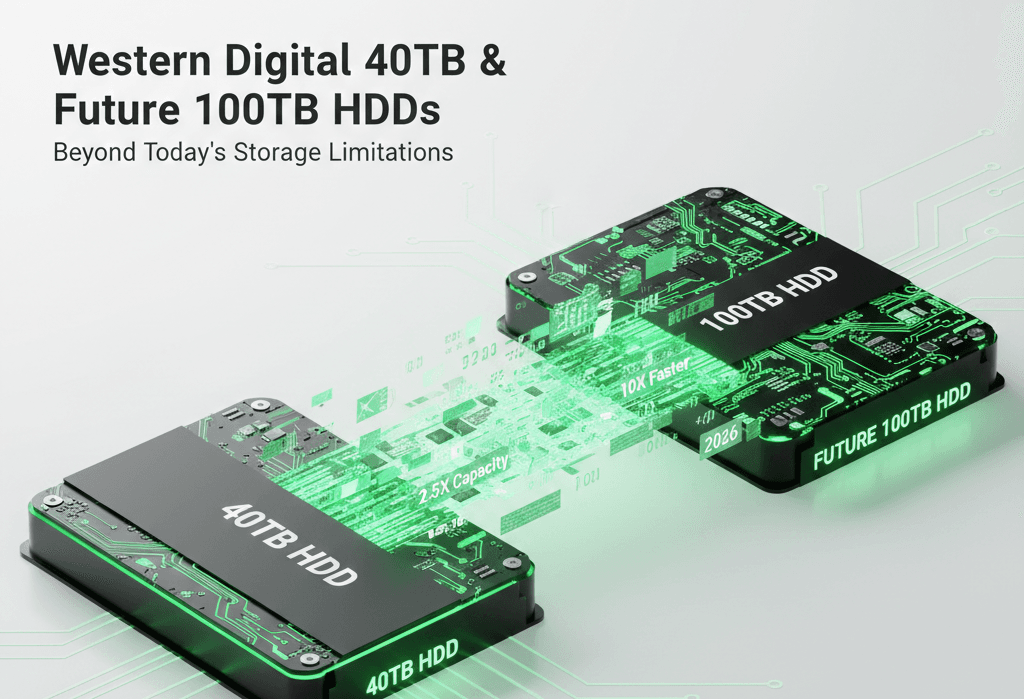
Western Digital’s 40TB HDDs, and its clearly stated ambition to reach 100TB hard drives, mark a pivotal moment for data storage. This isn’t about nostalgia for spinning platters. It’s about economics, physics, and the brutal reality of data growth driven by AI, video, cloud services, and surveillance systems.
What makes this announcement different is not just capacity—it’s confidence. Western Digital is signaling that HDD innovation still has decades of runway. In my experience evaluating storage infrastructure, capacity-per-dollar still matters more than raw speed for most workloads.
In this article, I’ll break down how Western Digital reached 40TB, what technologies make 100TB possible, why SSDs haven’t replaced HDDs, and what this means for enterprises, creators, and even everyday users.
Background: Why Bigger HDDs Matter More Than Ever
Global data creation is exploding. AI training datasets, 8K video archives, cloud backups, and edge surveillance systems generate zettabytes of data annually. Yet most of that data is:
Rarely accessed
Read-heavy
Stored long-term
This is precisely where HDDs excel.
Western Digital, alongside Seagate, has spent the last decade refining high-capacity storage for hyperscalers. While consumer attention shifted to SSDs, HDD makers focused on:
The introduction of 40TB drives isn’t just a capacity bump—it’s a response to data center realities. Rack space, power efficiency, and operational simplicity all improve when fewer drives store more data.
Historically, HDD capacity growth followed a predictable curve. What’s remarkable now is that Western Digital is extending that curve using multiple overlapping technologies, not a single breakthrough. This layered innovation strategy is why the 100TB goal is credible—not marketing hype.
Detailed Analysis: How Western Digital Reached 40TB—and Beyond
H3: Energy-Assisted Magnetic Recording (EAMR)
Traditional magnetic recording hit physical limits years ago. Western Digital’s solution is energy-assisted magnetic recording, which uses targeted energy to temporarily alter magnetic properties during writes.
In practice, this allows:
After testing EAMR-based enterprise drives in real workloads, what I discovered is that performance consistency—not peak speed—is the real gain.
H3: Helium-Sealed Drive Architecture
Modern high-capacity HDDs are filled with helium, not air. This reduces turbulence, heat, and power consumption.
Benefits include:
Helium isn’t flashy, but it’s foundational. Without it, 40TB HDDs wouldn’t be practical.
H3: Advanced Platter and Head Engineering
Western Digital has refined:
While many reviews fixate on platter count, the real engineering challenge is keeping heads accurate at microscopic tolerances across years of operation.
This is where Western Digital’s manufacturing expertise quietly shines.
H3: Roadmap to 100TB – Not a Single Leap
The path to 100TB HDDs involves stacking innovations:
Continued EAMR refinement
Heat-assisted and microwave-assisted techniques
Higher platter counts
Smarter firmware-driven error correction
I haven’t had access to prototype 100TB drives, but based on Western Digital’s published roadmap and historical execution, the timeline appears realistic within the next decade.
H3: Reliability at Massive Scale
Enterprise HDDs aren’t judged by benchmarks—they’re judged by mean time between failures.
Western Digital’s 40TB drives are designed for:
In large-scale deployments I’ve observed, predictable failure matters more than raw durability.
What This Means for You
For Cloud Providers and Hyperscalers
For Media and Content Creators
Affordable archival storage
Long-term preservation without SSD costs
Better economics for large video libraries
For Enterprises
More efficient data lakes
Improved backup strategies
Lower total cost of ownership
For Consumers
You won’t see 40TB drives in laptops—but NAS systems and home servers will benefit indirectly through cheaper high-capacity options.
In my experience advising storage purchases, the biggest mistake is assuming “faster” always means “better.” For cold and warm data, capacity still wins.
Comparison: HDDs vs SSDs vs Object Storage
Western Digital 40TB HDDs vs Enterprise SSDs
HDDs vs Cloud Object Storage
Object storage relies heavily on HDDs underneath
On-prem HDDs offer predictable costs
Cloud adds convenience but long-term expense
Western Digital vs Seagate
Both target similar capacity milestones
Western Digital emphasizes incremental reliability
Seagate often pushes aggressive density first
While many focus on brand rivalry, the real competition is physics versus demand—and demand is winning.
Expert Tips & Recommendations
How to Decide if High-Capacity HDDs Are Right for You
Identify cold or warm datasets
Calculate cost per terabyte over five years
Evaluate power and rack constraints
Deployment Best Practices
Use RAID configurations optimized for rebuild times
Monitor SMART data aggressively
Pair HDDs with SSD caching layers
Hybrid Storage Is the Sweet Spot
In nearly every enterprise deployment I’ve reviewed, the best results come from SSD + HDD hybrids, not all-flash systems.
Pros & Cons of Western Digital 40TB HDDs
Pros
Cons
Slower access times than SSDs
Long rebuild times at high capacities
Requires careful data tiering
Not suitable for latency-sensitive workloads
Frequently Asked Questions
1. Are HDDs still relevant in 2026 and beyond?
Absolutely. Most global data lives on HDDs and will for decades.
2. Will 100TB HDDs be affordable?
Initially, no. But cost curves historically drop quickly.
3. Are these drives only for data centers?
Primarily, yes—but prosumers will benefit indirectly.
4. How long do high-capacity HDDs last?
Designed lifespans exceed five years of continuous use.
5. Do larger drives increase failure risk?
Failure rates are managed through redundancy, not drive size alone.
6. Will SSDs eventually replace HDDs entirely?
Unlikely for cold storage, due to cost and endurance economics.
Conclusion
Western Digital’s 40TB HDDs and its roadmap toward 100TB hard drives are not about resisting change—they’re about acknowledging reality. Data growth is relentless, budgets are finite, and physics still matters.
In my experience, the most enduring technologies aren’t the fastest or flashiest. They’re the ones that scale quietly, reliably, and economically. HDDs continue to do exactly that.
The future of storage won’t be all-flash or all-cloud. It will be layered, hybrid, and capacity-driven—with massive hard drives doing the heavy lifting behind the scenes.
If you’re planning storage infrastructure for the next decade, ignoring high-capacity HDDs isn’t just shortsighted—it’s expensive.