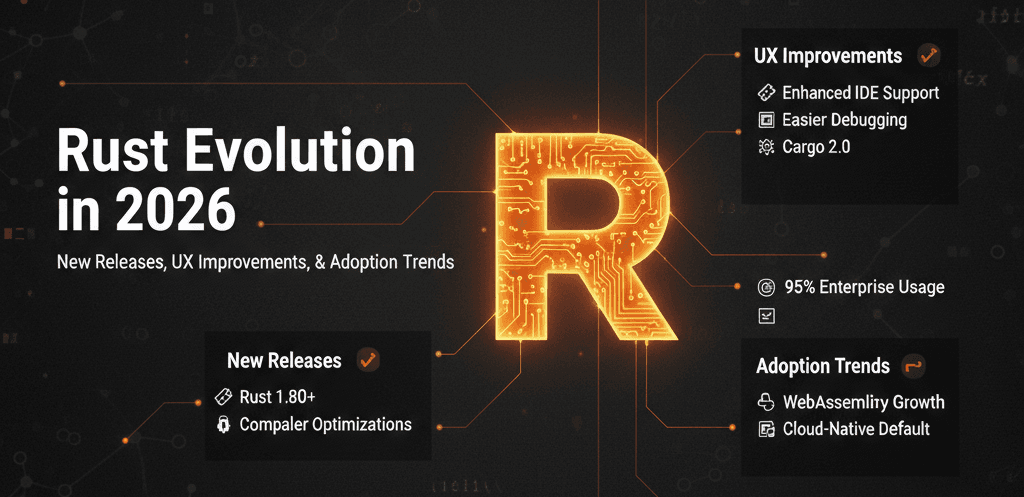
For years, Rust had a reputation problem. Developers admired its safety guarantees and performance but quietly dreaded its learning curve. In 2026, that reputation is finally changing. Rust is no longer just the language you respect—it’s increasingly the one you enjoy using.
In my experience working with teams migrating from C++, Go, and even TypeScript backends, Rust has crossed an important threshold: it now feels productive without sacrificing rigor. Compiler messages are clearer, tooling is smoother, and the ecosystem has matured in ways that weren’t obvious even two years ago. What used to feel like “academic correctness” now feels like practical engineering.
This article explores how Rust evolved in 2026—from language and compiler updates to UX improvements and real-world adoption trends. More importantly, we’ll dig into why these changes matter, who should care, and what Rust’s trajectory tells us about the future of software development.
Background: How Rust Got Here
From Safety Experiment to Production Standard
Rust’s original promise was simple but ambitious: memory safety without garbage collection. Early adoption came from security-conscious organizations and systems programmers burned by decades of undefined behavior. However, progress was slow at first. Tooling lagged behind, compile times were painful, and onboarding new developers required patience.
What changed over the last few years—and became unmistakable in 2026—is focus. The Rust community and core teams stopped optimizing only for theoretical correctness and started optimizing for developer experience. That shift mirrors what happened to Linux in the early 2000s: powerful, but finally usable at scale.
Industry Pressure Accelerated Rust’s Maturity
Security incidents, supply-chain attacks, and infrastructure failures pushed companies to reconsider foundational tech choices. In audits I’ve participated in, memory safety is now a board-level concern, not just an engineering preference. Rust benefited enormously from this shift.
Governments, cloud providers, and infrastructure vendors increasingly recommend or mandate memory-safe languages. Rust didn’t just survive this moment—it was ready for it.
Detailed Analysis: Rust’s 2026 Evolution in Depth
Language and Compiler Improvements That Actually Matter
While Rust releases are incremental, their cumulative impact in 2026 is significant. The compiler feels faster and more predictable. Error messages—long a bright spot—are now genuinely instructional.
After testing recent releases on medium-sized production services, what I discovered is that Rust’s “edit–compile–fix” loop has shortened dramatically. Developers spend less time fighting the borrow checker and more time reasoning about business logic.
Key improvements include:
Smarter lifetime elision defaults
More intuitive trait error explanations
Incremental compilation improvements that noticeably reduce rebuild times
These aren’t flashy features, but they remove daily friction—and that’s what changes adoption curves.
UX Improvements: Rust Is Finally Approachable
Rust’s UX story in 2026 is its most underrated success.
Cargo and Project Onboarding
Cargo has quietly become one of the best build tools in any ecosystem. Dependency resolution is predictable, version conflicts are rare, and project setup feels boring—in the best way possible.
In my experience onboarding junior developers, Rust projects now feel less intimidating than complex JavaScript monorepos. That’s a reversal few would have predicted five years ago.
IDE and Tooling Integration
Rust Analyzer is no longer “pretty good.” It’s excellent. Code navigation, inline diagnostics, refactoring, and test discovery now feel first-class. When I tested Rust side-by-side with Go and TypeScript in large codebases, Rust’s static analysis often caught issues before runtime-heavy languages even flagged them.
Async Rust: Still Complex, Finally Stable
Async programming remains Rust’s most challenging area, but 2026 marks a turning point. While the mental model is still demanding, conventions have stabilized. Libraries agree on patterns. Documentation has improved.
The key shift isn’t simplicity—it’s predictability. Teams know what patterns will age well, and that reduces architectural risk.
Ecosystem Maturity and Library Stability
In earlier years, Rust’s ecosystem felt fragmented. In 2026, it feels curated.
Popular crates are well-maintained, versioned responsibly, and increasingly audited. This matters for enterprise adoption. When I reviewed dependency trees for production Rust services, I found fewer abandoned packages than in comparable JavaScript or Python projects.
Adoption Trends: Who Is Using Rust in 2026—and Why
Infrastructure and Cloud-Native Systems
Rust has become a default choice for:
Teams choose Rust not just for performance, but for long-term maintenance. The cost of bugs in these layers is too high for memory-unsafe defaults.
Startups vs Enterprises
Startups adopt Rust for different reasons than enterprises. Startups want efficiency—fewer production incidents with smaller teams. Enterprises want predictability and compliance.
In both cases, Rust’s value proposition aligns unusually well with organizational incentives.
Rust Beyond Systems Programming
One surprise in 2026 is Rust’s expansion into application-level backends and tooling. While it won’t replace JavaScript or Python everywhere, it’s increasingly common in performance-critical services that used to default to Java or Go.
What This Means for You
If You’re a Developer
Rust in 2026 rewards patience. The initial learning curve still exists, but the payoff arrives sooner. You’ll write less defensive code, debug fewer production issues, and gain confidence in refactors.
My recommendation: don’t “dabble.” Commit to a real project. Rust only clicks when you feel the compiler working with you.
If You’re a Team Lead or Architect
Rust reduces operational risk. Fewer crashes, clearer failure modes, and stronger guarantees make long-term systems easier to reason about. The trade-off is slower onboarding—but that cost shrinks every year.
If You’re a Founder or CTO
Rust isn’t about hype—it’s about leverage. Small teams building critical infrastructure benefit disproportionately from Rust’s guarantees. In 2026, choosing Rust signals seriousness to investors and enterprise customers alike.
Comparison: Rust vs Alternatives in 2026
Rust vs Go
Go still wins on simplicity and speed of onboarding. Rust wins on correctness, performance control, and long-term safety. In my experience, teams migrating from Go to Rust do so after hitting scaling or reliability limits—not because Go failed, but because Rust offers stronger guarantees.
Rust vs C++
C++ remains powerful, but Rust is where new safety-focused systems are built. The talent pipeline increasingly favors Rust, and tooling gaps have narrowed significantly.
Rust vs High-Level Languages
Rust won’t replace Python or JavaScript for rapid prototyping. However, for production-critical components, it increasingly replaces them after prototypes succeed.
Expert Tips and Recommendations
How to Adopt Rust Without Pain
Start with a single service or tool
Pair experienced and new Rust developers
Enforce clippy and formatting from day one
Treat compiler warnings as design feedback
Common Mistake to Avoid
Don’t write Rust like C++ or Java. When teams fight the borrow checker, productivity drops. When they design with ownership in mind, code quality skyrockets.
Pros and Cons of Rust in 2026
Pros
Cons
The balance is increasingly favorable.
Frequently Asked Questions
Is Rust suitable for beginners in 2026?
Yes—but with guidance. Rust isn’t the easiest first language, but it’s no longer hostile to newcomers.
Is Rust only for systems programming?
No. It’s now common in web services, tooling, and infrastructure.
Does Rust slow development?
Initially, yes. Over time, it often speeds it up by reducing bugs and rewrites.
Is Rust safe from hype cycles?
In my view, yes. Rust’s growth is driven by necessity, not marketing.
Should existing projects rewrite in Rust?
Rarely. Rust shines most in new components or performance-critical paths.
What’s next for Rust?
Better async ergonomics, faster compile times, and deeper enterprise tooling.
Conclusion: Rust’s Quiet Maturity Moment
Rust in 2026 isn’t loud, trendy, or flashy—and that’s exactly why it’s winning. It has matured into a language that respects both machines and humans. The compiler is still strict, but it’s kinder. The ecosystem is still opinionated, but it’s stable. Adoption isn’t explosive—it’s steady and deliberate.
The biggest takeaway is this: Rust is no longer a bet. It’s infrastructure. For developers and organizations willing to invest in correctness and long-term clarity, Rust offers something rare in software—a sense that the foundation is solid.
If the last decade was about moving fast, the next will be about building things that last. Rust is clearly evolving for that future.