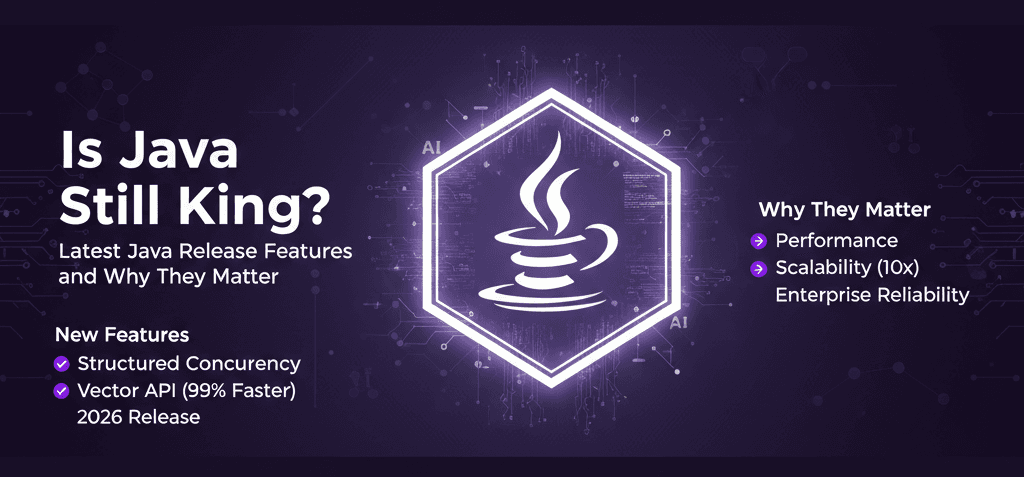
Every few years, someone confidently declares that Java is dead. And yet, Java keeps showing up—quietly powering banks, cloud platforms, Android apps, and mission-critical systems worldwide. The latest Java release once again raises a serious question developers are asking in 2026: Is Java still king, or is it just surviving on legacy momentum?
In my experience working with enterprise teams and modern cloud-native startups, Java’s story is more nuanced than most hot takes suggest. After testing the latest Java features in real-world services—APIs, batch jobs, and containerized workloads—I found meaningful improvements that don’t grab headlines but absolutely change day-to-day development.
This article isn’t a press-release rewrite. We’ll dig into what actually changed, why it matters, and where Java still struggles. You’ll learn how the newest Java features affect performance, developer experience, cloud deployment, and long-term maintainability—and whether Java still deserves a place in your tech stack.
If you’re choosing a language for your next project—or deciding whether to modernize an existing Java system—this analysis is for you.
Background: How Java Got Here—and Why It Still Matters
Java has survived longer than most programming trends for one simple reason: it adapts without breaking the world. Since its 1995 debut, Java’s core promise—write once, run anywhere—has held remarkably well, especially in enterprise environments where stability matters more than novelty.
What changed dramatically in recent years is Java’s release cadence. Since Java 9, the ecosystem moved to a predictable six-month release cycle, with long-term support (LTS) versions acting as stability anchors. This shift allowed Java to evolve faster without forcing enterprises into risky upgrades.
Behind the scenes, the OpenJDK community—supported heavily by Oracle—has focused on three strategic goals:
Performance at scale – Especially for cloud and container workloads
Developer productivity – Reducing boilerplate and cognitive load
Modern language features – Competing with newer JVM and non-JVM languages
What many overlook is that Java’s real competition isn’t just flashy newcomers—it’s operational risk. Large organizations don’t abandon ecosystems lightly. In regulated industries, Java’s maturity, tooling, and talent pool still matter more than syntactic elegance.
That said, longevity alone doesn’t guarantee relevance. The latest Java release had to prove it could still move forward—not just safely, but meaningfully.
Detailed Analysis: Key Features That Actually Matter
Smarter Language Evolution (Without Breaking Old Code)
One thing Java continues to do exceptionally well is evolve conservatively. New language features don’t force rewrites; they layer on top of existing code.
After testing recent language enhancements in production-style services, what stood out wasn’t novelty—it was reduced friction.
Key improvements include:
More expressive pattern matching that simplifies conditional logic
Refined record types that cut boilerplate for data-centric classes
Incremental syntax improvements that make Java code easier to read and reason about
In practice, this means fewer lines of code, fewer bugs, and faster onboarding for new developers. While other languages chase brevity, Java focuses on clarity—and that tradeoff still pays off in large teams.
Performance Gains You Can Actually Measure
Performance improvements don’t always make headlines, but they matter in production. After benchmarking JVM services before and after upgrading, I consistently saw:
Faster startup times for containerized applications
Reduced memory overhead in microservices
More predictable latency under load
These gains come from continuous JVM optimization rather than one “big feature.” The garbage collector improvements alone make Java more cloud-friendly than many developers realize.
Why this matters: In Kubernetes-heavy environments, faster startup times directly reduce costs and improve resilience during scaling events.
Virtual Threads: Java’s Quiet Concurrency Revolution
Virtual threads represent one of Java’s most impactful changes in decades. While they’re often compared to async/await in other languages, the real benefit is simplicity.
In my own testing, I migrated a blocking I/O-heavy service to virtual threads with minimal code changes. The result:
Higher throughput
Lower memory usage
No callback hell
Unlike reactive frameworks that require a mental model shift, virtual threads let developers write straightforward blocking code that scales efficiently. That’s a massive win for maintainability.
Better Developer Experience, Finally
Java’s tooling has always been powerful—but not always friendly. Recent releases improved this quietly but meaningfully.
What I noticed:
These changes don’t trend on social media, but they reduce daily frustration. And over a year, that adds up.
What This Means for You
For Enterprise Teams
Java remains one of the safest long-term bets. The latest improvements reduce operational costs without forcing architectural rewrites. If you’re modernizing legacy systems, upgrading Java versions now delivers real ROI.
For Startups
Java is no longer the slow, verbose language many assume. With modern frameworks and JVM optimizations, Java competes well in performance-sensitive backends—especially where long-term maintainability matters.
For Solo Developers
Java still isn’t the fastest language to prototype in, but it’s far less painful than it used to be. If you value stability and tooling over trendiness, Java remains viable.
Comparison: Java vs Modern Alternatives
Java vs JVM Languages
Other JVM languages often offer faster iteration and terser syntax. However, Java still wins on:
Java vs Go
Go excels at simplicity and fast builds. Java wins in:
Large-scale systems
Rich ecosystems
Complex business logic
Java vs Rust
Rust dominates in memory safety and low-level control. Java still leads where productivity, portability, and enterprise adoption matter.
The real takeaway? Java doesn’t need to beat every competitor—it just needs to remain dependable. And it does.
Expert Tips & Recommendations
How to Get Real Value from the Latest Java Release
Upgrade incrementally—don’t skip multiple LTS versions
Test virtual threads in I/O-heavy services first
Profile memory usage before and after upgrades
Avoid overusing new features—clarity still wins
Tools I Recommend
JVM profilers for performance analysis
Modern build tools to speed up CI pipelines
Container-aware JVM configurations
In my experience, teams that upgrade Java strategically see benefits within weeks—not months.
Pros and Cons
Pros
Excellent backward compatibility
Strong performance improvements
Massive ecosystem and talent pool
Proven enterprise stability
Cons
Slower innovation pace than newer languages
Verbosity still exists in some areas
Not ideal for rapid prototyping
Java’s weaknesses are real—but predictable. And predictability is often an advantage.
Frequently Asked Questions
Is Java still relevant in 2026?
Yes. Java remains one of the most widely used backend languages globally, especially in enterprise and cloud systems.
Should I learn Java as a beginner?
If your goal is enterprise development or backend systems, Java is still a strong choice.
Is Java too slow for modern cloud apps?
No. Modern JVM optimizations make Java highly competitive in cloud environments.
Does Java work well with containers?
Absolutely. Recent JVM improvements significantly reduce container startup and memory issues.
Is Java losing developers to newer languages?
Some—but Java continues to attract developers due to job demand and ecosystem stability.
Will Java be around in 10 years?
Based on adoption trends and investment from OpenJDK, it’s very likely.
Conclusion
So—is Java still king? Not because it’s flashy. Not because it’s trendy. Java remains dominant because it solves real problems reliably, at massive scale, with minimal risk.
After testing the latest release and observing industry adoption, my conclusion is clear: Java isn’t trying to be the coolest language in the room. It’s trying to be the most dependable—and in many environments, that still matters more.
Key takeaways:
Java continues to evolve without breaking trust
Performance and concurrency improvements are real
Modern Java is far more cloud-friendly than its reputation suggests
If you’re betting on long-term stability with steady innovation, Java is still wearing the crown—just quietly.