There’s a quiet revolution underway in software quality assurance (QA). Traditional test automation — once dominated by scripted Selenium tests and manually maintained suites — is quickly giving way to AI‑powered testing frameworks that promise smarter automation, predictive defect detection, and dramatically improved efficiency. For developers, QA engineers, and engineering leaders alike, this shift is more than evolutionary: it’s transformational.
In my experience covering QA trends since the early 2010s, the rise of generative AI and machine learning has shifted testing from a reactive task to a proactive discipline. What I discovered while researching current tools and workflows is that leading teams are now using intelligent systems not only to generate and execute tests but to predict where bugs are likely to occur, heal fragile scripts automatically, and reduce manual upkeep by orders of magnitude. This article goes beyond vendor hype to explain why AI‑powered testing matters, how real organizations are implementing it, and what actionable guidance you need to take advantage of these innovations in your projects.
Background/What Happened
From Scripted Tests to Smart Test Suites
Traditionally, QA automation was about scripting expected behaviors and executing them repeatedly. Teams wrote Selenium, Playwright, or Cypress scripts, often maintaining extensive test suites by hand. These suites were brittle: as applications evolved, locators changed, APIs shifted, and tests broke. Maintenance became a full‑time job.
The introduction of machine learning and generative AI into QA tools marked a turning point. Modern frameworks now use AI not just to run tests, but to understand application behavior, adapt to changes, and even suggest new test cases based on patterns, user stories, and historical defects. In fact, industry research shows that AI adoption for test creation and maintenance now exceeds 70 % among organizations embracing automated QA tooling, driven by nearly universal integration of AI workflows across pipelines.
These tools are emerging in conjunction with broader trends like hyperautomation, which integrates AI, robotic process automation (RPA), and advanced orchestration to create end‑to‑end QA pipelines that require minimal manual intervention.
Detailed Analysis/Key Features
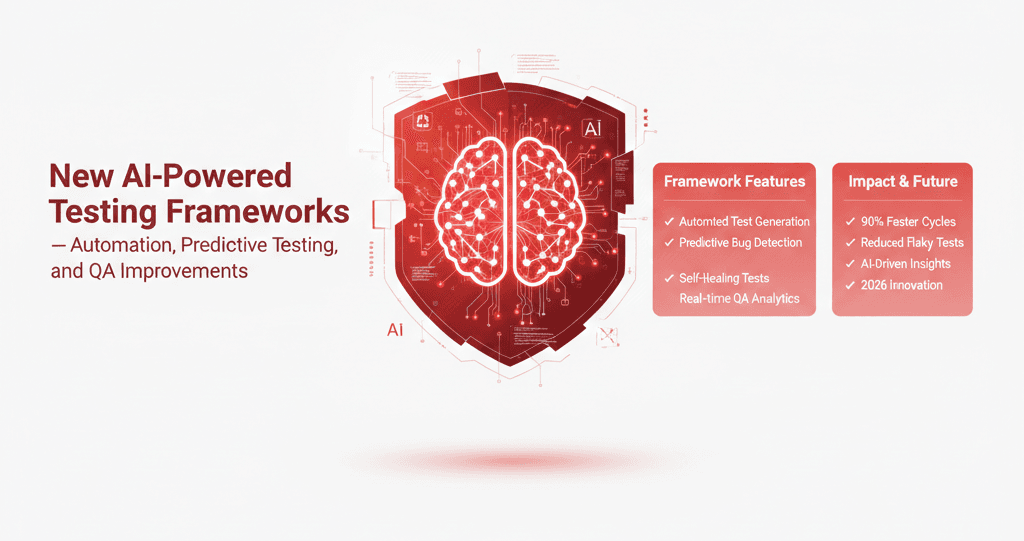
The next generation of AI‑powered testing frameworks brings several powerful capabilities that go well beyond conventional automation:
1. Predictive Testing and Risk Prioritization
AI doesn’t just execute tests — it can predict where bugs are most likely to surface. Modern engines analyze past bug histories, change logs, and code patterns to rank risk areas and recommend which tests should run first or which new tests are necessary. Tools with predictive analytics help QA teams focus on the most impactful paths, delivering faster feedback loops with fewer resources.
This kind of predictive defect analysis reduces wasted effort on low‑value tests and ensures critical vulnerabilities are caught earlier in the development cycle.
2. Generative Test Case Creation
Generative AI models can now inspect requirements documents, user stories, API specifications, and existing code to automatically generate complete test cases — including setup, assertions, and data parameters. Tools like Microsoft’s testing copilot or specialized assistants like Windsurf AI IDE illustrate this trend, turning plain text descriptions into runnable tests.
In practice, this means testers and developers spend less time scripting trivial flows and more time validating complex behaviors.
3. Self‑Healing and Maintenance‑Free Tests
One of the most painful aspects of automation has always been test maintenance: UI changes, renaming selectors, or rearchitected APIs often break entire suites. AI‑powered frameworks now use context‑aware models to self‑heal scripts, adapting to changes in the application by detecting patterns and adjusting assertions automatically.
For example, if a button’s identifier changes, AI tools may use semantic inference to identify the button’s new locator based on context — all without manual intervention, boosting test reliability significantly.
4. Natural Language Interfaces
Thanks to natural language processing (NLP), testers can now describe scenarios in plain English and have tools convert them into executable tests. This lowers the barrier to automation for business analysts, product owners, and non‑technical team members, democratizing QA workflows.
Rather than writing complex code, teams can express expected behavior in everyday language — a huge shift toward inclusive testing.
5. Integration With CI/CD and Hyperautomation
AI testing isn’t an isolated activity. Modern frameworks plug into continuous integration/continuous deployment (CI/CD) pipelines to trigger smart test execution, prioritize runs based on code changes, and feed results back into development workflows. This QAOps approach embeds testing deeply into delivery pipelines, ensuring quality is not an afterthought but an ongoing part of development.
What This Means for You
For QA Engineers
AI‑powered testing frameworks are a game‑changer, particularly for teams struggling with maintenance overhead and flaky tests. What I’ve observed across QA organizations is that those adopting AI early can reallocate effort from “keeping tests alive” to creating smarter, more strategic validations. Rather than fixing broken locators, a QA engineer can focus on designing scenarios that require human judgment — edge cases, integration behaviors, and workflow validations.
Additionally, predictive prioritization means tests most likely to catch defects get executed early, which shortens feedback loops and improves release confidence.
For Developers
Developers benefit from higher test coverage with less manual scripting. AI can suggest test scaffolding directly from code changes or commit messages, helping ensure that every new feature has associated QA without creating a large manual backlog. This creates a culture where quality isn’t pushed until later cycles — shift‑left QA becomes real, not aspirational.
For Product Managers and Stakeholders
AI testing frameworks make quality metrics more actionable. Predictive scores, risk ranking, and coverage analytics help product teams make decisions backed by data rather than gut instinct. Rather than debating whether a release is “ready,” teams have concrete confidence scores tied to risk models and test results.
Comparison/Alternatives
Traditional testing frameworks like Selenium, Cypress, and Playwright remain staples for many development teams because of their flexibility and mature ecosystems. However, these tools by themselves rely on scripted test definitions and handlers that must be maintained manually.
AI‑powered alternatives or enhancements build on top of these classic engines to deliver:
In contrast, pure traditional frameworks require more human oversight and fail to offer predictive or adaptive capabilities. AI frameworks don’t replace foundational tools entirely, but they augment them with intelligence that aligns automation with real business risk and delivery velocity.
For scenarios where predictability and deep control remain paramount — such as highly regulated systems — traditional approaches may still be preferred. But for fast‑moving agile environments, AI‑enhanced testing is rapidly becoming the new default.
Expert Tips & Recommendations
Whether you’re just exploring AI testing frameworks or planning an enterprise rollout, here’s how to get the most from these innovations:
1. Start With Clear Quality Goals
Define what success means for your testing: speed of feedback, reduction in manual maintenance, improved risk coverage, or predictive insights. Clear objectives help you choose the right tools and measure ROI.
2. Combine AI With CI/CD Early
Integrate AI test generation and execution into your existing pipelines. Automating test selection based on code changes or risk scores ensures quality gates are meaningful without overwhelming your infrastructure.
3. Use Hybrid Frameworks
Rather than abandoning traditional tools, augment them. For example, use Playwright or Selenium as a base engine while layering AI for self‑healing, predictive insights, and generation. This leverages the best of both worlds.
4. Build Feedback Loops
Use production telemetry and bug histories as training data for predictive models. The more historical data you feed into AI tools, the better their prioritization and predictive capability.
5. Train Your Team
AI doesn’t eliminate expertise — it shifts it. Invest in training so QA engineers understand when to trust AI outputs and when human judgment is necessary.
Pros & Cons of AI‑Powered Testing
Pros
Reduced maintenance overhead: Self‑healing and generative tests cut time spent fixing scripts.
Predictive insights: AI prioritizes tests, improving coverage where it matters most.
Lower barrier to entry: Natural language and low‑code test creation widen participation.
Broader coverage: AI can generate diverse test cases beyond what manual scripting anticipates.
Cons
Complexity and infrastructure: Integrating AI into pipelines adds overhead and requires orchestration expertise.
Data quality dependency: Predictive models rely on high‑quality historical data. Poor data leads to misleading recommendations.
Cost and tooling lock‑in: Advanced AI tools often come with subscription pricing and potential vendor lock‑in.
Human oversight required: AI can produce false positives or miss nuanced business logic without careful validation.
Frequently Asked Questions
1. Are AI testing frameworks ready for production?
Yes — many organizations now use AI‑powered testing in production, especially where automation has matured. However, hybrid approaches that combine AI with traditional scripts remain common.
2. Do these tools replace QA engineers?
No. AI reduces repetitive work but still requires human oversight for edge cases, complex logic, and strategic planning.
3. How much can AI reduce test maintenance?
Self‑healing scripts and AI‑generated test cases can cut maintenance effort by 40 % or more, depending on the application and tool maturity.
4. Are AI‑generated tests reliable?
They’re improving rapidly — especially when trained on historical data. Best results come from tools that iteratively learn and refine test strategies over time, particularly those using multi‑agent or reinforcement frameworks.
5. Do AI testing tools integrate with CI/CD?
Yes. Most modern tools plug into CI/CD, enabling automated test execution, coverage analytics, and prioritized runs based on risk.
6. Can non‑technical users write tests?
Thanks to NLP and low‑code interfaces, yes — business analysts and product managers can describe tests in plain language.
Conclusion
AI‑powered testing frameworks are no longer just a futuristic concept — they’re reshaping the day‑to‑day work of QA engineers, developers, and product teams alike. What started as simple script automation has evolved into intelligent, predictive, and adaptive QA ecosystems capable of generating, prioritizing, and maintaining tests with far less human intervention.
Key takeaways:
AI testing frameworks boost coverage, speed, and reliability.
Predictive and generative capabilities change the role of QA from executor to strategist.
Hybrid approaches combining AI with traditional tools strike the best balance.
Adoption still requires careful planning, data quality management, and human oversight.
Looking ahead, predictive analytics, multi‑agent testing systems, and deeper integration with delivery pipelines will continue to propel QA forward — making quality a true driver of business velocity and not a bottleneck in software delivery.