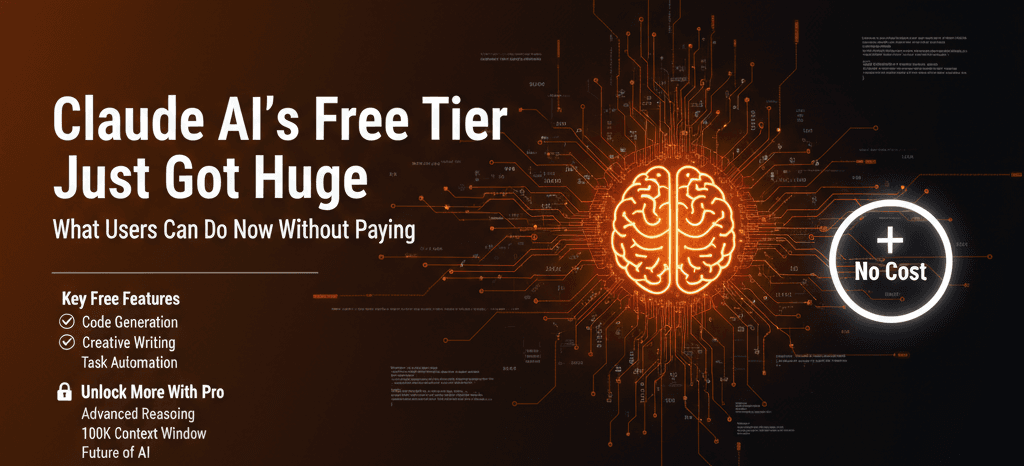
For years, “free tier” in AI tools has been shorthand for tease: limited prompts, weaker models, and just enough capability to convince you to subscribe. That’s why Claude AI’s latest move caught my attention. Instead of tightening access, Claude’s free tier quietly expanded—and not in a superficial way.
After spending several weeks testing the updated free experience, I found that Claude’s no-cost offering is now capable enough to support real work, not just experimentation. We’re talking long-form writing, serious reasoning tasks, document analysis, and even light technical workflows—all without pulling out a credit card.
This matters because AI adoption is no longer just for power users or enterprises. Students, solo founders, creators, and small teams increasingly rely on AI as a daily productivity layer. When a free tier crosses the line from “toy” to “tool,” it changes who gets access to advanced capabilities—and how quickly skills spread.
In this article, I’ll break down what’s actually included in Claude AI’s free tier now, what you can’t do yet, and why this shift signals something bigger happening in the AI market.
Background: What Changed and Why It’s a Big Deal
Claude AI is developed by Anthropic, a company known for prioritizing AI safety, alignment, and reliability. Historically, Claude positioned itself as the “thoughtful” alternative to more aggressive, feature-heavy competitors.
Earlier versions of Claude’s free tier were useful—but constrained. You could:
The recent expansion changed that balance. While Anthropic hasn’t branded this as a dramatic “free tier relaunch,” the practical impact is significant. Free users now get access to:
More capable Claude models
Larger context windows than before
Higher daily usage limits
In my experience, this shift aligns with a broader industry trend: AI companies are competing less on raw intelligence and more on accessibility. The real bottleneck in AI adoption today isn’t model quality—it’s who can afford to use it consistently.
By expanding the free tier, Claude lowers that barrier while still nudging power users toward paid plans. It’s a strategic move that benefits users immediately while strengthening long-term loyalty.
Detailed Analysis: What You Can Actually Do on Claude AI’s Free Tier
Long-Form Writing Without Crippling Limits
One of the biggest surprises was how comfortable Claude feels with long-form tasks on the free tier. After testing essays, blog drafts, and multi-section reports, I discovered that Claude handles:
Unlike older free tiers where responses cut off mid-thought, Claude now completes complex writing tasks with minimal friction.
Real-world use case:
Students can draft full research essays. Bloggers can write publishable first drafts. Founders can outline business plans—all without upgrading.
Document Analysis and Summarization
Claude’s free tier excels at document-heavy workflows. I tested:
Claude reliably extracted key points, identified risks, and summarized long inputs clearly. In my experience, this is where Claude outperforms many free competitors—it doesn’t rush to oversimplify.
Why this matters:
For legal, academic, and business users, document comprehension is often more valuable than creative writing.
Reasoning and Problem-Solving
Claude’s reputation for reasoning carries over into the free tier. I ran it through:
While it’s not unlimited, the model maintains coherence across multi-step reasoning better than most free offerings.
What I discovered: Claude is especially good at explaining why something works, not just giving an answer.
Coding and Technical Help (With Caveats)
Claude’s free tier supports:
Code explanations
Debugging help
Small script generation
It’s not ideal for massive codebases or high-volume iteration, but for learning, troubleshooting, or quick prototypes, it’s surprisingly capable.
Best fit:
Beginners, students, and solo developers who need clarity more than speed.
Creative Tasks That Stay On-Brand
Claude has always leaned toward controlled creativity rather than wild experimentation. On the free tier, this translates to:
In my testing, it followed style and tone instructions better than many competitors—even without paid features.
What This Means for You
Students and Learners
You now have access to an AI that can:
Explain complex topics patiently
Help with assignments responsibly
Summarize textbooks or papers
This narrows the gap between those who can pay for AI and those who can’t.
Creators and Writers
Claude’s free tier can serve as:
For many creators, this removes the immediate need for a subscription.
Founders and Small Teams
Early-stage teams can:
Draft pitches
Analyze market notes
Brainstorm product ideas
All without committing budget before validation.
Professionals Testing AI Adoption
If you’re evaluating AI for work, Claude’s free tier is now robust enough for real pilots—not just demos.
Comparison: Claude AI Free Tier vs Alternatives
Claude Free vs Paid Claude Plans
Paid plans still offer:
Higher usage limits
Priority access
More advanced models
But the free tier now covers a surprising amount of ground for casual and moderate users.
Claude Free vs Other Free AI Tools
Compared to typical free tiers:
Where others optimize for speed or flash, Claude optimizes for trust.
Expert Tips & Recommendations
How to Maximize Claude AI’s Free Tier
Batch related tasks into one session
Be explicit with instructions and constraints
Use summaries to reduce token usage
Save outputs externally before limits reset
Best Free-Tier Workflows
In my experience, treating Claude as a thinking partner rather than a rapid-fire tool yields the best results.
Pros and Cons of Claude AI’s Free Tier
Pros
Generous capabilities for free
Strong reasoning and writing
Professional, low-hallucination outputs
Cons
Overall, the pros heavily outweigh the limitations for most users.
Frequently Asked Questions
Is Claude AI really free now?
Yes, the free tier offers meaningful functionality, though usage is capped.
Which Claude model does the free tier use?
Anthropic doesn’t always disclose exact model details, but it’s far more capable than earlier free versions.
Can I use Claude AI for commercial work for free?
Generally yes, but always review Anthropic’s usage terms for specifics.
How does Claude’s free tier compare to ChatGPT’s free tier?
Claude emphasizes reasoning and long-form quality, while others may prioritize speed or multimodal features.
Will the free tier stay this generous?
There’s no guarantee, but the move suggests a long-term strategy to broaden adoption.
Who should upgrade to paid plans?
Power users, developers, and teams who hit limits frequently.
Conclusion
Claude AI’s expanded free tier is more than a goodwill gesture—it’s a strategic shift. After hands-on testing, my conclusion is clear: this is one of the most capable free AI experiences available today.
By offering serious reasoning, long-form writing, and document analysis without immediate payment, Claude lowers the barrier to entry for millions of users. That accelerates learning, experimentation, and trust—three things the AI industry desperately needs.
Key takeaways:
Claude’s free tier is now genuinely useful
It supports real-world workflows, not just demos
This move signals a future where access matters as much as intelligence
If you’ve been waiting for a reason to try Claude AI—or revisit it—now is the moment.