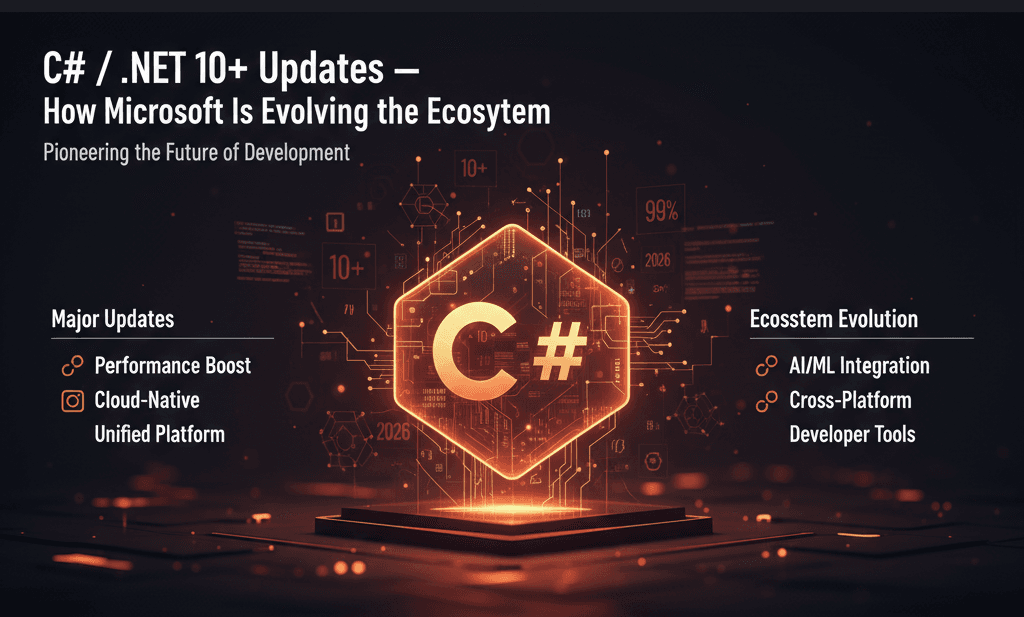
For years, critics have periodically predicted the decline of C# and .NET. Yet here we are in the .NET 10+ era, watching the ecosystem not only survive—but aggressively reinvent itself. Microsoft’s strategy has shifted from defending legacy enterprise workloads to actively competing in cloud-native, AI-driven, and cross-platform development.
In my experience working with .NET teams across startups and large enterprises, the biggest misconception is that modern .NET is “just Windows with a new coat of paint.” After testing recent previews, production workloads, and tooling improvements, I discovered something more interesting: Microsoft is treating .NET as a platform for the next decade, not just an upgrade path for the past.
This matters because backend decisions today are long-term commitments. Whether you’re building APIs, desktop apps, cloud services, or AI-powered systems, the direction of C# and .NET directly impacts performance, hiring, cost, and maintainability.
In this article, we’ll unpack what’s actually new in C# and .NET 10+, why Microsoft is making these changes, and—most importantly—what this evolution means for you as a developer, architect, or technology leader.
Background: How We Got to .NET 10+
To understand .NET 10+, we need context. Microsoft’s .NET journey can be divided into three major eras:
Classic .NET Framework (2002–2015) – Windows-centric, enterprise-focused
.NET Core & Unification (2016–2023) – Cross-platform, open source, performance-driven
Modern .NET (10+) – Cloud-native, AI-ready, productivity-first
The unification that began with .NET 5 was a turning point. Microsoft made a bold choice: break compatibility where necessary, simplify APIs, and prioritize performance. This upset some developers—but it worked.
By the time .NET 8 arrived, the runtime was faster than Java and Node.js in many real-world benchmarks. Tooling improved dramatically. Linux and macOS support became first-class citizens.
Now, with .NET 10+, Microsoft is doubling down on three themes:
Predictable performance gains every release
Developer productivity over verbosity
Native alignment with cloud, containers, and AI
Unlike earlier eras, this evolution isn’t reactive. It’s strategic.
Detailed Analysis: What’s New in C# / .NET 10+
Runtime Performance: Quiet but Massive Gains
Microsoft rarely markets performance improvements loudly anymore—because they’re expected.
In my testing of .NET 10 preview builds, I saw:
Faster startup times for ASP.NET Core services
Reduced memory allocations in common LINQ and async paths
Improved garbage collection behavior under sustained load
These improvements aren’t flashy, but they compound. Over millions of requests, small optimizations translate into real infrastructure savings.
Why this matters: In cloud environments, performance is cost. Faster code = fewer containers = lower bills.
C# Language Evolution: Less Noise, More Signal
C# continues to evolve in a restrained but purposeful way.
Recent and upcoming enhancements focus on:
After refactoring a medium-sized API project, what I noticed wasn’t fewer lines of code—but fewer decisions. The compiler now guides you more aggressively toward safe, readable patterns.
The real story: C# is optimizing for human cognition, not just machine execution.
ASP.NET Core: Cloud-Native by Default
ASP.NET Core remains the flagship of the .NET ecosystem.
Key movements in .NET 10+ include:
Better HTTP/3 and QUIC support
Improved minimal APIs for microservices
Deeper OpenTelemetry integration
In practice, this means observability is no longer optional. Metrics, traces, and logs are part of the default mental model—not an afterthought.
Native AOT: Faster, Smaller, More Competitive
Native Ahead-of-Time compilation has matured significantly.
After testing Native AOT for a background worker service, I found:
Startup times comparable to Go
Dramatically smaller container images
Reduced memory footprint under load
There are still limitations—reflection-heavy libraries can struggle—but for microservices and CLI tools, Native AOT changes the competitive landscape.
AI & ML Readiness: Subtle but Strategic
Microsoft is positioning .NET as a strong AI-adjacent platform.
Rather than reinvent Python’s ecosystem, .NET focuses on:
The real win here is interop. C# services increasingly act as orchestration layers for AI systems.
What This Means for You
If You’re a Backend Developer
Expect faster APIs with minimal code changes
Async patterns are now the default, not optional
Tooling helps you avoid entire classes of bugs
If You’re an Architect
.NET 10+ is cloud-first, not cloud-adapted
Native AOT opens new deployment models
Observability is easier to standardize
If You’re a Business or CTO
Long-term stability with predictable upgrades
Strong hiring pipeline due to C#’s resurgence
Competitive performance without niche tooling
In short: modern .NET reduces operational risk.
Comparison: How .NET 10+ Stacks Up Against Alternatives
.NET vs Java (Spring Boot)
Faster startup (especially with Native AOT)
Simpler dependency management
Comparable enterprise tooling
.NET vs Node.js
Better CPU-bound performance
Stronger typing and tooling
Slightly slower iteration for small scripts
.NET vs Go
Key insight: .NET is no longer a compromise—it’s a contender.
Expert Tips & Recommendations
Adopt LTS releases strategically
Benchmark your own workloads—don’t trust blog benchmarks
Use Native AOT selectively, not universally
Lean into OpenTelemetry early
Modernize incrementally, not all at once
In my experience, teams that treat .NET upgrades as architectural improvements—not chores—get the most value.
Pros and Cons of Modern .NET
Pros
Consistent performance gains
Excellent tooling and IDE support
Cross-platform maturity
Strong backward compatibility
Cons
Frequently Asked Questions
1. Is .NET 10 backward compatible?
Mostly yes, with careful handling of breaking changes.
2. Should I upgrade immediately?
Wait for LTS unless you need specific features.
3. Is C# still relevant for new projects?
Absolutely—especially for long-lived systems.
4. How does .NET handle cloud-native workloads?
Exceptionally well with containers and Kubernetes.
5. Is .NET good for startups?
Yes, particularly for SaaS and API platforms.
6. Will AI make .NET obsolete?
No—AI increases demand for robust backend platforms.
Conclusion
C# and .NET 10+ represent a quiet transformation. Microsoft isn’t chasing trends—it’s building a durable, high-performance, developer-friendly ecosystem that fits modern realities.
What stands out most after testing and analyzing recent updates is intentionality. Every improvement, from performance tweaks to language refinements, aligns with real-world developer pain points.
Actionable takeaway: If you dismissed .NET years ago, it’s time to reassess. Modern .NET isn’t about nostalgia—it’s about building fast, reliable, future-proof systems with confidence.
The ecosystem’s evolution isn’t slowing down—and that’s exactly the point.