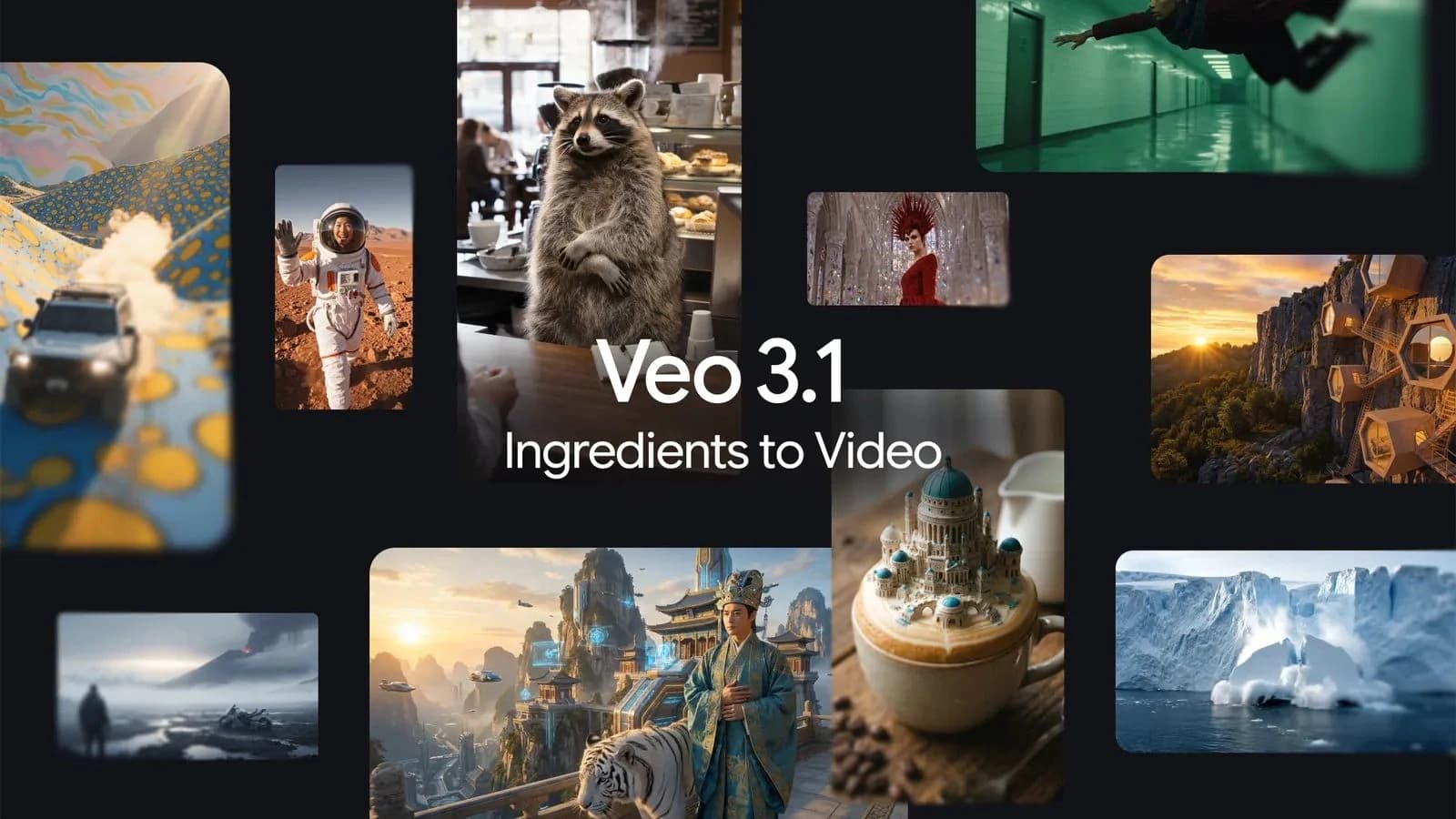
Google has updated its AI-assisted video generation tool, Veo, to version 3.1, adding support for vertical video formats, expanded capabilities in the Ingredients to Video workflow, and 4K output. These upgrades are significant because they align AI video tools with real-world content trends, especially in social platforms where vertical formats dominate, and the demand for high-resolution video continues to rise among professionals and enthusiasts alike.
While the announcement itself highlights functional improvements, the deeper implication is that AI video generation is maturing from experimental novelty to practical creative infrastructure. By enabling creators to generate vertical content natively, refine video through iterative ingredient guidance, and output at professional resolutions, Google is addressing both the creative process and output quality expectations of modern users. This progression elevates Veo from a curios tool to a viable platform for content creation workflows.
Why This Update Matters: Broader Context
To appreciate the importance of Veo 3.1’s updates, it helps to see the macro trends in content creation and distribution:
Mobile-First Consumption: Smartphones have made vertical video not just common but dominant on platforms like TikTok, Instagram Reels, YouTube Shorts, and Snap. Tools that can natively generate vertical formats eliminate friction and avoid costly re-editing workflows.
AI as a Creative Partner: Instead of automating simple tasks (e.g., trimming or color correction), modern AI tools are expected to participate in idea generation, composition, scene staging, and narrative construction. Upgrades like “Ingredients to Video” reflect this shift.
Resolution Expectations: With 4K displays ubiquitous and viewers growing accustomed to high-fidelity media, AI tools that cap out at 1080p risk being sidelined for professional or broadcast use.
Democratization of Video Production: Historically, achieving professional video quality required expensive cameras, editing software, and specialized skills. AI tools, when responsibly designed, lower this barrier while creating new expectations about speed, iteration, and accessibility.
In this larger narrative, Google Veo’s update is not merely incremental. It reflects a transition point where AI video generation embraces platform realities, creative workflows, and quality thresholds that matter in the real world.
Implications for Users, Industry, and Competitors
Implications for Content Creators
For current and aspiring creators, the Veo 3.1 update reduces several friction points:
Native Vertical Support: Eliminates the need to crop or repurpose horizontal output for mobile-first platforms. This saves time and preserves composition integrity.
Improved Ingredients to Video: Veo’s concept of “Ingredients to Video” lets creators supply narrative elements, reference imagery, or stylistic cues. As this workflow improves, it becomes closer to creative collaboration with AI rather than high-level prompts.
4K Output: Content produced at 4K is future-proofed for streaming, archiving, and professional distribution. It also enhances details for AR/VR and large-screen playback scenarios.
Creators who once used Veo as a curiosity now have a tool capable of anchoring parts of their production pipeline.
Industry Implications
Advertising and Marketing
Agencies and brands can generate quick, high-fidelity vertical ads tailored to platforms — potentially faster and cheaper than traditional production. This could accelerate campaign cycles and personalization at scale.
Media and Entertainment
The ability to generate stageable scenes in 4K with vertical support means AI tools can assist in:
Previz and concept exploration
Short-form episodic content
Rapid prototyping of storyboards
While not replacing traditional production, they act as creative accelerators.
Education and Training
Learners of media production can experiment with composition, pacing, and narrative without tooling overhead — which may democratize skill development.
Competitive Implications
Google Veo’s evolution pressures other AI and creative tool vendors to adapt:
Adobe (Firefly/Express Video)
Adobe’s suite is already rooted in professional workflows. Veo’s 4K and vertical video support challenges Adobe to integrate similar multimodal generation alongside established DTP and video tools.
Canva / Kapwing / Descript
These platforms have quick social video creation in their DNA. Veo’s AI generation raises expectations around original content creation rather than editing and templating stock assets.
Meta and TikTok
Internal creators and AI features on these platforms may converge with AI generation tools, blurring lines between creation and consumption. Veo’s 4K support signals readiness for cross-platform export.
Comparisons to Similar Moves by Other Companies
Adobe’s Generative Tools
Adobe has leaned into generative content (images, text, animation) integrated with professional editing applications. Adobe’s strength lies in fine-grained control and ecosystem continuity. Google, by contrast, is building end-to-end AI generation workflows that are simpler and faster but may trade off some manual precision.
Canva and Template-First Approaches
Canva and similar tools excel at templating and rapid design but typically do not generate original video content from scratch in the way Veo does with “Ingredients to Video.” Veo’s evolution edges toward originative generation, whereas Canva’s are generally combinative.
Meta’s AI Initiatives
Meta has been experimenting with AI creation inside social platforms, but typically tied to the Meta ecosystem and not built for exportable high-fidelity workflows. Veo’s 4K ambition speaks to broader usage beyond feed-centric content.
These comparisons reveal different strategic orientations:
Adobe: professional creative infrastructure
Canva: accessible, templatized media
Meta: social creation pipelines
Veo: originative AI video generation
Each has a role, but Veo’s unique position is in building foundational generative capabilities that feed into multiple downstream consumptions.
Potential Problems and Criticisms
1. Quality vs. Intent Alignment
AI video generation often struggles to match creative intent precisely. Even with improved Ingredients workflows, interpretations can diverge from user expectations — especially in complex narratives.
2. Ethical and Copyright Concerns
Automatic generation of video content introduces questions about:
Source material provenance
Unintended reuse of copyrighted elements
Bias and representation in generated scenes
Veo’s maturity in output quality raises expectations around responsible AI governance.
3. Overreliance on Templates
While vertical support and 4K raise the bar, creators may still find themselves constrained by underlying generative patterns or stylistic defaults rather than true expressive control.
4. Professional Production Integration
Even with 4K, the tool is not a replacement for professional cinematography. A key question is whether output meshes cleanly with existing post-production workflows (color grading, editing suites, asset pipelines) or remains a parallel, standalone utility.
Predicting Likely Outcomes and Next Steps
1. Expansion of Platform Integration
Veo’s vertical video support suggests tighter alignment with social platforms. Next steps could include:
2. Deeper Role in Creative Workflows
Generative AI features may expand to:
This elevates AI from assistant to collaborative partner.
3. Emergence of Hybrid Human-AI Workflows
We may see tools that:
This can transform video creation from linear to iterative storytelling workflows.
Expert Commentary on Strategic Decisions
Google’s decision to elevate features such as vertical video and 4K output is savvy for several reasons:
A. Platform Relevance
Creators—and eventually professional editors—expect native support for modern formats without conversion overhead. This keeps Veo relevant.
B. Market Segmentation
Rather than positioning Veo as either “toy” or “pro only,” Google is walking a middle path: accessible enough for beginners, capable enough to assist seasoned creators.
C. Competitive Differentiation
By emphasizing original AI generation rather than templated outputs, Veo distinguishes itself from lightweight editors and templating tools.
D. Forward-Looking Quality Thresholds
4K output acknowledges that 1080p is no longer the default bar. This anticipates future distribution channels (VR screens, large displays, broadcast re-use).
What This Means for Different User Segments
Aspiring Creators
Veo 3.1 lowers barriers to entry:
Professional Creators
While not a replacement for end-to-end professional pipelines, Veo can:
Marketers and Agencies
The ability to generate vertical 4K concepts rapidly is a strategic asset in:
Enterprises and Learning Platforms
Enterprise internal communications and educational content can be generated faster, with consistent quality metrics.
Historical Context: AI in Video Creation
Traditionally, video creation has been:
Expensive
Time-intensive
Skill-dependent
Even with affordable cameras and editing software, creating polished content has required:
AI has disrupted this paradigm in two phases:
Assistance: helping with tasks like color grading and noise reduction
Generation: creating original video elements from text or structured cues
Veo’s evolution into vertical formats and 4K underscores the transition from editing assistance to creative generation.
Broader Industry Trends
The Veo 3.1 update sits at the intersection of multiple megatrends:
Mobile-First Content Dominance
Vertical video is not a fad—it is the default in short-form platforms. Tools that ignore this format lose relevance.
AI-Augmented Creativity
AI is no longer supplemental; it is becoming central to creative workflows.
Convergence of Consumer and Professional Tools
Tools once categorized as “consumer-grade” are evolving to meet professional expectations, blurring historical boundaries.
Platform-Integrated Creation
Expect future video tools to embed more deeply within distribution platforms, automating format adaptation, engagement optimization, and platform compliance.
Conclusion: An Inflection Point in Creative Tools
Google Veo 3.1’s addition of vertical video support, enhanced Ingredients to Video capabilities, and 4K output isn’t just a feature rollout—it’s a strategic evolutionary step. It demonstrates that AI video tools are reaching functional maturity, and can soon become core parts of creative workflows rather than experimental playthings.
By aligning generation capabilities with real-world formats, quality expectations, and iterative creative input, Veo is positioning itself not just as a tool but as a creative co-pilot. This shift has broad implications:
It raises the bar for competitors
It redefines creative expectations
It expands who can engage in high-quality content production
It anticipates a future where AI is an authoring partner
As AI tools become more capable, the real differentiators will not be raw capability but how these tools integrate into human creative processes—and Veo’s latest update is a strong early step in that direction.