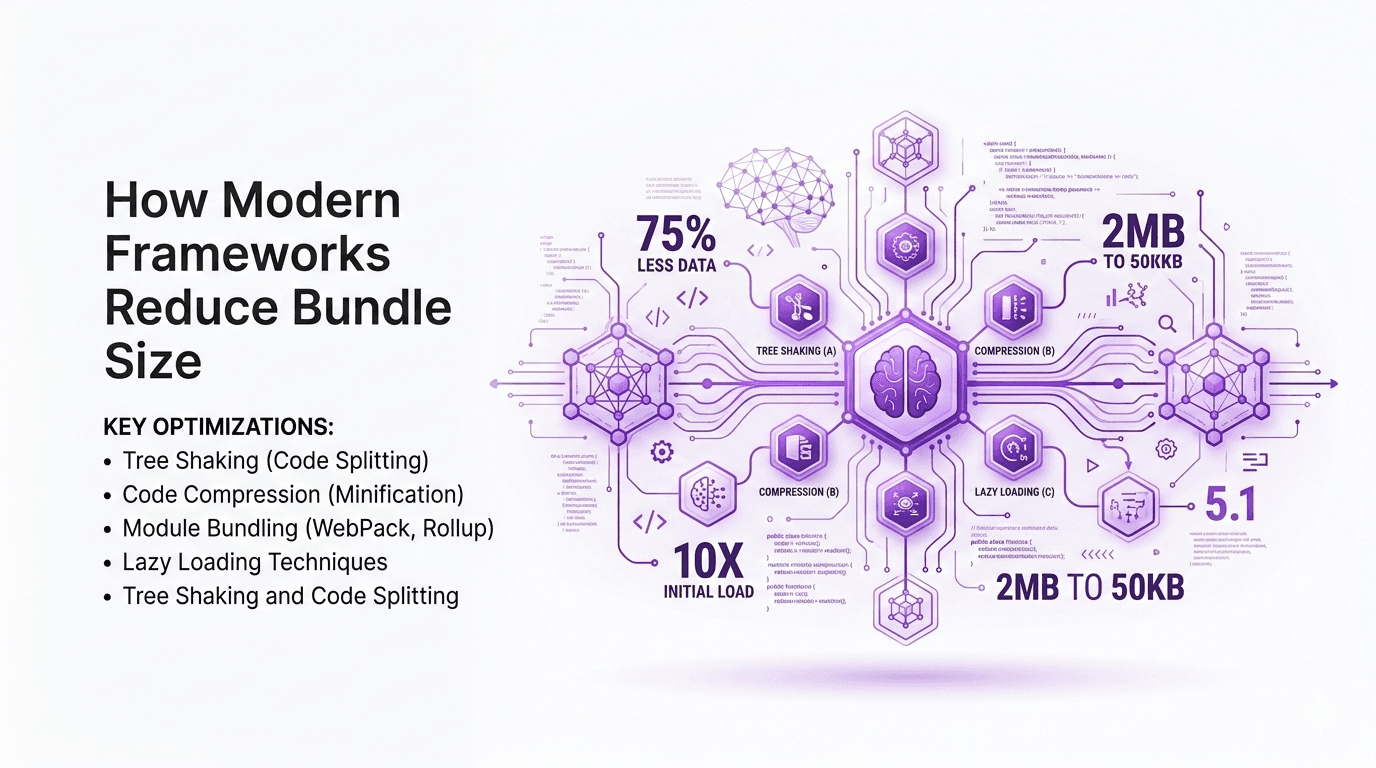
In 2025, the Vue.js ecosystem continues to gain momentum, driven by a clear focus on performance, developer productivity, and ecosystem maturity. One of the most discussed developments is Vapor Mode, a compiler-driven rendering approach that reduces runtime overhead by eliminating unnecessary abstractions in component rendering. Alongside this, Vue’s tooling—such as Vite, improved devtools, and tighter TypeScript integration—has matured to the point where UI development is both faster and more predictable.
Rather than chasing novelty, Vue’s evolution emphasizes refinement: smaller bundles, faster startup times, and smoother runtime performance without sacrificing its declarative, approachable syntax. This positions Vue as a strong alternative to heavier frameworks at a time when performance budgets are shrinking and user expectations are rising.
While Vue does not dominate headlines the way some competitors do, its steady progress reflects a broader industry shift toward compiler-led optimization and pragmatic framework design.
Broader Context: Why Vue’s 2025 Direction Matters
To understand why Vue’s current trajectory is significant, it helps to look at the state of frontend development in 2025:
Web apps are heavier than ever, often rivaling native applications in complexity
Users expect instant interaction, especially on low-end or mobile devices
Performance is now a product feature, not just an engineering concern
Teams are fatigued by complexity, especially from over-engineered stacks
In this environment, frameworks are under pressure to deliver more speed with less code, and to do so without pushing cognitive overload onto developers.
Vue’s renewed emphasis on performance innovations like Vapor Mode is a response to this pressure. Instead of asking developers to radically change how they write components, Vue shifts complexity into the compiler—where it can be optimized once and reused everywhere.
This matters because it represents a maturing philosophy in frontend engineering: performance should be automatic, not optional.
Historical Context: How Vue Reached This Moment
Vue’s Early Identity
Vue began as a reaction to the complexity of early Angular versions, offering:
For years, Vue’s biggest strength was approachability, not raw performance.
The Rise of Compiler-Driven Frameworks
As React popularized virtual DOM abstractions, limitations became apparent—especially in performance-critical scenarios. Framework authors began exploring compile-time optimizations.
Vue was well-positioned here because:
Its template syntax is compiler-friendly
It already emphasized declarative rendering
Its ecosystem was not tightly coupled to legacy patterns
Vue 3 as the Turning Point
Vue 3 introduced the Composition API and a more modular core, laying the groundwork for advanced compiler optimizations. Vapor Mode in 2025 is best understood as a continuation of that architectural shift, not a sudden pivot.
What Makes Vue’s 2025 Innovations Different
Vapor Mode: Performance Without the Tax
Unlike traditional runtime rendering approaches, Vapor Mode:
Minimizes virtual DOM usage
Compiles templates into highly optimized imperative code
Reduces memory overhead and runtime diffing
The key distinction is that developers don’t write different code. They opt into a mode, and the framework does the heavy lifting.
This contrasts with approaches that require developers to manually manage reactivity boundaries or learn new mental models.
Mature Tooling as a Force Multiplier
Vue’s performance gains are amplified by:
Vite’s near-instant dev server startup
Faster hot module replacement
Better build-time optimizations
Performance is not just about runtime—it’s about developer feedback loops, and Vue excels here.
Implications for Developers and Teams
For Individual Developers
Faster apps with minimal extra effort
Lower risk of performance regressions
Easier onboarding compared to more complex frameworks
For Teams
Better predictability in large codebases
Less need for specialized performance experts
Reduced pressure to prematurely optimize
Vue’s approach aligns well with teams that value sustainable velocity over short-term experimentation.
Industry Implications: How Vue Affects the Frontend Landscape
Pressure on Competitors
Vue’s compiler-first direction increases pressure on other frameworks to:
This is especially relevant for ecosystems that rely heavily on runtime abstractions.
Raising the Baseline for Performance
When a mainstream framework offers near-zero-cost abstractions by default, performance expectations rise across the industry. This benefits users—but challenges frameworks that are slower to adapt.
Comparison With Similar Moves by Other Frameworks
React
React has introduced performance improvements, but often:
Requires developer intervention
Depends heavily on conventions and discipline
Carries legacy constraints
Vue’s compiler-centric approach offers a different trade-off: less flexibility in internals, more predictability in output.
Svelte
Svelte pioneered compile-time rendering, but:
Vue borrows the best of this idea while maintaining ecosystem depth.
Angular
Angular continues to modernize, but its complexity and learning curve remain barriers. Vue positions itself as a lighter-weight alternative with similar long-term stability goals.
Potential Problems and Criticisms
Ecosystem Fragmentation
Optional modes like Vapor Mode risk:
Vue must manage this carefully to avoid “configuration fatigue.”
Diminishing Returns
At some point, performance gains may become marginal compared to:
Network latency
Backend bottlenecks
Third-party scripts
Framework-level optimization alone cannot solve all performance problems.
Adoption Hesitation
Some enterprises may hesitate to adopt newer modes until:
Expert Commentary: A Strategic Bet on the Compiler
From a strategic standpoint, Vue’s 2025 direction reflects confidence in:
Compiler-led optimization as the future
Stability over rapid reinvention
Developer experience as a competitive advantage
Rather than chasing trends, Vue is doubling down on fundamentals: fast rendering, predictable behavior, and maintainable code.
This is a long-term bet—and one that aligns well with enterprise and product-focused teams.
What This Means for Different User Segments
Startups
Enterprises
Educators and Learners
Predictions: What Comes Next for Vue
Short Term (2025–2026)
Wider adoption of Vapor Mode
Better defaults and auto-configuration
More performance-focused documentation
Medium Term (2026–2028)
Deeper integration with design systems
Improved server-side and edge rendering
Stronger enterprise adoption
Long Term
Vue may become the reference framework for “boring but excellent” UI development—not flashy, but reliable, fast, and trusted.
Final Analysis: Vue’s Quiet Confidence Pays Off
In 2025, Vue.js is not trying to win the frontend wars through hype. Instead, it is executing a disciplined strategy: shift complexity into the compiler, polish the tooling, and make performance the default outcome rather than a developer burden.
Innovations like Vapor Mode are not just technical upgrades—they are philosophical statements about where frontend development should go next. For teams tired of constant churn and unpredictable performance trade-offs, Vue’s ecosystem offers something increasingly rare in modern software: calm, clarity, and speed—at the same time.
That combination may prove to be Vue’s most powerful feature yet.