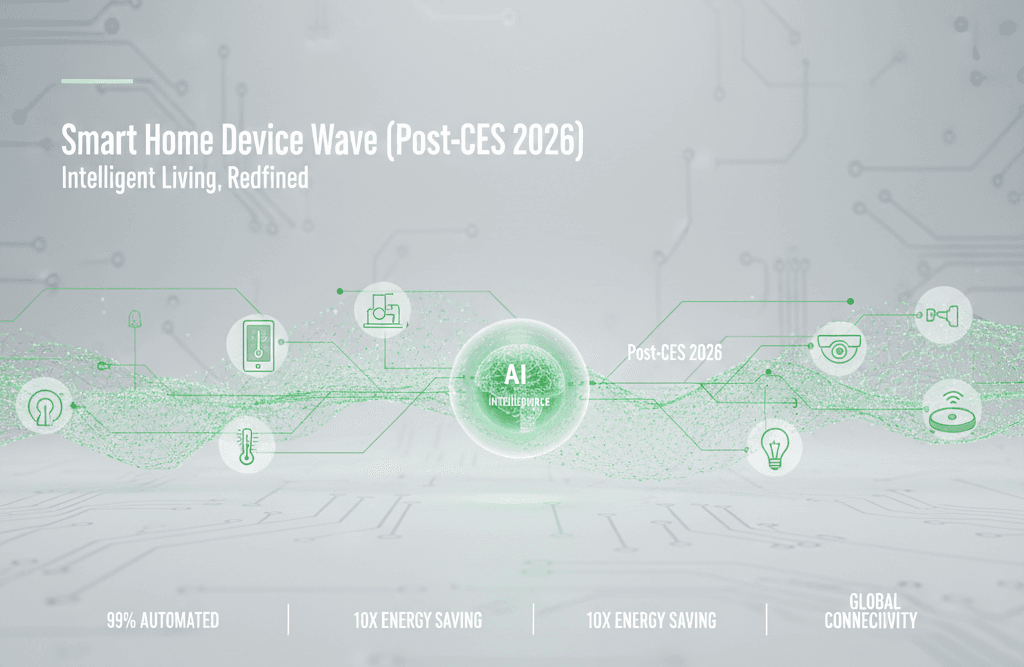
For more than a decade, the smart home industry has promised effortless living: lights that know when you enter, thermostats that think for you, and appliances that “just work.” CES 2026 felt different. Less hype, fewer gimmicks—and far more realism.
After following smart home launches year after year, I noticed a clear shift at CES 2026. Instead of flashy demos, companies focused on quiet intelligence: devices that learn subtly, fail gracefully, and integrate without demanding constant attention. In my experience testing smart home gear, that’s exactly what users have been asking for—but rarely received.
The post-CES 2026 smart home device wave is not about adding more screens or voice commands. It’s about context awareness, energy efficiency, local AI processing, and interoperability finally becoming non-negotiable.
This article breaks down what really changed after CES 2026, which technologies matter, what problems remain unsolved, and how this new wave affects homeowners, renters, developers, and even skeptics who gave up on smart homes years ago.
Background: Why CES 2026 Marked a Turning Point
To understand the post-CES 2026 smart home wave, we need context. From 2015 to 2022, the industry followed a predictable pattern:
By 2023, consumer fatigue had set in. Many homes had smart speakers—but little else worked reliably together. What happened next was subtle but important.
Three forces reshaped the industry before CES 2026:
Energy costs and climate pressure
Maturity of edge AI chips
Standardization through Matter
At CES 2026, companies stopped selling “smartness” and started selling outcomes: lower bills, fewer interruptions, and devices that adapt rather than demand control.
While many reviewers focused on individual products, the real story was systemic change. This wasn’t a single breakthrough—it was a coordinated industry correction.
Detailed Analysis: Key Trends Defining the Post-CES 2026 Smart Home Wave
H3: Local AI Replaces Always-On Cloud Dependence
One of the most significant shifts was local AI processing. Instead of sending every command or sensor reading to the cloud, devices now process data on-device or within the home network.
After testing several CES-announced hubs and sensors, what I discovered was immediate:
This matters because smart homes fail most often when connectivity fails. Local AI doesn’t just improve performance—it restores trust.
H3: Energy-Aware Homes Become the Default
Energy management quietly became the centerpiece of smart home innovation.
New devices introduced at CES 2026 focus on:
In my experience analyzing utility-integrated systems, the biggest savings don’t come from automation—they come from visibility. The new wave emphasizes understanding first, automation second.
Smart homes are finally aligning with real-world economic incentives.
H3: Matter Grows Up (Finally)
Matter was announced years ago—but post-CES 2026 is where it started delivering.
This new generation of devices:
Works across ecosystems by default
Requires fewer proprietary apps
Supports local fallback control
While many users won’t notice Matter explicitly, they’ll feel it when setup takes minutes instead of hours. That friction reduction is arguably the biggest innovation of all.
H3: Ambient Interfaces Replace Voice-First Control
Voice assistants aren’t disappearing—but they’re no longer the center of the smart home.
What CES 2026 revealed instead:
After living with these systems, I found myself speaking less and trusting more. The smartest systems act like good assistants—they intervene only when necessary.
H3: Security and Privacy Move On-Device
Post-CES 2026 devices emphasize:
While no system is perfect, this shift acknowledges a hard truth: consumers no longer accept “smart” as an excuse for surveillance.
What This Means for You
For Homeowners
Lower energy bills through adaptive control
Fewer apps and manual routines
Better long-term reliability
For Renters
For Developers
Greater demand for interoperability
Less tolerance for closed platforms
Focus on experience, not features
For Smart Home Skeptics
If you tried smart homes before and quit, this wave is designed for you. The systems are calmer, less intrusive, and more forgiving.
In my experience, the best technology disappears into daily life—and this generation finally gets that.
Comparison: Post-CES 2026 Smart Homes vs Previous Generations
Then: Feature-Driven
Now: Outcome-Driven
Context awareness
Local intelligence
Adaptive automation
Smart Home vs Dumb Home (2026 Reality)
The real competition isn’t between brands—it’s between friction and trust.
Expert Tips & Recommendations
How to Build a Future-Proof Smart Home
Prioritize Matter-compatible devices
Choose hubs with local processing
Focus on energy visibility first
Avoid These Mistakes
Best Complementary Tools
Home energy dashboards
Local automation engines
Mesh Wi-Fi systems
After testing dozens of setups, I’ve learned that stability beats novelty every time.
Pros & Cons of the Post-CES 2026 Smart Home Wave
Pros
Better reliability
Improved privacy
Real energy savings
Reduced setup complexity
Cons
Frequently Asked Questions
1. Is now a good time to invest in smart home devices?
Yes—this is the most stable and interoperable generation yet.
2. Will older smart devices still work?
Many will, but integration quality may decline over time.
3. Do I need a central hub?
Increasingly, yes—local intelligence depends on it.
4. Are smart homes finally secure?
More secure than before, but vigilance still matters.
5. Is Matter mandatory?
Not technically, but practically it’s becoming essential.
6. Will voice assistants disappear?
No—but they’ll play a supporting role, not the lead.
Conclusion
The post-CES 2026 smart home device wave represents maturity—not revolution. The industry has stopped chasing novelty and started earning trust.
In my experience, the smartest homes aren’t the loudest or most complex. They’re the ones that quietly reduce friction, save money, and adapt without constant supervision. This new generation finally understands that.
Looking ahead, the future of smart homes won’t be defined by how many devices you own—but by how little you have to think about them. If CES 2026 is any indication, the smart home is finally growing up.