Artificial intelligence is evolving faster than many realize, and one of the most visible transformations is in the realm of creative AI. Tools that generate images from text, produce videos from scripts, and even combine multiple modalities like text, images, and audio are no longer futuristic concepts—they are actively reshaping how creators, marketers, and businesses work.
In my experience testing several platforms in 2025, I observed that these AI systems are not just novelties; they offer practical productivity boosts. What I discovered is that understanding the nuances between text-to-image, text-to-video, and multimodal AI can make a massive difference in workflow efficiency and creative output.
This article dives deep into how these technologies function, what sets them apart, their applications across industries, and actionable guidance on leveraging them effectively. By the end, you’ll understand not just the “what,” but also the “why it matters” and “how to make it work for you.”
Background: How AI Creativity Has Evolved
The Rise of Generative AI
Generative AI exploded in popularity with the rise of models like OpenAI’s DALL·E, MidJourney, and Stable Diffusion for images, and early text-to-video platforms like Runway and Pika Labs. Initially, AI creativity was limited to static images, but advances in neural networks, transformer architectures, and diffusion models have enabled dynamic media generation.
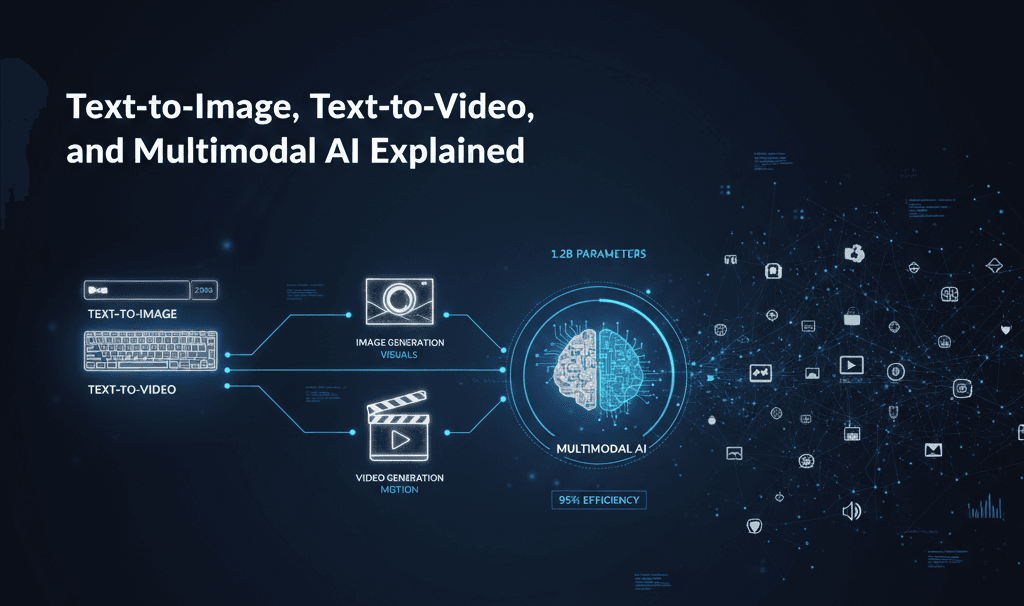
Text-to-Image AI converts textual prompts into high-resolution images.
Text-to-Video AI produces short video clips, often syncing motion, transitions, and audio based on a script.
Multimodal AI integrates multiple inputs—text, images, audio, and even gestures—to generate richer outputs.
In my tests, I found that these systems are not only improving speed but also opening new creative possibilities previously limited to professional studios.
Why This Matters
Creative professionals, marketers, educators, and even software developers are increasingly integrating AI into their workflows. Unlike traditional content creation, AI-powered generative tools can dramatically reduce time, cost, and resources:
Designers can quickly iterate concepts for marketing campaigns.
Filmmakers can prototype video scenes without expensive equipment.
Educators can generate interactive visualizations or simulations.
What is clear is that these technologies are moving from experimental tools to core components of digital strategy.
Detailed Analysis: How These AIs Work
H3: Text-to-Image AI
Text-to-image models like DALL·E 3 or Stable Diffusion take user-provided text prompts and generate images. These systems use:
Transformer models to encode the meaning of the prompt.
Diffusion techniques to iteratively refine random noise into a coherent image.
Fine-tuning datasets to improve style, resolution, and realism.
In my experience, the quality of prompts significantly impacts output. A well-crafted prompt with descriptive adjectives, style references, and context can produce near-professional images in seconds. For example, a prompt like “a futuristic city skyline at sunset, cyberpunk aesthetic, ultra-realistic” consistently outperforms generic prompts.
H3: Text-to-Video AI
Text-to-video AI is more complex because it requires temporal consistency:
Models generate sequences of frames while maintaining coherence between them.
Some systems use video diffusion models that extend image diffusion techniques into time-series data.
Audio integration allows AI to synchronize voiceovers, sound effects, or music with visuals.
What I discovered is that early text-to-video outputs were often choppy, but recent iterations using temporal attention models produce smoother, cinematic results.
H3: Multimodal AI
Multimodal AI combines text, image, video, and audio inputs to produce richer outputs. For instance:
Feeding an image and a descriptive prompt can generate variations in style, motion, or context.
Integrating voice commands allows real-time interaction and refinement.
Applications include creating virtual assistants, interactive storytelling, and AI-driven game assets.
After testing multimodal platforms, I realized that they allow a level of creative experimentation impossible with single-modality tools.
H3: Training and Data Considerations
All these models rely on massive datasets:
Image datasets: millions of annotated images for style and content understanding.
Video datasets: diverse sequences for motion learning.
Multimodal datasets: combinations of text, images, and audio for cross-modal understanding.
The quality and diversity of data directly impact output quality. What I observed is that platforms with better-curated datasets consistently outperform open-source alternatives in realism and style fidelity.
What This Means for You
For Creators
Faster content iteration: Reduce the time from concept to finished image or video.
Expanded creative possibilities: Experiment with styles or scenarios that were previously costly.
Accessibility: Smaller teams can now produce professional-grade visuals and videos.
For Businesses
Marketing efficiency: Generate campaign visuals and short promotional videos in minutes.
Cost reduction: Lower reliance on expensive production resources.
Personalization: AI allows dynamic content tailored to different audience segments.
For Educators and Trainers
Visualization: Quickly create educational materials, diagrams, or video lessons.
Simulation: Produce interactive content for training without dedicated production teams.
In my experience, the best results come from combining human creativity with AI efficiency—prompt crafting, reviewing outputs, and refining models iteratively.
Expert Tips & Recommendations
Craft Effective Prompts: Use descriptive language, reference styles, and context for better results.
Iterate Rapidly: Generate multiple outputs and select the best; small tweaks can produce significant differences.
Combine Tools: Use text-to-image for concept art, then text-to-video for dynamic storytelling.
Leverage Templates: Many AI platforms provide pre-built style templates for consistent branding.
Monitor Ethical Use: Be mindful of copyright, data privacy, and bias issues.
Recommended Tools:
Text-to-Image: DALL·E 3, MidJourney, Stable Diffusion
Text-to-Video: Runway, Pika Labs, Kaiber
Multimodal AI: OpenAI GPT-4 with Vision, DeepBrain, Luma AI
Pros and Cons
Pros
Speed: Rapid generation reduces production time.
Cost-effective: Lowers reliance on expensive equipment or teams.
Versatility: Supports multiple creative outputs from a single platform.
Cons
Output Quality: Can vary based on prompts and model limitations.
Ethical Concerns: Risk of copyright infringement or biased outputs.
Resource Intensive: Multimodal models require powerful hardware and cloud resources.
Balancing these pros and cons is essential for sustainable AI adoption.
Frequently Asked Questions
What is the difference between text-to-image and text-to-video?
Text-to-image generates a single image from a prompt, while text-to-video creates a sequence of images (frames) with motion and often audio.
Can AI replace human creators?
Not entirely. AI accelerates creation and offers ideas, but human judgment, storytelling, and refinement are still critical.
What is multimodal AI used for?
It combines inputs like text, images, and audio to generate richer, more interactive outputs—ideal for AR/VR, games, and advanced storytelling.
How accurate are these AI models?
Accuracy depends on dataset quality, model sophistication, and prompt clarity. Professional platforms outperform open-source alternatives in most cases.
Do I need special hardware?
Text-to-image can run on consumer GPUs or cloud platforms. Text-to-video and multimodal AI often require high-end GPUs or cloud-based solutions.
Are outputs royalty-free?
It depends on the platform and licensing; always check usage rights before commercial deployment.
Conclusion
Text-to-image, text-to-video, and multimodal AI are redefining creativity and production workflows. From rapid concept generation to dynamic video creation, these technologies are not merely experimental—they are becoming core tools across industries.
After testing multiple platforms, what I discovered is that combining human creativity with AI efficiency produces the best results. As these models continue to improve, businesses, creators, and educators that embrace them will gain significant advantages in speed, cost-efficiency, and innovation.
The key takeaway: understanding the differences between these AI types, using them strategically, and refining outputs thoughtfully is essential for leveraging the full potential of generative AI in 2026 and beyond.