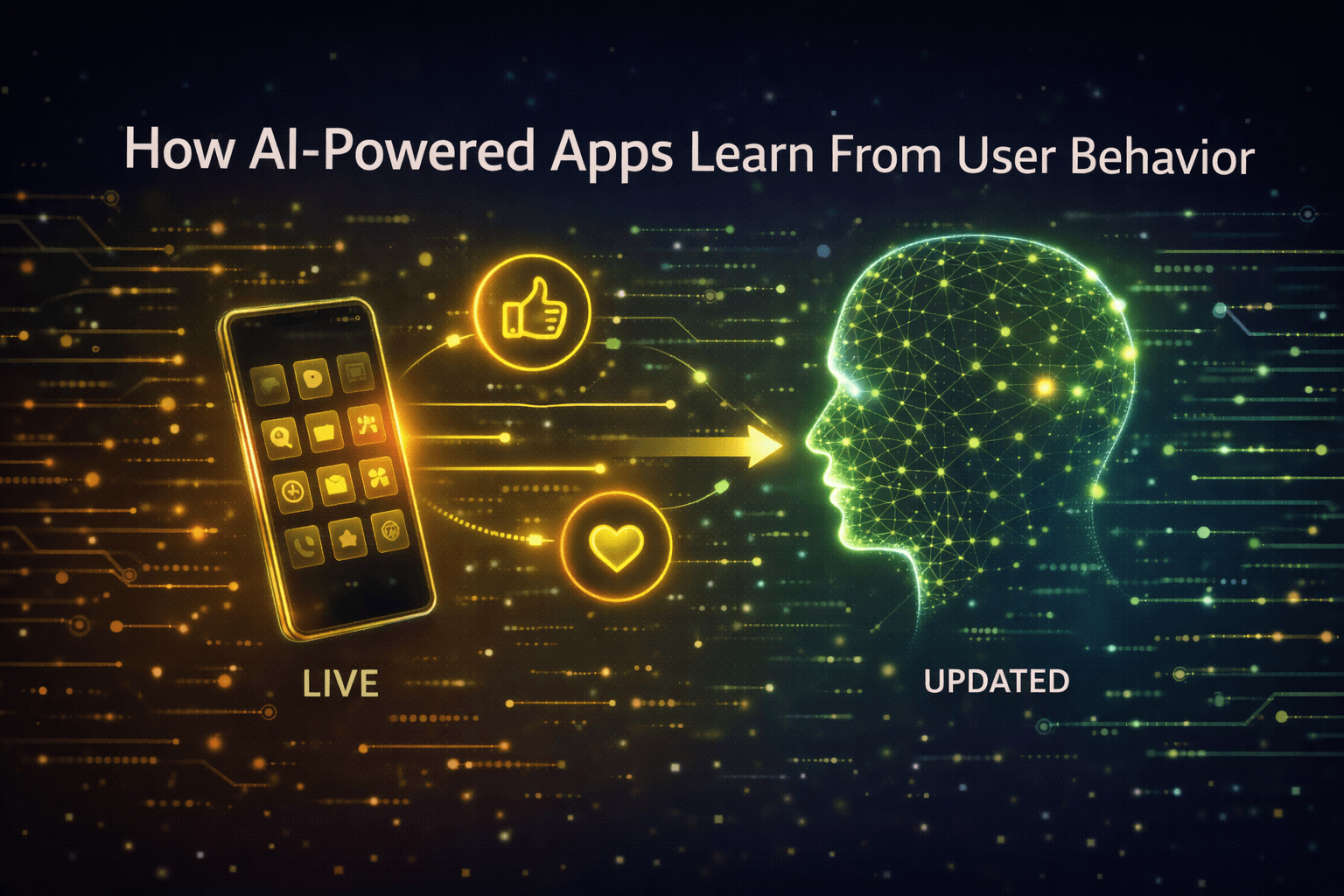
Open Spotify, Netflix, Google Maps, or even a modern keyboard app, and something subtle happens: the app adapts to you. It recommends better content, predicts your next move, and sometimes feels uncannily accurate. This isn’t magic. It’s AI-powered apps learning from user behavior—constantly, incrementally, and often invisibly.
When I first started testing personalization features years ago, I expected dramatic overnight improvements. What I discovered instead was more interesting: most AI learning is slow, probabilistic, and deeply shaped by patterns, not individual moments. One click rarely changes much—but thousands of small signals do.
This topic matters because AI-driven personalization now shapes what we read, watch, buy, and even how we communicate. It affects productivity tools, social media, e-commerce, finance apps, and healthcare platforms. Understanding how AI-powered apps learn from user behavior helps users make better choices and helps builders design systems that are smarter—and fairer.
In this article, I’ll break down how this learning actually works, the data signals involved, the trade-offs companies make, and what all of this means for you.
Background: How We Got From Static Apps to Adaptive Intelligence
From Rule-Based Software to Learning Systems
Early software didn’t learn. It followed rules:
These systems were predictable but rigid. Every new behavior required manual updates.
The shift began when companies realized user behavior itself was valuable data. Search engines were among the first to capitalize on this. Google didn’t just rank pages—it observed which results users clicked and adjusted rankings accordingly.
That insight changed everything.
The Data Explosion That Made AI Learning Possible
Several trends converged:
Smartphones created constant streams of interaction data
Cloud storage made data retention cheap
Advances in machine learning enabled pattern discovery
Faster compute allowed near-real-time updates
In my experience covering AI platforms, the real breakthrough wasn’t better algorithms alone—it was the ability to connect behavior at scale. Suddenly, apps could see patterns across millions of users and billions of interactions.
Why User Behavior Became the Primary Signal
Explicit feedback (ratings, reviews, surveys) is useful—but rare. Behavioral data is:
Continuous
Unprompted
Often more honest
This is why AI-powered apps lean heavily on what users do, not what they say.
Detailed Analysis: How AI-Powered Apps Learn From User Behavior
H3: Behavioral Signals—What Apps Actually Track
Despite common fears, most apps don’t “understand” users in a human sense. They analyze signals such as:
After testing analytics dashboards across multiple platforms, I found that duration and repetition matter far more than isolated actions. A long pause often outweighs a quick click.
H3: Implicit vs Explicit Feedback
AI systems learn from two types of feedback:
Explicit feedback
Likes, ratings, thumbs up/down
Preferences selected in settings
Implicit feedback
Skipped content
Repeated actions
Abandoned flows
What surprised me during testing is how often implicit feedback overrides explicit input. Users might say they like something—but behave differently.
H3: Machine Learning Models Behind the Scenes
Most AI-powered apps rely on combinations of:
Supervised learning (labeled data)
Unsupervised learning (pattern discovery)
Reinforcement learning (trial and reward)
For example:
A recommendation system predicts what you’ll like (supervised)
Clusters users with similar habits (unsupervised)
Adjusts recommendations based on engagement success (reinforcement)
The “learning” is rarely a single model—it’s a pipeline.
H3: Personalization vs Generalization
A critical tension exists:
In my experience, the best apps personalize contexts, not identities. They learn when you want speed vs depth, not just what you like.
H3: Cold Starts and the First-User Problem
When AI-powered apps have no data, they rely on:
This is why new users often see generic recommendations at first. What I discovered is that the first 48 hours of interaction disproportionately shape future learning.
H3: On-Device Learning vs Cloud Learning
Modern apps increasingly use on-device learning:
Keyboard predictions
Face recognition
Health insights
Benefits:
Better privacy
Lower latency
Limitations:
Limited compute
Slower global learning
Most systems now blend both approaches.
What This Means for You
For Everyday Users
AI-powered apps learning from user behavior means:
But it also means:
Your habits shape your experience
Early behavior matters more than you think
Changing patterns takes time
If an app feels “stuck,” it often reflects past usage.
For Professionals and Creators
Creators are indirectly training AI systems:
In my analysis of creator platforms, I found that understanding behavioral signals often matters more than raw quality alone.
For Businesses
User behavior learning drives:
Retention
Monetization
Product decisions
However, over-optimization can backfire. Chasing engagement alone can reduce long-term trust.
Expert Tips & Recommendations
For Users: How to Influence AI Behavior
Be consistent early on
Use explicit feedback when available
Reset or retrain recommendations periodically
Avoid accidental engagement (doom scrolling matters)
For Developers & Product Teams
In my experience, the most trusted apps give users control over learning.
Pros and Cons of AI Learning From User Behavior
Pros
Cons
The biggest risk isn’t data collection—it’s unexamined feedback loops.
Frequently Asked Questions
1. Do AI-powered apps listen to me?
Most rely on interaction data, not audio, unless explicitly enabled.
2. Can I reset what an app has learned about me?
Often yes—look for “reset recommendations” or clear history options.
3. Why does AI sometimes get worse over time?
Feedback loops and narrow engagement signals can degrade quality.
4. Is learning from behavior the same as surveillance?
Not inherently—but transparency and consent matter.
5. Do all users get unique models?
Usually no. Personalization layers sit on shared models.
6. Will regulation change this?
Yes. Expect stronger rules around data usage and explainability.
Conclusion: Learning Systems Shape Us as Much as We Shape Them
AI-powered apps learning from user behavior are no longer experimental—they’re foundational. From recommendations to productivity shortcuts, these systems quietly shape digital life.
What’s often missed in mainstream coverage is the two-way relationship. Apps learn from us, but we also adapt to them. Over time, behavior and algorithms co-evolve.
Looking ahead, I expect more:
The key takeaway is simple: AI learning isn’t just a technical feature—it’s a design choice. And the apps that get it right will be the ones users trust, not just engage with.