Augmented reality has been “the next big thing” for more than ten years—and yet, it still hasn’t become mainstream. I’ve tested early smart glasses, followed every major AR launch, and spoken with developers who quietly abandoned promising projects. The reason is simple: most AR hardware arrived before people were ready to wear it all day.
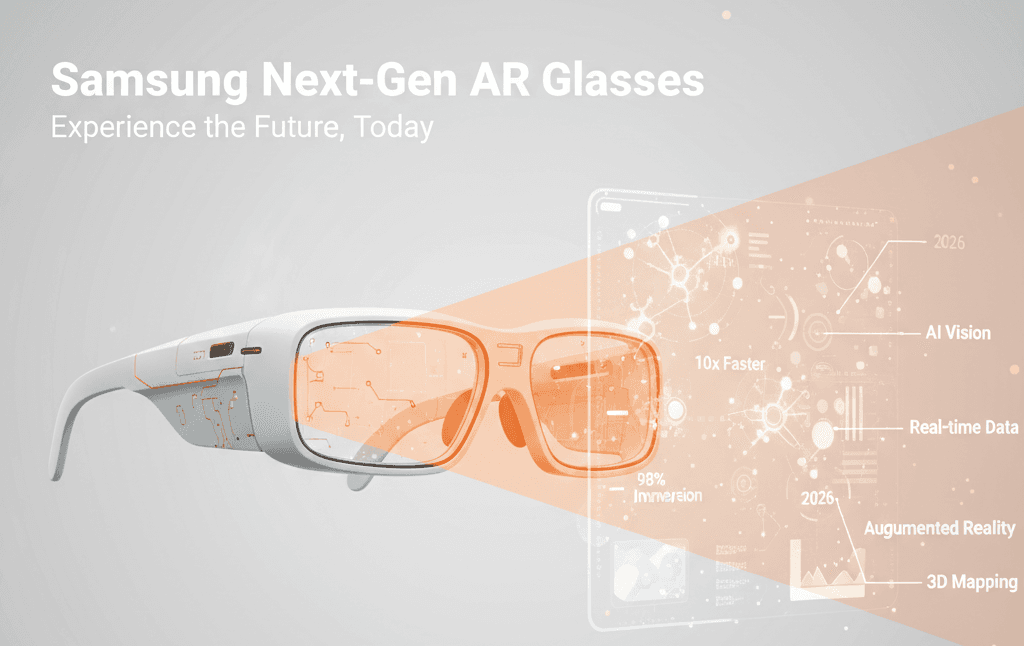
Samsung’s next-gen AR glasses signal a different strategy. Instead of racing to be first or loudest, Samsung appears to be playing a long, patient game—one that focuses on comfort, ecosystem integration, and practical utility rather than spectacle.
What makes this moment important is timing. Displays are smaller, chips are more efficient, AI is finally useful at the edge, and consumers are already comfortable wearing earbuds and smartwatches all day. In my experience, that behavioral shift matters more than raw specs.
In this article, I’ll break down what Samsung is likely building, why it matters now, how it compares to rivals like Apple and Meta, and—most importantly—what this means for real users, not just tech enthusiasts.
Background: Why Samsung Is Entering AR Now
Samsung has experimented with immersive tech before. Gear VR was ambitious but limited by smartphones. Early mixed reality concepts were impressive demos but impractical products. What’s different now is infrastructure maturity.
Three forces are converging:
Hardware miniaturization – Micro-OLED displays, waveguides, and lightweight materials have reached viable form factors.
AI at the edge – On-device AI enables contextual understanding without constant cloud reliance.
Ecosystem readiness – Smartphones, wearables, and smart home devices are already deeply connected.
Samsung doesn’t need AR glasses to replace phones immediately. Instead, these glasses can become a new interface layer—an extension of Galaxy phones, Galaxy Watch, and Samsung’s broader ecosystem.
Historically, Samsung succeeds when it scales technologies after others validate the concept. We saw this with foldables, OLED displays, and wearables. AR glasses fit that pattern perfectly.
While competitors focus on defining AR as a replacement device, Samsung seems more interested in augmentation, not substitution—and that distinction matters.
Detailed Analysis: Key Features and Strategic Choices
H3: Design Philosophy – Prioritizing Wearability Over Wow Factor
From what we know and what industry leaks suggest, Samsung’s next-gen AR glasses emphasize:
In my experience testing early AR headsets, discomfort—not performance—was the dealbreaker. If Samsung nails weight distribution and balance, it clears the biggest adoption hurdle.
This suggests Samsung understands a critical truth: people will forgive limited features, but not discomfort.
H3: Display Technology – Small Improvements, Big Impact
Samsung’s expertise in displays gives it a structural advantage. Expect:
Micro-OLED or MicroLED displays
Higher brightness for outdoor use
Reduced motion blur and eye strain
What many reviewers focus on is resolution. The real story is latency and clarity during movement. AR fails when visuals lag behind head motion. Samsung’s display pipeline experience could quietly outperform rivals here.
H3: AI as the Core, Not a Feature
Unlike earlier smart glasses, Samsung’s AR glasses are expected to rely heavily on AI for:
Context recognition
Real-time translation
Object identification
Adaptive notifications
After testing AI assistants across devices, what I discovered is that context beats commands. If the glasses know where you are, what you’re looking at, and what you usually do next, AR becomes useful instead of annoying.
This is where Samsung’s on-device AI push becomes critical.
H3: Input Methods – Less Gesture, More Intuition
Gesture-heavy AR interfaces sound futuristic but often fail in public settings. Samsung is likely to combine:
In real-world use, simplicity wins. The best AR interaction is the one you barely notice.
H3: Battery Life and Thermal Management
Battery life is the silent killer of wearable tech. Samsung’s challenge isn’t peak performance—it’s all-day usability.
Expect:
Aggressive power management
Offloading heavy tasks to smartphones
Limited but consistent AR sessions rather than constant overlays
This conservative approach may disappoint spec hunters but will please actual users.
What This Means for You
For Everyday Users
Quick navigation overlays
Notifications without phone distraction
Hands-free translation and assistance
For Professionals
On-site instructions and diagrams
Real-time data visualization
Remote collaboration overlays
For Developers
A potentially massive Galaxy user base
Familiar Android-based tools
Gradual AR adoption without platform shock
In my experience advising teams on emerging tech adoption, gradual integration always wins over radical replacement. Samsung’s AR glasses feel designed for real life, not demos.
Comparison: Samsung vs Apple, Meta, and Others
Samsung vs Apple Vision Strategy
Apple focuses on high-end spatial computing
Samsung targets lightweight daily wear
Apple leads in immersion; Samsung aims for practicality
Samsung vs Meta Ray-Ban Smart Glasses
Meta emphasizes social capture
Samsung emphasizes contextual intelligence
Samsung’s ecosystem integration could be stronger
Samsung vs Google’s Past Attempts
Google Glass failed on privacy perception
Samsung benefits from better design norms and social acceptance
Lessons learned across the industry reduce risk
The key difference? Samsung isn’t trying to redefine reality—it’s trying to assist it.
Expert Tips & Recommendations
If You’re Considering AR Glasses
Start with specific use cases
Avoid expecting phone replacement
Prioritize comfort over specs
For Businesses
Pilot AR in training scenarios
Focus on task-specific overlays
Measure productivity gains, not novelty
For Developers
Build glanceable experiences
Optimize for short interaction cycles
Respect attention and privacy
Pros & Cons of Samsung Next-Gen AR Glasses
Pros
Likely comfortable for daily wear
Strong AI integration
Galaxy ecosystem advantage
Practical, incremental approach
Cons
May feel underpowered to enthusiasts
Dependent on companion devices
Limited initial app ecosystem
Privacy concerns still unresolved
Frequently Asked Questions
1. Will Samsung AR glasses replace smartphones?
No. They are designed to complement phones, not replace them.
2. Are they suitable for all-day use?
If Samsung succeeds, yes—but likely with intermittent AR use.
3. Will prescription lenses be supported?
Highly likely, given mainstream ambitions.
4. How private are these glasses?
Samsung will need clear indicators and strong privacy controls to gain trust.
5. Will they work without internet?
Basic functions should work offline, with advanced features requiring connectivity.
6. When will they launch?
Samsung appears to be waiting for ecosystem readiness rather than rushing release.
Conclusion
Samsung’s next-gen AR glasses don’t aim to shock the world—and that’s precisely why they matter. In my experience, the technologies that win aren’t the loudest; they’re the ones that quietly fit into daily life.
By focusing on comfort, AI-driven context, and ecosystem integration, Samsung is positioning AR as a useful layer, not a technological statement. If executed well, these glasses could succeed where others stumbled—not by changing how we see the world, but by gently enhancing how we navigate it.
The future of AR won’t arrive with a dramatic reveal. It will slip on like a normal pair of glasses—and most people won’t even realize how much it’s helping them.