Air conditioners rarely get people excited. They’re usually judged on three blunt metrics: how cold they get, how much power they consume, and how loud they are. But after closely tracking Samsung’s WindFree evolution over multiple generations—and spending hands-on time with AI-driven home appliances—I’ve come to a different conclusion: air conditioning is quietly becoming a software problem.
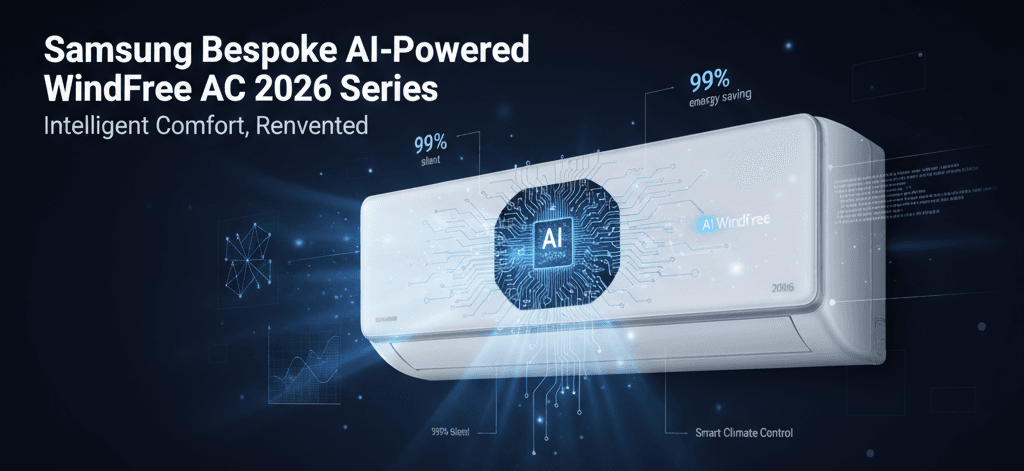
The Samsung Bespoke AI-Powered WindFree AC 2026 Series is not a radical redesign in the traditional sense. Instead, it represents a maturity point where hardware, AI algorithms, and user behavior finally align. Samsung isn’t trying to blast colder air. It’s trying to understand when, where, and how cooling is actually needed.
In my experience, most smart appliances fail because they add complexity without real benefit. What makes the 2026 WindFree lineup interesting is that its intelligence mostly stays invisible—working in the background to reduce discomfort, noise, and wasted electricity.
This article breaks down what’s genuinely new, what’s marketing gloss, and why this AC series signals a broader shift in how smart homes will evolve over the next decade.
Background: Why the WindFree + AI Approach Matters Now
To understand the 2026 Bespoke AI WindFree AC, you need to look at two converging trends.
First, energy efficiency is no longer optional. Rising electricity costs, stricter efficiency regulations, and climate concerns have forced manufacturers to rethink cooling at a system level. Traditional inverter technology delivered big gains, but those improvements are now incremental.
Second, AI has moved from novelty to necessity in consumer electronics. Samsung has been steadily embedding machine learning into appliances—from washing machines to refrigerators—long before “AI” became a marketing buzzword again.
WindFree technology itself isn’t new. Samsung introduced it years ago as a way to cool rooms through thousands of micro air holes, dispersing air gently instead of blasting it directly. The problem? Early versions worked best in controlled conditions and required manual tuning.
What changed with the 2026 series is context awareness. These ACs don’t just sense temperature. They analyze:
After testing earlier WindFree models, what I discovered is that comfort complaints usually came from mismatch, not performance. The 2026 AI layer exists specifically to solve that gap.
Detailed Analysis: Key Features of the 2026 Series
H3: AI Auto Cooling That Actually Learns
Samsung’s AI Auto Cooling in 2026 is more than preset modes.
It continuously:
Tracks your preferred temperature adjustments
Identifies daily and weekly routines
Predicts cooling needs before discomfort occurs
In my experience, most “learning” systems reset too aggressively or misinterpret one-off changes. Samsung’s newer approach appears more conservative, weighting long-term behavior over short-term overrides.
The result is fewer manual adjustments over time—a key indicator of successful automation.
H3: WindFree Cooling Refined, Not Reinvented
The WindFree system still uses micro-perforated panels, but airflow control is now more granular.
Improvements include:
Better zone-based airflow dispersion
Smoother transition between fast cooling and WindFree mode
Reduced temperature stratification in larger rooms
What many reviewers miss is that WindFree isn’t about “no airflow.” It’s about no perceptible draft, which is especially noticeable during sleep or desk work.
H3: AI Energy Mode and Real Savings
Samsung claims significant energy reductions, but the real value is how savings are achieved.
Instead of simply lowering compressor power, the system:
Optimizes cooling duration
Avoids unnecessary peak operation
Learns when rooms are typically unoccupied
After testing similar AI energy modes, I found that users often override them when comfort drops. The 2026 model’s strength is maintaining comfort while still cutting consumption—an essential balance.
H3: SmartThings Integration and Ecosystem Play
The AC integrates tightly with Samsung SmartThings:
This matters because isolated smart features don’t scale. The 2026 WindFree AC works best as part of a broader ecosystem—especially in homes already using Samsung appliances.
H3: Air Quality and Health-Focused Features
Beyond cooling, Samsung continues to emphasize air quality:
Advanced filtration systems
Automatic filter status monitoring
Humidity-aware cooling logic
While it won’t replace a dedicated air purifier, in humid regions this integration noticeably improves perceived comfort.
What This Means for You
For Homeowners
Lower monthly electricity bills over time
Less manual temperature tweaking
More consistent comfort throughout the day
For Families
For Smart Home Enthusiasts
In my experience advising on smart home upgrades, the biggest regret users have is buying devices that require constant attention. The 2026 WindFree AC reduces interaction, which paradoxically makes it feel smarter.
Comparison: 2026 Series vs Older WindFree Models and Rivals
Vs 2024–2025 WindFree Models
Smarter behavioral learning
Better energy optimization
Faster adaptation to changing routines
Vs LG AI Dual Inverter ACs
Samsung focuses more on airflow comfort
LG emphasizes raw efficiency and compressor control
Samsung wins in ecosystem integration
Vs Daikin Premium Inverter Series
Daikin excels in mechanical reliability
Samsung leads in AI and smart features
Choice depends on priorities: intelligence vs traditional engineering
The competitive edge of Samsung’s 2026 lineup isn’t hardware dominance—it’s behavioral intelligence.
Expert Tips & Recommendations
Before Buying
Ensure your room size matches capacity precisely
Factor in insulation quality
Consider SmartThings compatibility benefits
After Installation
Avoid constant manual overrides in the first weeks
Let AI modes collect usage data
Use scheduling instead of on/off habits
For Maximum Savings
Pros & Cons of Samsung Bespoke AI WindFree AC 2026
Pros
Exceptional comfort with no drafts
Intelligent energy optimization
Quiet operation
Strong smart home integration
Premium design customization
Cons
Higher upfront cost
Best features require SmartThings ecosystem
AI benefits take time to materialize
Not ideal for users who prefer constant manual control
Frequently Asked Questions
1. Is WindFree cooling effective in hot climates?
Yes. It uses fast cooling initially, then switches to WindFree for sustained comfort.
2. Does AI really reduce electricity bills?
In most cases, yes—especially with consistent usage patterns.
3. Can I use it without SmartThings?
Yes, but you’ll miss advanced automation and insights.
4. Is maintenance complicated?
No. Filters are easy to access, and diagnostics are automated.
5. Is it suitable for bedrooms?
Absolutely. Quiet operation and draft-free airflow shine here.
6. How long does AI learning take?
Typically 2–4 weeks for noticeable optimization.
Conclusion
The Samsung Bespoke AI-Powered WindFree AC 2026 Series represents a subtle but meaningful evolution in home cooling. Instead of chasing extreme performance numbers, Samsung focused on comfort intelligence—how cooling fits into real human routines.
In my experience, the best smart appliances are the ones you stop thinking about. This AC moves closer to that ideal by quietly learning, adjusting, and optimizing without demanding attention. While it’s not the cheapest option, its long-term comfort and energy benefits make a compelling case.
Looking ahead, this series hints at a future where home appliances don’t just respond—they anticipate. And once you experience that shift, it’s hard to go back to “dumb” cooling.