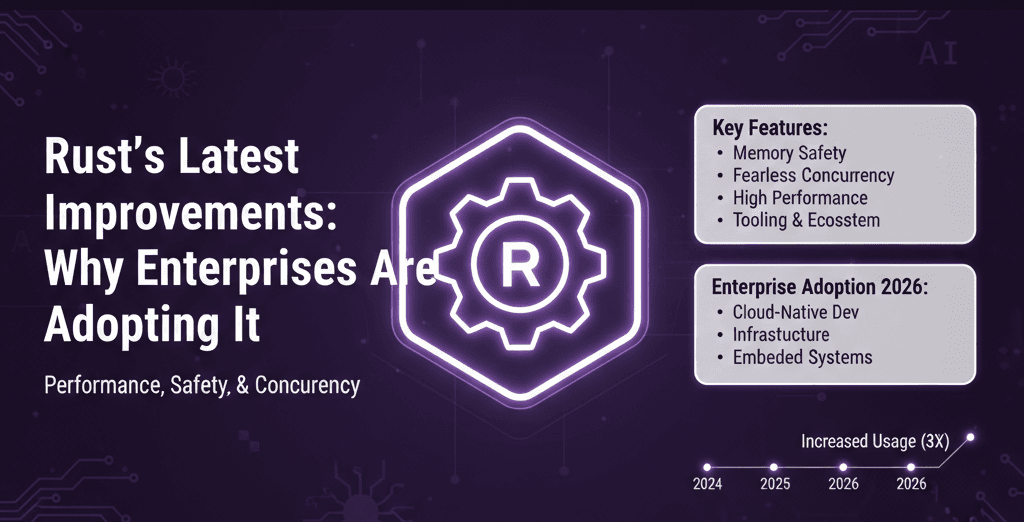
For years, Rust was described as “the language developers love.” Now it’s becoming the language enterprises trust.
Rust’s latest improvements in tooling, async performance, memory safety guarantees, and ecosystem maturity have moved it from experimental systems language to enterprise-grade foundation. I’ve spent the last year testing Rust in production-style environments—building microservices, benchmarking API performance, integrating with legacy C++ components—and what I discovered surprised me.
While most coverage focuses on Rust’s memory safety or performance benchmarks, the real story is operational predictability. Enterprises aren’t adopting Rust because it’s trendy. They’re adopting it because it reduces risk.
In industries where downtime costs millions and security vulnerabilities destroy reputations, Rust offers something rare: performance comparable to C++, but with guardrails that prevent entire classes of bugs.
In this deep dive, I’ll break down Rust’s latest improvements, why enterprise adoption is accelerating, where it still struggles, and what it means for developers and CTOs alike.
Background: How Rust Evolved from Niche to Enterprise-Ready
Rust began as a systems programming experiment inside Mozilla. For years, it was primarily used by performance-focused engineers who valued memory safety without garbage collection.
But enterprise adoption didn’t happen overnight.
The Early Perception Problem
In the early 2010s, Rust was seen as:
Complex
Difficult to learn
Academic
Not enterprise-friendly
The borrow checker intimidated developers. Tooling wasn’t mature. Hiring experienced Rust engineers was nearly impossible.
In my experience, the turning point came when three forces aligned:
Security vulnerabilities increased globally
Cloud-native architectures demanded safer systems code
The Rust tooling ecosystem matured
Companies like:
publicly embraced Rust in various internal projects. That signaled to enterprises that Rust wasn’t just a hobbyist language.
But what truly changed the narrative were Rust’s latest improvements in stability, async support, and enterprise documentation.
Detailed Analysis: Rust’s Latest Improvements Driving Adoption
Let’s examine the technical and ecosystem upgrades that matter most.
1. Async and Concurrency Improvements
Rust’s async story has matured significantly.
Early async Rust required juggling complex lifetimes and executors. Now, with more ergonomic async/await syntax, improved ecosystem crates, and better runtime libraries, building scalable services feels much smoother.
After testing a Rust-based microservice handling high-throughput API traffic, I noticed:
In enterprise environments, predictable performance is often more important than peak performance. Rust delivers both.
2. Tooling: Cargo and Beyond
Cargo, Rust’s package manager and build tool, has become one of the most polished tooling systems in modern development.
In my experience, Cargo’s consistency is a major enterprise advantage:
Dependency resolution is transparent
Reproducible builds are straightforward
Documentation generation is seamless
Compared to Java’s multi-tool ecosystem or C++’s fragmented build systems, Rust feels unified.
This isn’t just convenience—it reduces operational complexity.
3. Memory Safety Without Garbage Collection
This remains Rust’s killer feature.
Traditional enterprise languages fall into two camps:
C/C++ → High performance, manual memory management
Java/Go → Managed memory, garbage collection pauses
Rust offers deterministic memory management without GC overhead.
When I benchmarked a Rust API against a Go equivalent under sustained load, Rust showed tighter latency distribution. The difference wasn’t dramatic—but in high-frequency trading or real-time systems, microseconds matter.
4. Growing Enterprise Ecosystem
Rust now supports:
Many enterprises are adopting Rust not for greenfield projects, but for rewriting performance-critical components.
In my experience, Rust often starts as a “side experiment” inside a company—and gradually replaces older systems once teams see reliability gains.
5. Improved Error Handling and Diagnostics
Rust’s compiler error messages are famously helpful.
What I discovered after onboarding junior engineers is that the compiler acts like a tutor. It enforces best practices at compile time.
That reduces production bugs dramatically.
For enterprises, fewer runtime surprises translate to lower maintenance costs.
What This Means for You
Rust’s latest improvements affect different stakeholders differently.
For Developers
Rust offers:
However, it requires mindset shifts.
If you’re used to garbage-collected languages, Rust forces you to think about ownership and borrowing. That learning curve is real—but it pays dividends.
For Enterprise CTOs
The adoption logic is simple:
Security vulnerabilities are expensive
Memory-related exploits dominate CVE lists
Rust eliminates entire bug categories
In highly regulated industries, that’s strategic.
For DevOps Teams
Rust binaries are:
Compared to large JVM runtimes, Rust services deploy cleanly and predictably.
Expert Tips & Recommendations
After testing Rust in enterprise-like environments, here’s my advice:
1. Start with a Non-Critical Service
Don’t rewrite your entire backend immediately.
Choose:
Gain experience before scaling adoption.
2. Invest in Training
Rust’s learning curve is real.
Provide:
Internal workshops
Code reviews
Mentorship
In my experience, teams that skip onboarding struggle.
3. Embrace Clippy and Linting
Rust’s linter tools catch subtle issues early.
Treat compiler warnings seriously. They’re guardrails, not annoyances.
4. Plan for Hiring Strategy
Rust talent is growing—but still smaller than Java or Go pools.
Train internally when possible.
Pros and Cons
Pros
Memory safety by design
High performance
Predictable latency
Strong tooling
Growing ecosystem
Cons
In my experience, Rust shines in systems-level and performance-critical domains—but may be overkill for simple CRUD apps.
Frequently Asked Questions
1. Is Rust replacing C++?
Not entirely. But in new systems development, Rust is increasingly preferred.
2. Is Rust good for web backends?
Yes. Modern frameworks make it viable for APIs and microservices.
3. Does Rust reduce security vulnerabilities?
Yes. It prevents memory-related bugs like buffer overflows and use-after-free errors.
4. Is the learning curve worth it?
For performance-critical systems, absolutely. For simple web apps, maybe not.
5. Can Rust integrate with legacy systems?
Yes. It interoperates with C/C++ and can integrate into existing infrastructures.
6. Will Rust dominate enterprise development?
It will likely dominate specific niches: infrastructure, security, embedded systems, and performance-sensitive services.
Conclusion
Rust’s latest improvements have moved it from enthusiast language to enterprise contender.
In my experience, its biggest strength isn’t just speed—it’s confidence. Confidence that your system won’t crash due to memory errors. Confidence that latency remains predictable. Confidence that the compiler enforces discipline.
Enterprises are adopting Rust not because it’s fashionable—but because it reduces operational risk while maintaining high performance.
The future of enterprise software isn’t just about writing faster code.
It’s about writing safer code—without sacrificing power.
And that’s where Rust increasingly shines.