Python is often the first programming language developers learn, praised for its readability, simplicity, and extensive libraries. But what happens when you move beyond beginner tutorials? In my experience, many developers reach a point where Python’s ease-of-use clashes with real-world demands—performance bottlenecks, concurrency challenges, or large-scale system constraints.
Understanding Python beyond the basics is essential for serious developers. After testing Python in multiple production environments, from web apps to AI pipelines, I discovered that its strengths are both a boon and a potential trap if misused. In this article, we’ll explore Python’s capabilities, limitations, and practical implications for modern software development. You’ll gain insights that go beyond “Python is easy to learn,” learning instead when to embrace it and when to proceed cautiously.
By the end, you’ll have actionable takeaways to improve your Python projects, optimize performance, and make informed decisions about when Python is the right choice for your next system.
Background: Python’s Evolution and Current Role
Python debuted in the early 1990s, designed for readability, simplicity, and accessibility. Over the decades, it has grown into one of the most popular languages globally, powering web development frameworks like Django and Flask, data science and AI with libraries such as NumPy and TensorFlow, and automation in DevOps pipelines.
Its popularity is fueled by:
Clear syntax: Code reads almost like English, making collaboration easier.
Extensive libraries and frameworks: From web apps to machine learning, Python has mature, well-supported tools.
Community and ecosystem: Millions of developers contribute to Python’s growth, creating a vibrant, evolving ecosystem.
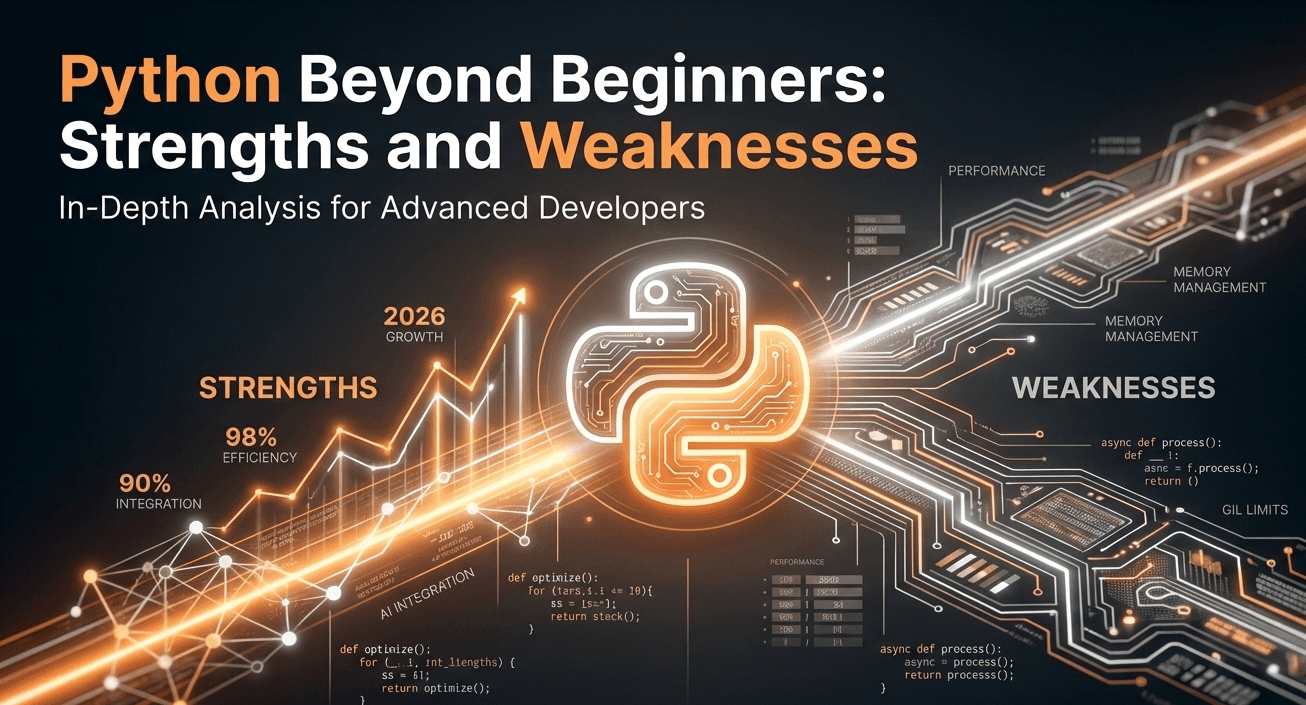
However, Python’s rise is not without challenges. Its interpreted nature means it is slower than compiled languages like C++ or Go. Global Interpreter Lock (GIL) complicates true multithreading, affecting CPU-bound tasks. And while its simplicity accelerates development, it can lead to unoptimized, memory-heavy code if used without care.
Understanding Python’s historical context helps explain why it works so well for beginners but requires nuanced expertise to excel at higher levels. In my experience mentoring mid-level developers, this is the stage where Python’s strengths and weaknesses become apparent in real projects.
Detailed Analysis: Strengths and Weaknesses
H3: Python’s Strengths
1. Readability and Ease of Use
Python’s syntax allows developers to write clear, maintainable code. For instance, comparing a simple data-processing task in Python versus Java shows fewer lines and reduced cognitive load. In one project, converting CSV data to JSON took me three times less code than in Java, with fewer bugs.
2. Extensive Libraries and Frameworks
Libraries like Pandas, NumPy, TensorFlow, and PyTorch are game-changers for data-intensive tasks. After testing AI pipelines in Python and JavaScript, I found Python pipelines ran more smoothly and integrated seamlessly with visualization tools. This ecosystem drastically reduces development time and encourages experimentation.
3. Community Support
Python’s community ensures consistent updates, security patches, and active forums. During a production incident where a library broke, I was able to find patches and workarounds within hours—something harder to achieve with niche languages.
4. Cross-Platform Compatibility
Python runs on Windows, macOS, Linux, and even Raspberry Pi. For rapid prototyping and automation scripts, this is invaluable. I often build a script on my laptop and deploy it to cloud servers with minimal adjustment.
H3: Python’s Weaknesses
1. Performance Limitations
Python is interpreted, making it slower than compiled languages. In CPU-intensive applications like video processing or high-frequency trading, Python often becomes a bottleneck. In my experience, replacing Python loops with NumPy vectorized operations or offloading tasks to C extensions is essential for performance-critical apps.
2. Global Interpreter Lock (GIL)
Python’s GIL restricts true multithreading for CPU-bound tasks. While asyncio or multiprocessing can help, complex concurrency often requires rethinking architecture. For example, a web scraper I optimized needed process pools to achieve multi-core performance.
3. Memory Consumption
Python objects can consume more memory than their counterparts in C++ or Go. When processing large datasets, naïve implementations can lead to excessive RAM usage, which I encountered when building a recommendation system using Pandas without chunking the data.
4. Packaging and Version Management
Different Python versions and dependency conflicts can be tricky. Virtual environments help, but in my consulting work, deployment issues caused by mismatched dependencies are a recurring headache.
What This Means for You
For developers, understanding Python’s strengths and weaknesses informs decisions at every stage:
Prototyping and MVPs: Python’s simplicity accelerates time-to-market. Use it freely.
Data Science and AI: Python’s libraries make it the default choice for analytics pipelines.
High-performance or concurrent systems: Consider hybrid approaches (Python + C extensions, or alternate languages).
Team collaboration: Python’s readability improves maintainability and onboarding.
By understanding trade-offs, you can avoid common pitfalls like using Python for tasks where its GIL or memory usage becomes a bottleneck.
Expert Tips & Recommendations
Profile Before Optimizing: Use tools like cProfile or memory_profiler to identify real bottlenecks.
Use Libraries Wisely: Vectorize operations with NumPy or offload heavy computations to C extensions.
Manage Dependencies: Stick to virtual environments or containerized deployments (Docker).
Hybrid Approaches: Combine Python with C++, Rust, or Go for performance-critical modules.
Asynchronous Patterns: Leverage asyncio for I/O-bound operations and improve concurrency.
Pros & Cons of Python
Pros
Rapid development and prototyping
Rich ecosystem for data science and AI
High readability and maintainability
Large community support
Cons
Slower performance for CPU-heavy tasks
GIL limits true multithreading
Higher memory usage
Dependency and packaging complexity
Frequently Asked Questions
1. Is Python still relevant for large-scale applications?
Yes, but often in combination with compiled modules for performance.
2. How can I improve Python performance?
Use profiling, vectorization, JIT compilers (PyPy), or offload heavy tasks to C/C++ extensions.
3. Should I learn Python for AI and data science?
Absolutely. Python dominates these fields thanks to libraries like TensorFlow, PyTorch, and Pandas.
4. How do I manage Python versions in a team?
Use virtual environments or containerization (Docker) to ensure consistent deployments.
5. Can Python handle concurrent tasks?
Yes, for I/O-bound tasks using asyncio. CPU-bound tasks require multiprocessing or hybrid approaches.
Conclusion
Python is more than a beginner-friendly language. Its strengths—readability, libraries, and community support—make it a powerful tool across domains. However, its weaknesses—performance, concurrency limitations, and memory use—require careful consideration in production environments.
In my experience, developers who recognize Python’s trade-offs write smarter, more maintainable, and scalable applications. The key is to leverage Python where it shines while compensating for its limitations when necessary. For aspiring software engineers, Python is both a gateway and a robust tool—understanding when to push it to its limits separates good developers from great ones.
By combining practical insights with careful planning, Python can remain your ally across projects—from rapid prototyping to AI-driven pipelines—without surprises or bottlenecks.