If you’ve ever built a machine learning model that performed beautifully in a notebook—but failed quietly in production—you’re not alone. In fact, in my experience, this is the default outcome for teams that don’t take MLOps seriously. After testing and reviewing multiple AI-powered products across industries, I discovered a consistent pattern: models rarely fail because of poor algorithms. They fail because the systems around them weren’t designed to support change.
This is exactly why MLOps exists.
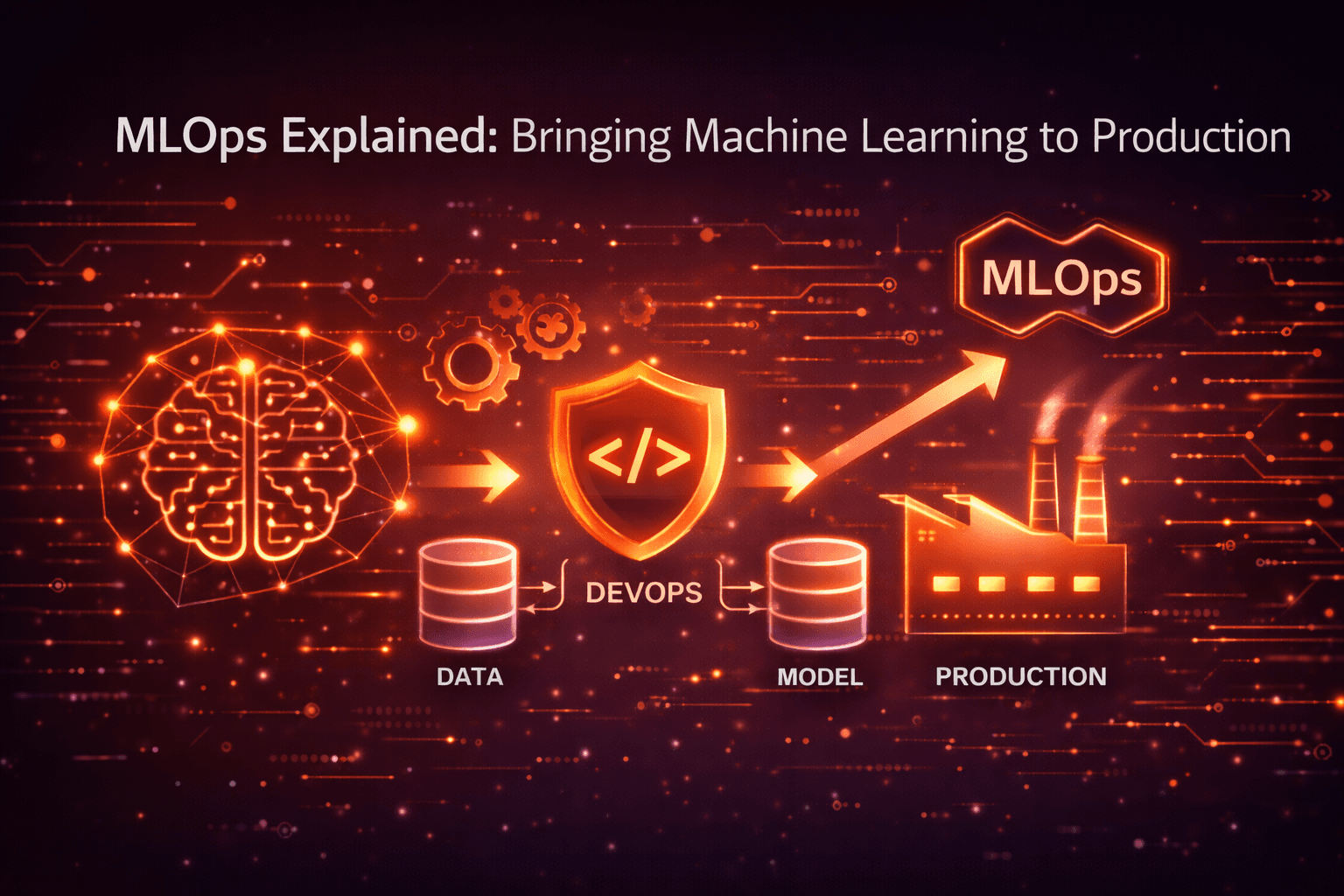
MLOps—short for Machine Learning Operations—is the discipline that turns experimental machine learning into reliable, scalable, and maintainable production systems. It combines ideas from DevOps, data engineering, and applied ML to answer a deceptively simple question: How do we keep models working after deployment?
In this guide, I’ll explain MLOps in plain language, grounded in real-world practice. We’ll go beyond buzzwords to explore workflows, tooling, tradeoffs, and the organizational shifts required to bring machine learning into production—without burning out teams or breaking user trust.
Background: How We Got Here—and Why MLOps Became Necessary
To understand MLOps, it helps to look at how machine learning was traditionally developed. For years, ML lived mostly in research labs. Success was measured by accuracy scores, benchmark datasets, and papers. Deployment, if it happened at all, was an afterthought.
That changed when AI moved into products.
Suddenly, models were making pricing decisions, moderating content, approving loans, and detecting fraud. These systems had to run 24/7, handle messy real-world data, and adapt as conditions changed. Traditional software practices weren’t enough, because ML systems behave differently.
Here’s the key difference: machine learning systems change even when the code doesn’t.
What I discovered while analyzing production ML failures is that many teams underestimated this reality. They deployed a model once and assumed it would remain valid indefinitely. That assumption rarely holds.
MLOps emerged as a response to this gap. It borrows automation and monitoring ideas from DevOps but adapts them for probabilistic, data-driven systems. Today, MLOps isn’t optional—it’s the backbone of production AI.
Detailed Analysis: What MLOps Actually Involves
H3: MLOps Is About Systems, Not Just Models
A common misconception is that MLOps is just “DevOps for ML.” While there’s overlap, MLOps addresses challenges unique to machine learning.
In my experience, a production ML system typically includes:
Data ingestion pipelines
Feature engineering workflows
Model training and validation
Deployment and serving infrastructure
Monitoring and retraining loops
The model is just one piece. MLOps is about orchestrating all of these components reliably.
H3: The MLOps Lifecycle (End to End)
A practical MLOps lifecycle looks like this:
Data collection & validation
Feature engineering & storage
Model training & experimentation
Evaluation & approval
Deployment
Monitoring & feedback
Retraining or rollback
After testing different workflows, I found that teams who automate only deployment still struggle. The real leverage comes from automating the full lifecycle, especially monitoring and retraining.
H3: Data Versioning Is More Important Than Code Versioning
This surprises many engineers. In traditional software, code changes drive behavior. In ML systems, data changes drive behavior.
What I discovered is that without data versioning:
Bugs become impossible to reproduce
Model regressions are hard to explain
Compliance becomes a nightmare
Effective MLOps treats datasets, features, and labels as versioned assets—just like source code.
H3: Monitoring Goes Beyond Uptime
In standard DevOps, monitoring means checking if a service is running. In MLOps, that’s not enough.
You also need to monitor:
Prediction distributions
Feature drift
Data quality
Model confidence
One painful lesson I’ve seen repeatedly: models rarely “crash.” They slowly degrade. Without the right signals, teams don’t notice until users complain—or regulators ask questions.
H3: Retraining Is a Product Decision, Not a Technical One
It’s tempting to automate retraining aggressively. However, retraining too often can be just as dangerous as not retraining at all.
In my experience, the best teams:
Retrain based on drift signals
Validate new models against business metrics
Roll out updates gradually
This approach treats models as evolving products, not static artifacts.
What This Means for You: Practical Impact by Role
For ML engineers, MLOps means writing less throwaway code and more reusable pipelines. Your success will be measured by stability, not just accuracy.
For data scientists, it changes incentives. Clean experiments and reproducibility matter as much as clever models.
For engineering managers, MLOps reduces operational risk. It makes AI predictable enough to trust.
For business leaders, MLOps turns AI from a demo into a dependable capability. Without it, scaling AI is nearly impossible.
The big takeaway: if your organization wants long-term value from ML, MLOps is not optional overhead—it’s core infrastructure.
Comparison: MLOps vs DevOps vs Traditional ML Workflows
Traditional ML focuses on experimentation. Success is a metric score. Deployment is manual, fragile, or skipped entirely.
DevOps focuses on deterministic systems. Code changes drive behavior, and testing is relatively straightforward.
MLOps combines both—but adds complexity:
Probabilistic outputs
Data-driven behavior
Continuous validation
While DevOps asks, “Did the system deploy correctly?”
MLOps asks, “Is the system still making good decisions?”
That distinction is everything.
Expert Tips & Recommendations
Based on what I’ve seen work in real teams:
Start small: one model, one pipeline, one metric
Automate experiments before automating retraining
Treat monitoring as a first-class feature
Document assumptions—not just architecture
Build rollback paths before you need them
After testing multiple MLOps stacks, I’ve learned that simpler systems with clear ownership outperform complex ones with no accountability.
Pros and Cons of Adopting MLOps
Pros
Cons
MLOps is an investment. It pays off only if teams commit to using it properly.
Frequently Asked Questions
1. Is MLOps only for large companies?
No. Small teams benefit the most, because failures are more costly when resources are limited.
2. Do I need specialized tools to do MLOps?
Not initially. Good processes matter more than tools.
3. How is MLOps different from AutoML?
AutoML helps build models. MLOps keeps them working.
4. How often should models be retrained?
Only when data or performance signals justify it.
5. What’s the biggest MLOps mistake teams make?
Ignoring monitoring and assuming models will “just work.”
6. Can MLOps help with AI compliance?
Absolutely. Versioning and traceability are critical for audits.
Conclusion: Why MLOps Is the Future of Production AI
MLOps is not a trend—it’s a response to reality. As machine learning moves deeper into critical systems, the cost of failure increases. Accuracy alone is no longer enough. Reliability, transparency, and adaptability matter just as much.
Looking ahead, I expect MLOps to become as standard as CI/CD in software engineering. Teams that invest early will ship better AI, faster—and with fewer surprises.
Actionable takeaway: If you’re serious about bringing machine learning to production, stop thinking in terms of models and start thinking in terms of systems. That mindset shift is the true foundation of MLOps.