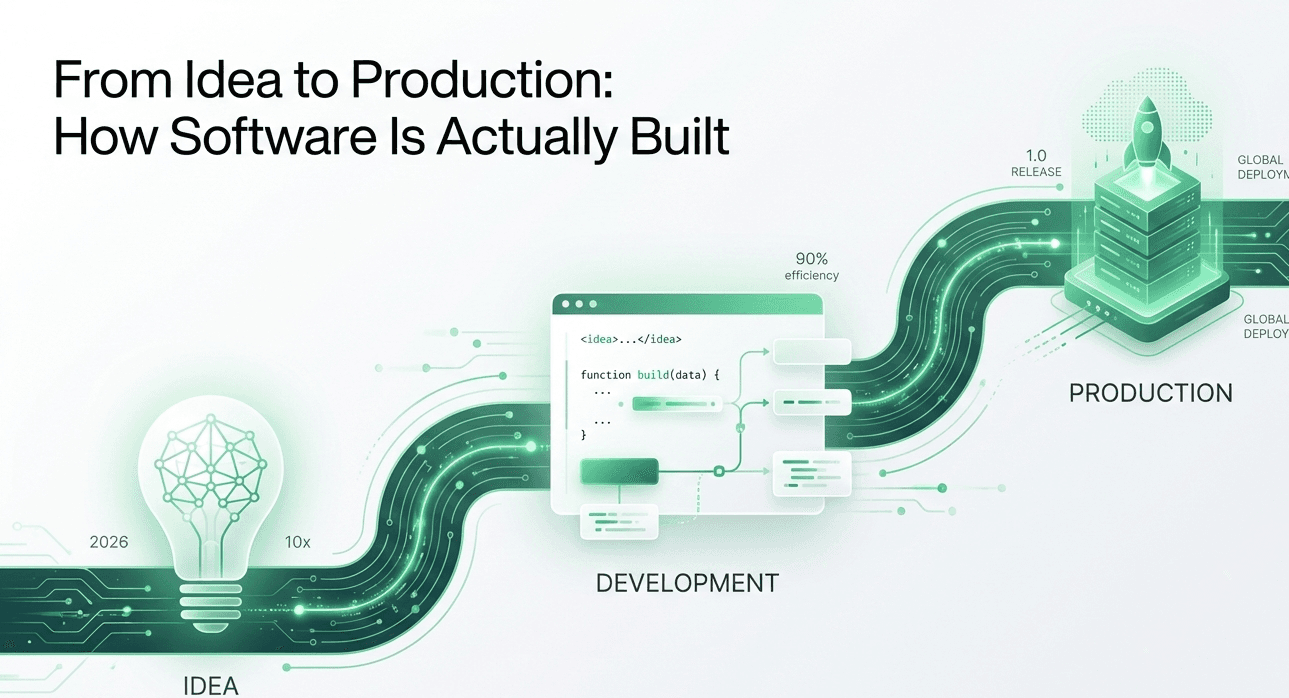
If you’ve ever read a textbook, watched a startup pitch, or skimmed a product roadmap, software development looks deceptively clean. There’s an idea, then a design, then some coding, testing, and—like magic—production. In reality, that version of events exists mostly to make stakeholders feel comfortable.
In my experience working with early-stage startups, mid-sized SaaS teams, and enterprise engineering groups, software is almost never “built” the way it’s described. It’s negotiated into existence. Features are compromised. Timelines slip. Assumptions collapse. And yet, somehow, usable systems still emerge.
After testing products at different stages—from rough prototypes to systems handling millions of users—what I discovered is that the real skill of software development isn’t writing code. It’s managing uncertainty while continuously shipping something that works well enough.
This article pulls back the curtain. Not on the ideal process, but on how software is actually built in the real world, step by step—from the first fragile idea to something running in production.
Background: Why the “Official” Software Process Keeps Failing
The Gap Between Theory and Practice
Most developers are taught some version of a formal process: Waterfall, Agile, Scrum, DevOps. Each comes with diagrams, ceremonies, and best practices. Yet project failures remain stubbornly common.
Why?
Because these frameworks describe how software should be built, not how it actually survives inside businesses with deadlines, budgets, and human constraints.
In my experience, the biggest disconnect happens at the earliest stage: the idea itself.
Ideas Are Vague, Not Requirements
Contrary to popular belief, software projects rarely begin with clear requirements. They start with statements like:
“We need something like X, but simpler”
“Our competitors have this feature”
“Customers are asking for it, somehow”
What’s missing is clarity. And that’s normal.
Historically, software evolved this way because technology changes faster than planning documents. Teams that waited for perfect requirements shipped too late. Over time, the industry learned—often painfully—that building reveals truth faster than planning.
Detailed Analysis: The Real Lifecycle of Software
H3: Stage 1 — The Idea Is Just a Hypothesis
The first hard truth: an idea is not a plan.
In my experience, most ideas are educated guesses about:
User behavior
Market demand
Technical feasibility
At this stage, the most valuable work is not coding—it’s questioning assumptions.
What I’ve discovered works best:
Writing one-paragraph problem statements
Defining what success would look like, not how to build it
Identifying the fastest way to be wrong
Teams that skip this stage often build impressive systems nobody needs.
H3: Stage 2 — Prototypes Over Perfection
Prototypes exist to answer questions, not impress users.
After testing dozens of internal prototypes, I’ve noticed a pattern: the best teams prototype ugly and fast. They use throwaway code, mock data, and minimal UI.
Common prototype goals include:
Can users understand this workflow?
Is this technically feasible?
Where do users get confused?
The real story here is that most prototype code should never reach production—but many teams keep it anyway, and that decision haunts them later.
H3: Stage 3 — Requirements Emerge From Reality
This is where theory collapses.
Once users touch something real, requirements change—sometimes dramatically. Features that seemed essential get ignored. Small details become critical.
In my experience, this is when tension rises:
What I discovered is that successful teams don’t fight this tension—they manage it through prioritization and ruthless scope control.
H3: Stage 4 — Architecture Is Chosen Under Pressure
Architecture decisions rarely happen in calm environments.
They’re made:
Despite what blog posts suggest, most systems are not over-engineered—they’re under-considered.
Common real-world drivers include:
Hiring availability
Existing infrastructure
Short-term deadlines
Good architecture isn’t about perfection. It’s about making future change possible.
H3: Stage 5 — Building the “First Real Version”
This phase feels productive—and dangerous.
Features accumulate quickly. The system “works.” Stakeholders relax. This is where technical debt quietly forms.
After reviewing production codebases, I’ve learned that this stage determines long-term velocity more than any other.
Key risks:
The difference between scalable systems and fragile ones often comes down to decisions made here—under pressure, without applause.
H3: Stage 6 — Testing Happens Later Than You Think
Despite best intentions, testing is often delayed.
In reality:
Unit tests come after bugs appear
Integration tests follow outages
Monitoring arrives after incidents
This isn’t laziness—it’s incentive structure. Shipping features is rewarded immediately. Preventing failures is invisible.
In my experience, teams that integrate testing just enough early outperform teams that aim for perfection and stall.
H3: Stage 7 — Production Is a Shock
The first real deployment is always humbling.
Production reveals:
What I discovered after multiple launches is that production is the most honest environment. It exposes everything your staging setup hides.
Teams that expect this learn quickly. Teams that don’t blame tools, users, or luck.
What This Means for You
If You’re a Developer
Writing code is only half the job
Understanding trade-offs matters more than frameworks
Production experience is irreplaceable
If You’re a Founder or Product Manager
Ideas evolve—plan for change
Speed without feedback is wasted effort
Technical decisions are business decisions
If You’re a Team Lead
Process won’t save bad communication
Protect engineers from constant churn
Make invisible work visible
Expert Tips & Recommendations
1. Validate Before You Build
Use mockups, demos, or no-code tools to test ideas fast.
2. Optimize for Change
Choose architectures that allow rewrites, not perfection.
3. Track Decisions
Document why choices were made—it saves future debates.
4. Invest in Observability Early
Logs and metrics beat assumptions every time.
5. Ship Small, Learn Fast
Big releases hide big failures.
In my experience, teams that treat software as a learning system outperform those that treat it as a construction project.
Pros and Cons of the Real-World Approach
Pros
Cons
The trade-off is worth it—but only if teams acknowledge it consciously.
Frequently Asked Questions
1. Why do software projects change so much?
Because users don’t know what they want until they see it.
2. Is technical debt unavoidable?
Yes—but unmanaged debt is the real problem.
3. When should architecture be finalized?
Never completely. It should evolve.
4. Why do timelines slip so often?
Uncertainty compounds faster than plans account for.
5. Is Agile actually used correctly?
Rarely. Most teams use a hybrid without admitting it.
6. What matters more: speed or quality?
Early speed, later quality—timing is everything.
Conclusion: Software Is Built by Learning, Not Following Diagrams
From idea to production, software isn’t built in stages—it’s shaped through feedback, failure, and adaptation. The myth of the clean, linear process persists because it’s comforting. Reality is messier—but far more effective.
The most important takeaway from years of building and analyzing real systems is this: great software emerges from teams that learn faster than their problems grow.
Looking ahead, tools will change, frameworks will rise and fall, and AI will automate parts of the process. But the core truth will remain: software is built by people making decisions under uncertainty. Understanding that is the real competitive advantage.