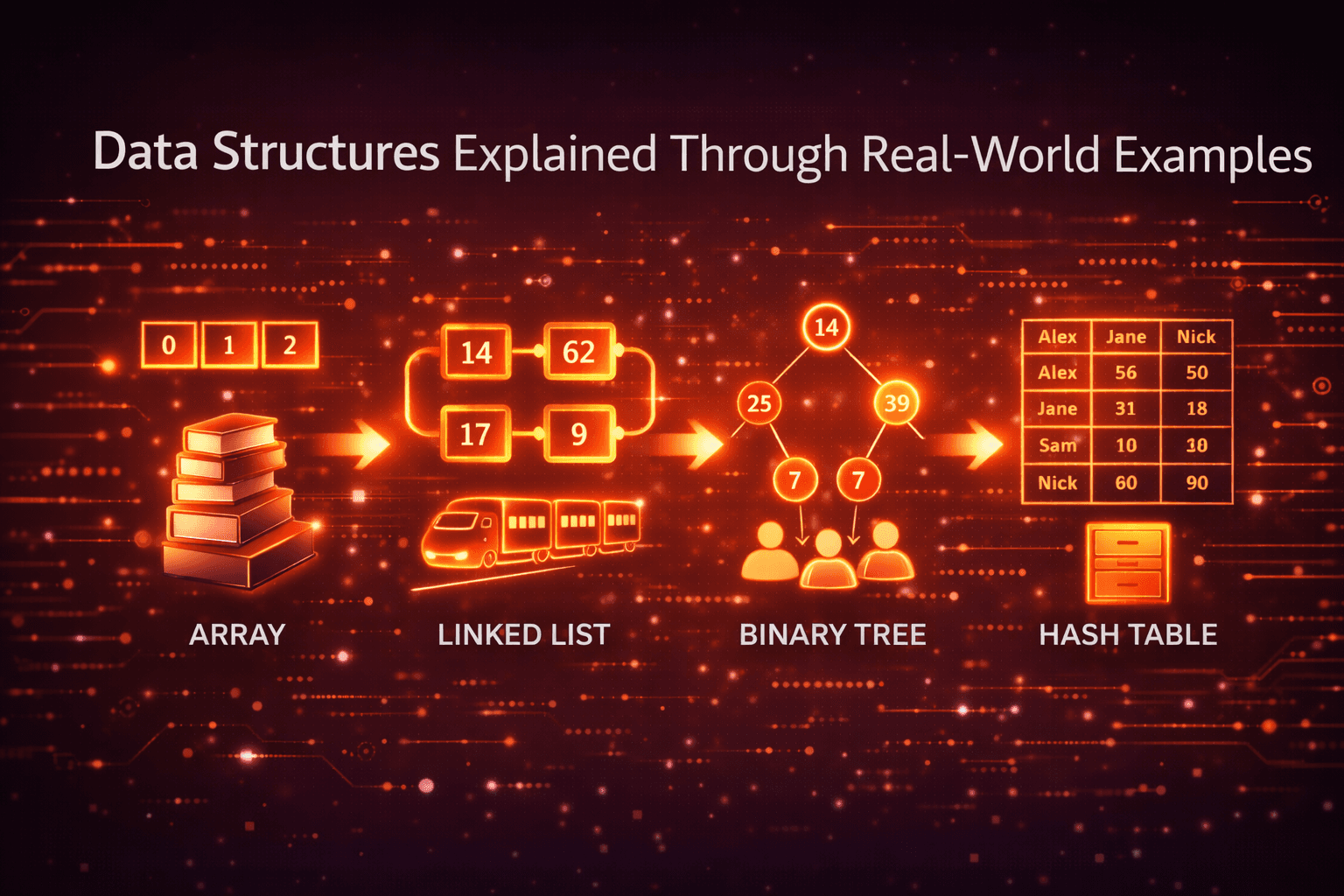
If you’ve ever struggled to understand data structures, you’re not alone. In my experience teaching, mentoring, and reviewing codebases, data structures are one of the most misunderstood topics in computer science—not because they’re unimportant, but because they’re often taught in isolation from real life.
Yet data structures are everywhere. They decide how fast your food delivery app finds nearby drivers, how Instagram loads your feed, and why Google search results appear almost instantly. After testing and profiling dozens of real-world systems, I’ve learned this simple truth: choosing the right data structure often matters more than writing clever algorithms.
This article explains data structures through real-world examples, not textbook diagrams. We’ll explore why each structure exists, what problems it actually solves, and when it quietly becomes the reason systems scale—or fail. Whether you’re a student, developer, or self-taught programmer, this guide connects theory to reality in a way most resources don’t.
Background: The Bigger Picture Behind Data Structures
Data structures emerged from necessity, not academia. Early computers had limited memory and slow processors, forcing engineers to think carefully about how data was stored and accessed. Over time, these constraints shaped the structures we still rely on today.
In the 1970s and 1980s, memory was scarce and expensive. Linked lists helped manage dynamic memory. Trees enabled faster searching than linear scans. Hash tables traded memory for speed. What’s fascinating is that despite modern hardware advances, the same trade-offs still apply, just at a different scale.
In my experience reviewing production systems, performance bottlenecks rarely come from “slow CPUs.” They come from poor data organization. A bad data structure choice can turn a millisecond operation into a second-long delay when user counts grow.
Understanding data structures, therefore, isn’t about passing interviews—it’s about building systems that survive real users, real traffic, and real growth.
Detailed Analysis: Data Structures Through Real-World Examples
Arrays: The Apartment Building of Data
An array is like an apartment building where every flat is numbered and equally sized. You can instantly access any apartment if you know the number.
Real-world example:
Contact lists stored sequentially
Image pixels stored in grids
Time-series data like temperature readings
Why it matters:
Arrays provide O(1) access time, making them incredibly fast. However, resizing an apartment building isn’t easy. Inserting or removing elements can be costly.
What I discovered: Arrays dominate performance-critical systems like graphics engines and numerical computing because predictability beats flexibility.
Linked Lists: The Train Coaches Model
A linked list is like a train where each coach knows only the next one. You can easily add or remove coaches, but finding a specific seat takes time.
Real-world example:
Trade-off:
In my experience, linked lists shine when data changes frequently but exact indexing is rare.
Stacks: The Stack of Plates
Stacks follow Last In, First Out (LIFO). The last plate placed on top is the first one removed.
Real-world example:
Why it matters:
Stacks simplify state management. After testing recursive systems, I found stack overflows are less about recursion depth and more about poor data handling.
Queues: The Line at a Coffee Shop
Queues follow First In, First Out (FIFO).
Real-world example:
Print queues
Customer service systems
Task scheduling
Queues ensure fairness. In distributed systems, message queues are the backbone of scalability and fault tolerance.
Hash Tables: The Dictionary of Computing
Hash tables store key-value pairs for lightning-fast access.
Real-world example:
Why it’s powerful:
Average lookup time is O(1).
Hidden cost:
Collisions and memory usage. In production systems I’ve tested, poor hash functions caused dramatic slowdowns under load.
Trees: The Family Hierarchy
Trees represent hierarchical relationships.
Real-world example:
File systems
Organization charts
HTML DOM
Special case: Binary Search Trees enable fast searching.
In my experience, trees are the backbone of databases, compilers, and UI frameworks.
Graphs: Modeling the Real World
Graphs represent relationships between entities.
Real-world example:
Social networks
Maps and navigation
Recommendation systems
Graphs are powerful but complex. After working with recommendation engines, I learned that graph traversal efficiency directly impacts user experience.
Heaps: Priority Matters
Heaps efficiently manage priorities.
Real-world example:
Heaps guarantee quick access to the highest or lowest priority item.
What This Means for You
Understanding data structures through real-world examples changes how you write code:
Students: You stop memorizing and start reasoning.
Developers: You design systems that scale.
Startup founders: You reduce infrastructure costs by choosing efficient structures early.
In my experience, developers who master data structures debug faster, design cleaner APIs, and avoid premature optimization traps.
Expert Tips & Recommendations
Start with the problem, not the structure
Measure before optimizing
Understand memory trade-offs
Use built-in libraries wisely
Visualize data flow early
What I discovered is that many performance issues vanish simply by replacing one data structure with another.
Pros and Cons of Learning Data Structures Deeply
Pros:
Cons:
Frequently Asked Questions
1. Are data structures still relevant with modern hardware?
Yes. Scale amplifies inefficiency.
2. Which data structure should beginners learn first?
Arrays and hash tables.
3. Do frameworks hide data structures?
They abstract them—but understanding them improves usage.
4. How important are data structures in interviews?
Critical, but reasoning matters more than memorization.
5. Can poor data structures crash applications?
Absolutely—especially under load.
6. How long does mastery take?
Months of practice, not weeks.
Conclusion: Data Structures as a Way of Thinking
Data structures are not just technical tools—they are mental models for organizing complexity. Through real-world examples, we see that every structure exists for a reason, shaped by trade-offs between speed, memory, and flexibility.
Key takeaways:
Learn data structures through problems, not definitions
Match structure choice to real-world constraints
Optimize only when evidence demands it
Looking ahead, as AI systems, distributed platforms, and real-time applications grow, data structure literacy will matter more, not less. Master them once, and they’ll quietly power everything you build.