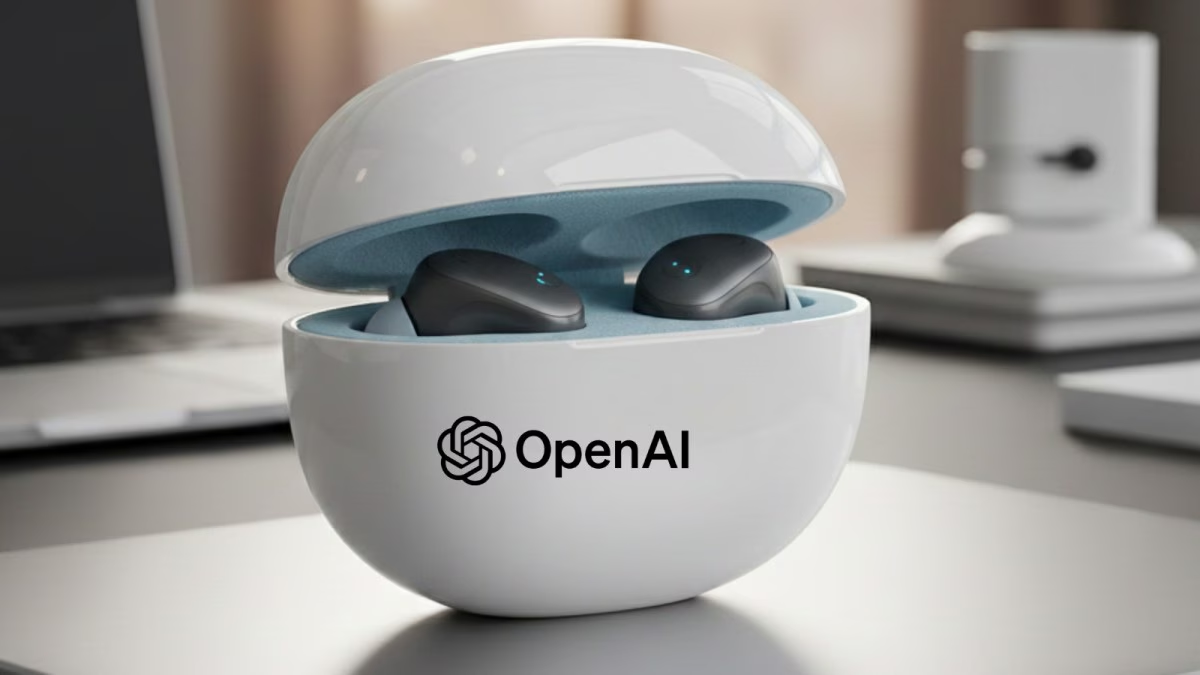
Reports suggest that OpenAI — a company best known for groundbreaking software like ChatGPT — may debut its first consumer hardware product as a pair of ChatGPT-powered wireless earbuds, codenamed “Sweetpea.” Far from being simple audio accessories, the earbuds are said to feature a unique, even disruptive design and powerful hardware capable of on-device AI processing. Leaked details also point to collaboration with design heavyweight Jony Ive, custom silicon potentially manufactured by Samsung, and an ambitious production roadmap aiming for tens of millions of units.
At first glance, this may sound like a surprising pivot — a software-first company diving into hardware. But deeper analysis reveals this move is emblematic of how AI platforms are evolving from software experiences to integrated ecosystems that extend into everyday physical interactions. Let’s unpack what this means, why it matters, and where it may lead.
What Makes This Different from Predecessors and Competitors
A. Purpose Beyond Audio Playback
Traditional TWS (true wireless stereo) earbuds — like Apple AirPods, Samsung Galaxy Buds, and Google Pixel Buds — primarily focus on:
OpenAI’s rumored earbuds aim to go further: they’re not just Bluetooth audio devices, but always-on AI companions with deep ChatGPT integration. Reportedly, the hardware may act as an AI interface, capable of issuing complex queries and commands without the user needing a phone or screen in hand.
B. Unique Design Narrative
Unlike the familiar stem-style earbuds, leaks describe a metal “egg-stone” case and pill-shaped modules worn behind the ear — an unconventional design not seen in mainstream earbuds. This suggests OpenAI is aiming for functionally driven ergonomics, potentially to house more sensors, mics, or processing power than typical earbuds.
C. Embedded AI and On-Device Intelligence
The reported inclusion of a 2nm-class smartphone-style chip (likely Samsung Exynos-based) combined with custom AI silicon could position Sweetpea earbuds as actual AI processors in your ears, rather than merely AI-enabled accessories. If true, this represents a leap in how AI is deployed in wearables — shifting from cloud-assisted to locally capable, low-latency intelligence.
In contrast, competitors like Apple are incrementally integrating generative AI into AirPods through paired devices, not as standalone AI centers. If OpenAI’s earbuds can truly process complex conversational and contextual tasks on-device, it would be unique. This also parallels emerging AI wearables, such as AI audio devices from niche brands, but at a much more integrated and ambitious level.
Real-World Use Cases and Who Should Care
1. Ambient AI Assistance
Imagine asking your earbuds:
“Summarize my calendar events today.”
“Translate this conversation in real time.”
“Draft a quick email from this voice note.”
The ability to converse with AI without pulling out a phone could be transformative for professionals, commuters, and multitaskers.
2. Contextual Voice Control
Leaked details hint that Sweetpea might replace common smartphone interactions by enabling voice-based actions — for example, commanding Siri or similar systems via AI mediation. This could streamline tasks like messaging, reminders, navigation, and accessibility commands.
For busy professionals and users with mobility challenges, voice-centric workflows may reduce friction and increase productivity.
3. Language Translation & Interpretation
If powered by robust models like those already deployed in ChatGPT, such earbuds could offer on-the-fly translation, contextual advice, and even content summarization — capabilities that go beyond typical GPU-assisted voice assistants.
This would be especially useful for travelers, global teams, educators, and real-time communication scenarios.
4. Health and Safety Functions
With more space and a unique design, Sweetpea could accommodate advanced sensor arrays — perhaps monitoring biometric signals, environmental audio cues (such as alarms), or safety notifications.
This opens potential extensions into wellness, though such use cases would require strong privacy design.
Technical Analysis of Key Features
A. Custom 2nm-Class Silicon
The rumored chip is a significant departure from typical low-power microcontrollers found in conventional TWS earbuds. A 2nm node — similar to flagship smartphone SoCs — implies:
This suggests audio processing, speech recognition, and generative AI tasks may run with minimal latency and with less dependence on cloud connectivity.
B. On-Device AI Models vs. Cloud
Current voice assistants often rely on server-side processing to interpret context beyond basic commands. On-device AI chips enable:
However, real-time generative outputs (like detailed explanations or compositions) may still need cloud assistance depending on model size and power. Balancing local and cloud processing will be a key architectural challenge.
C. Unique Form Factor and Sensor Suite
The “behind-the-ear” design described in leaks could house additional:
Microphones for spatial audio and beamforming
Sensor arrays for head/ear detection
Potential bio-signal sensors
Such enhancements can improve voice capture accuracy, active noise suppression, and contextual awareness — important for a device with a conversational AI interface.
D. Integration with Smartphones and Other Devices
According to reports, the earbuds may be designed to “replace iPhone actions by commanding Siri.” If true, this implies deep OS-level hooks that securely allow voice-to-AI commands to interact with native features (calls, apps, notifications) — a complex integration challenge requiring partnerships between hardware and platform owners.
Potential Problems or Limitations
1. Battery Life Constraints
High performance silicon and always-on AI will consume more power than standard earbuds. Recharge cycles must balance between daily usability and performance — a technical tightrope that even leading brands have struggled with.
2. Heat Dissipation
Powerful processors generate heat; in a constrained form factor with close proximity to the ear, managing thermal profiles without discomfort is non-trivial.
3. Latency and Connectivity Dependencies
If cloud-assisted AI remains part of the workflow, network dependency could degrade user experience — particularly in low-connectivity regions.
4. Interaction Paradigm Challenges
Using conversational AI via earbuds raises questions:
Will users be comfortable speaking out loud in all contexts?
How effectively can the device differentiate ambient noise from voice input?
How intuitive will error handling be in real conversations?
These UX considerations make or break adoption.
5. Privacy and Security
Earbuds with AI may listen constantly — raising legitimate privacy concerns. Users may fear unintended recording or interception of private speech. Clear, auditable privacy guarantees will be crucial.
6. Market Saturation and Consumer Urgency
The TWS market is already crowded. Convincing mainstream users to replace existing AirPods or Galaxy Buds with a premium AI-centric alternative will require not just novelty but substantive daily value.
Reddit discussion underscores consumer skepticism about the necessity of such a device: many users question whether people want another expensive wearable when smartphones already serve as general-purpose AI interfaces.
Price-to-Value Assessment
Although exact pricing is unconfirmed, several signals imply a premium positioning:
High bill of materials closer to smartphones
Custom 2nm-class chipsets
Unique design by Jony Ive’s team
If priced near or above flagship earbuds (e.g., Apple AirPods Pro tier), Sweetpea must justify its cost through:
Unparalleled AI integration
Real utility beyond standard audio and calls
Seamless ecosystem support
For lifestyle buyers, audio quality and comfort remain baseline expectations. Advanced AI features must be perceptibly beneficial — not just a novelty.
Buying Recommendations for Different User Types
Early Adopters and AI Enthusiasts
Recommended. For those who live on the bleeding edge and want always-available AI, these earbuds could be transformative — provided they deliver on interactive capabilities and privacy.
Professionals and Knowledge Workers
Conditional. If the device genuinely enhances productivity via contextual voice intelligence, it could become a daily tool. But integration with existing workflows matters.
Casual Audio Consumers
Not yet. If your primary use is music, calls, or standard voice assistance, less expensive earbuds with solid ANC may suffice.
Privacy-Conscious Users
Assess Carefully. The AI capabilities come with deep voice interactions; prospective buyers should scrutinize the privacy model.
Gamers and Media Lovers
Wait for Reviews. Unless audio performance excels, this device is not primarily designed for high-fidelity media consumption — it’s centered on AI interaction.
What Reviewers and Experts Are Saying (With Analysis)
Early media coverage and industry chatter paint a cautious but intrigued picture.
Many reports emphasize the unique design and AI potential but note the lack of official confirmation — meaning details could change before launch.
Commentary highlights the ambitious nature of embedding generative AI outside traditional screens, which represents a broader shift toward ambient AI experiences rather than app-centric ones.
Some voices express skepticism about practicality, drawing parallels to the failure of other early AI wearables and the challenge of finding compelling daily use cases beyond voice queries.
From a strategic vantage point, analysts see OpenAI’s entry into hardware as a necessary step if AI is to truly permeate human environments — not just screens. The behind-the-ear design and custom silicon signal a desire to escape limitations of current smartphone extensions of AI.
How This Fits into Broader Industry Trends
1. Ambient AI Interfaces
The future of AI is ambient, not app-locked. Devices like the rumored earbuds, AI pins, and context-aware wearables point to a trend where AI is accessible without screens — responding to voice, environmental cues, and user context fluidly.
OpenAI’s plan echoes earlier strategic statements about reducing dependency on screens and direct typing, making AI an everyday companion rather than a tool you consciously open.
2. Diversification of AI Product Strategy
Software companies are increasingly building hardware to deliver differentiated AI experiences:
Apple’s Vision Pro focuses on spatial computing
Google and Samsung embed AI in mobile and wearables
Startups experiment with smart rings, AR glasses, and pins
OpenAI’s earbuds signal the AI community’s hardware push to complement software dominance.
3. Edge AI and On-Device Processing
The inclusion of a high-performance chip reflects industry shifts toward on-device AI inference, reducing latency and protecting privacy compared to cloud-only processing.
4. Design-Driven AI Devices
The involvement of Jony Ive — a designer behind iconic consumer products — points to a belief that form factor matters. AI gadgets must be compelling, comfortable, and expressive — not just functional.
Conclusion: A Bold Gamble on Ambient Intelligence
OpenAI’s rumored ChatGPT-powered earbuds could represent a watershed in how generative AI transitions from screens to the physical world. Designed to be always available, deeply interactive, and uniquely styled, they embody a future where AI is ambient, voice-centric, and intimately woven into daily life.
However, success is not guaranteed. Practical engineering challenges (battery life, thermal limits, voice detection), usability trade-offs (speaking aloud in public), ecosystem fit, and consumer willingness to adopt a disruptive interface will all determine whether Sweetpea — or whatever the final product is called — becomes a defining AI device or a niche enthusiast gadget.
What is clear: OpenAI’s leap into hardware signifies a broader industry evolution — from AI as software glue to AI as physical presence. If Sweetpea lives up to its ambitions, it could reshape expectations not just for earbuds, but for how intelligent systems accompany us across contexts, tasks, and spaces.